
Why Memory Pressure Produces Unpredictable App Behavior?
Learn learned after realizing the app wasn’t broken, just constantly forgetting itself.

earn For a long time, I blamed users.
Not openly, of course. Quietly. Internally.
When someone said the app “lost their place” or “reset for no reason,” I assumed edge cases. Bad networks. Unlucky timing. Maybe they switched apps too fast.
Then I started watching the app under memory pressure.
That’s when things stopped feeling random.
The Day Behavior Became Inconsistent
The app didn’t crash. That was the strange part.
Screens loaded. Navigation worked. Features responded, mostly. But nothing behaved the same way twice. A list remembered its scroll position one moment and forgot it the next. A form saved progress sometimes, then wiped itself clean.
From the outside, it felt unreliable. From the inside, logs looked clean.
Memory pressure doesn’t announce itself. It just changes the rules mid-session.
What Memory Pressure Actually Does to an App
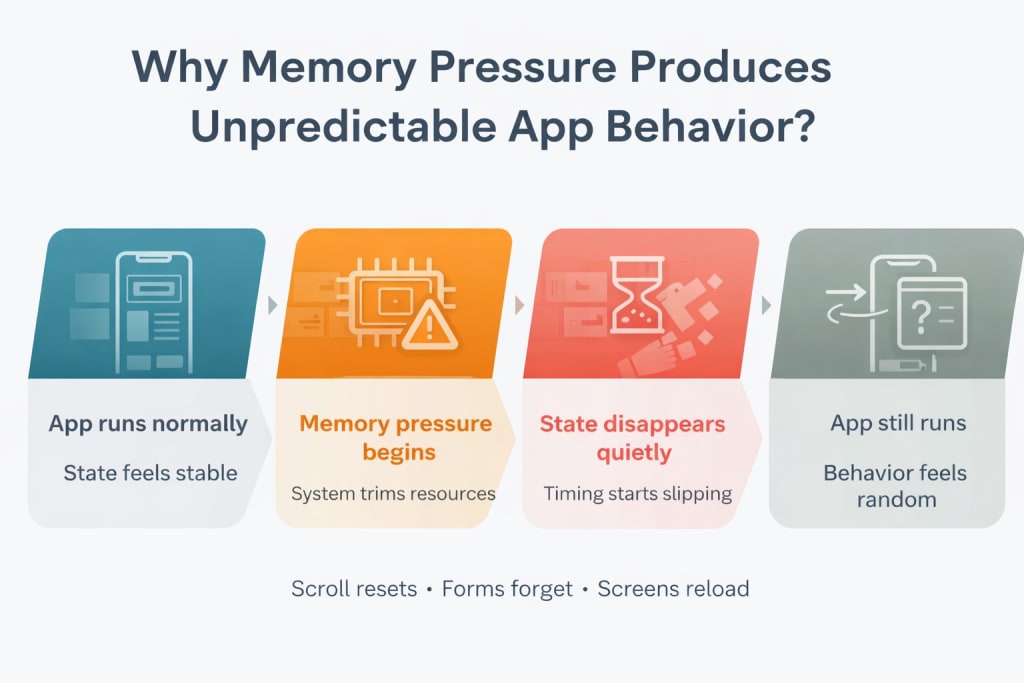
Memory pressure isn’t about running out of memory completely. It’s about the system deciding your app is no longer entitled to keep what it’s holding.
Caches get purged. Objects get reclaimed sooner. Background state gets trimmed aggressively.
The app keeps running, but pieces of its mental model disappear.
That’s where unpredictability comes from.
State Is the First Casualty
Why Apps Start Forgetting Things
Under pressure, the system reclaims memory wherever it can. State that felt stable suddenly becomes disposable.
Scroll positions reset. Temporary selections vanish. Navigation stacks shorten unexpectedly.
Users don’t describe this as a technical issue. They say things like “it didn’t remember me” or “I had to start over.”
They’re describing memory pressure in human terms.
Persistence Is Not as Persistent as You Think
Developers often assume saved state equals safety.
It doesn’t.
When pressure increases, saving and restoring state becomes a race. Writes get delayed. Restores happen after UI decisions already fired.
I’ve seen apps restore state too late, creating moments where the UI briefly shows one thing, then snaps to another. No errors. Just confusion.
Timing Starts Slipping
Memory pressure rarely acts alone. It drags timing with it.
Garbage collection runs more often. Threads get rescheduled. Tasks that used to complete predictably now land late.
That’s how bugs appear and disappear without explanation.
A callback fires after the user navigated away. A response updates a screen that no longer exists. The app feels haunted.
It isn’t. It’s just underfed.
Why QA Rarely Catches This
Testing environments are polite.
Fresh installs. Plenty of free memory. Minimal background noise. The app gets treated generously.
Real devices don’t behave that way.
Users keep dozens of apps open. Media plays in the background. Location services run constantly. The system makes choices about who gets to stay resident.
Memory pressure lives there.
You don’t see it until the app competes for survival.
Analytics Stay Quiet While Behavior Degrades
Analytics happily log events.
A button tap is a button tap, even if it took longer to respond. A screen view is a screen view, even if the screen reloaded unexpectedly.
Memory pressure affects how things happen, not whether they happen.
By the time engagement metrics shift, users have already adapted. They tap slower. They trust less. They leave sooner.
The damage is already done.
Architectural Decisions That Make Things Worse
Long-Lived Objects Become Liabilities
Holding onto large in-memory structures feels efficient until it isn’t.
Under pressure, those structures get reclaimed unpredictably. Rebuilding them repeatedly costs more than releasing them intentionally.
I’ve learned that planned loss beats accidental loss every time.
Implicit State Is Fragile
State that lives only in memory assumes continuity.
Memory pressure breaks that assumption. When the system trims aggressively, implicit state disappears without warning.
Architectures that externalize critical state survive better. They expect loss. They plan for recovery.
How I Changed My Approach
I stopped trusting memory.
Not completely. Just enough.
I assume anything not persisted might vanish. I design flows that tolerate reset. I treat restoration as optional, not guaranteed.
I test by stressing the device. Opening other apps. Triggering background work. Forcing the app to fight for resources.
The goal isn’t perfection. It’s predictability.
Where mobile app development Portland Teams See This First
Teams working in mobile app development Portland environments often encounter memory pressure issues earlier.
Users adopt OS updates quickly. Devices span a wide range of capabilities. Expectations stay high.
That mix exposes weak assumptions fast. Apps built on generous memory behavior feel erratic. Apps built for constraint feel calmer.
It’s uncomfortable at first. Then it becomes an advantage.
Unpredictability Is a Symptom, Not a Mystery
When apps behave unpredictably, memory pressure is often already at work.
It doesn’t break things cleanly. It bends them. Softens guarantees. Changes timing.
Once I stopped treating these bugs as random and started seeing them as resource signals, debugging got easier.
Not faster. Just clearer.
And clarity goes a long way when the app keeps forgetting what it was doing.
About the Creator
Keep reading
More stories from Samantha Blake and writers in Journal and other communities.
Why Mobile Apps Age Poorly Without Strong Technical Guardrails?
I’ve noticed that mobile apps rarely fail suddenly. They don’t wake up one morning broken beyond repair. They age. Gradually. Almost politely. The first signs are easy to dismiss. A feature that takes longer than expected. A fix that requires more explanation than code. A pause before someone says, “We should be careful here.”
By Samantha Blake2 months ago in Journal
SpongeBob Review
From the moment the episode’s opening riff swells, “Squidward the Unfriendly Ghost” plunges viewers into a delightfully eerie, yet unmistakably Bikini Bottom‑centric, ambience that feels both nostalgic and freshly inventive. The water‑logged streets, tinged with an uncanny violet hue, pulse with a low‑key hum that mimics the thrum of an old‑school haunted house, while the familiar pastel houses take on a shadowy glow that suggests something mischievously supernatural is afoot. The animation team masterfully layers subtle visual cues—dripping kelp, flickering lantern‑like coral, and the occasional translucent wisp curling around the reef—to heighten the sense of otherworldly intrigue without abandoning the bright, cartoonish charm that defines the series. This atmospheric groundwork is not merely decorative; it deftly primes the audience for the episode’s thematic blend of comedy and gentle spookiness, making the ensuing ghostly escapades feel both plausibly spooky and comfortably absurd.
By Forest Green3 days ago in Journal




Comments
There are no comments for this story
Be the first to respond and start the conversation.