
Why Mobile Apps Age Poorly Without Strong Technical Guardrails?
Why Mobile Apps Age Poorly Without Strong Technical Guardrails.

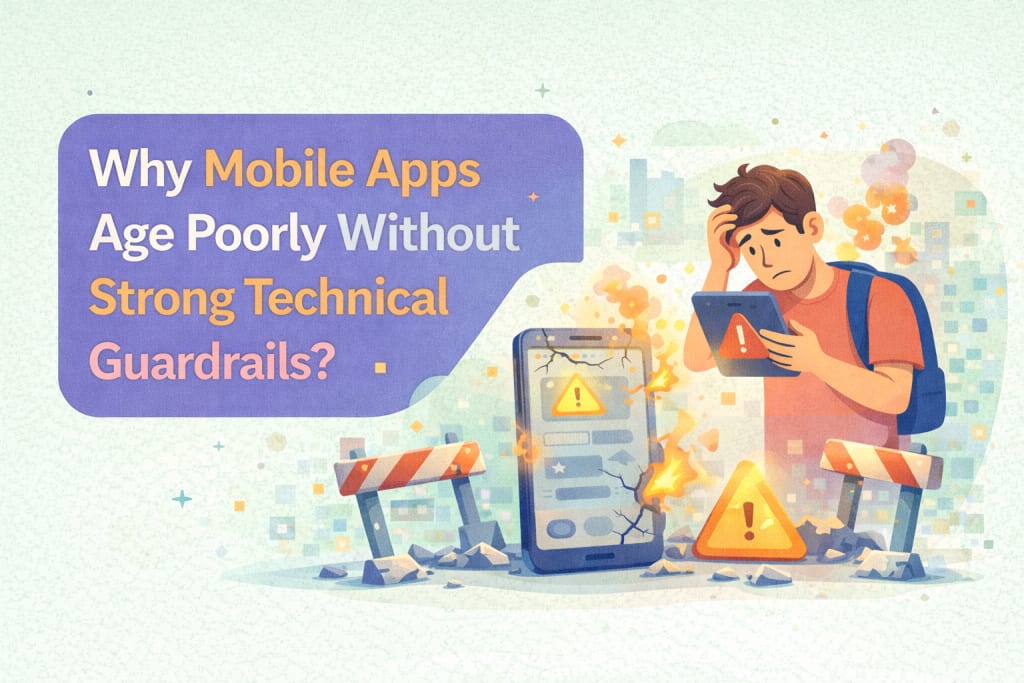
I’ve noticed that mobile apps rarely fail suddenly. They don’t wake up one morning broken beyond repair. They age. Gradually. Almost politely. The first signs are easy to dismiss. A feature that takes longer than expected. A fix that requires more explanation than code. A pause before someone says, “We should be careful here.”
That pause is never about the present. It’s about the past catching up.
Apps Don’t Decay, They Drift
When an app is young, momentum hides a lot. Decisions are quick. Changes feel safe. Everything bends without resistance.
In that phase, guardrails feel unnecessary. They slow things down. They feel pessimistic. Why restrict something that’s working fine.
Without guardrails, the app starts to drift. Not in a single direction, but outward. Patterns multiply. Exceptions pile up. Temporary choices quietly become defaults.
Nothing feels wrong yet. That’s what makes it dangerous.
Guardrails Are About Prevention, Not Control
Strong technical guardrails aren’t about locking teams down. They’re about preventing accidental complexity from becoming permanent.
They define where state can live. How dependencies can grow. What kinds of shortcuts are acceptable.
Without them, every developer solves problems locally. Each solution makes sense in isolation. Collectively, they create inconsistency.
The app doesn’t break. It becomes unpredictable.
Early Freedom Creates Long-Term Fragility
I’ve seen teams celebrate flexibility early on. No strict patterns. No enforced boundaries. Move fast and adjust later.
That freedom works until the app grows beyond shared memory.
Years later, no one remembers why things are the way they are. The flexibility that once empowered progress now creates hesitation.
Changes feel risky because there’s no clear sense of what’s allowed and what’s accidental.
Aging Shows Up as Fear Before Bugs
One of the clearest signals of poor aging isn’t technical failure. It’s emotional.
Developers become cautious. Code reviews get tense. Refactors are postponed indefinitely.
People start memorizing rules that aren’t written anywhere. Don’t touch this. Avoid that. Always test here.
These rules are symptoms. They exist because guardrails never did.
Guardrails Reduce Cognitive Load Over Time
Without guardrails, every decision requires fresh reasoning.
Should this state be shared. Should this logic live here. Is it safe to call this now.
Strong guardrails answer these questions quietly. They remove entire categories of doubt.
As the app ages, that reduction in cognitive load becomes priceless.
Performance Degrades Structurally, Not Accidentally
Performance issues in aging apps often come from structure, not inefficiency.
Extra layers. Redundant observers. Shared state updated too often.
These patterns don’t emerge overnight. They accumulate when nothing prevents them.
Guardrails limit how performance debt forms. Without them, optimization becomes reactive instead of preventive.
Inconsistent Patterns Multiply Maintenance Cost
When teams lack guardrails, patterns diverge.
One screen manages state one way. Another does it differently. A third invents a workaround.
Maintaining such systems requires context switching constantly. Fixes take longer. Bugs feel harder.
The app doesn’t just cost more to run. It costs more to think about.
Scaling Exposes the Absence of Constraints
Small teams can survive without guardrails because communication fills the gaps.
As teams grow, that shared understanding fades.
In environments like mobile app development Atlanta, where apps often scale across teams and timelines, the absence of technical guardrails becomes visible quickly.
New contributors hesitate. Onboarding slows. Mistakes repeat.
The app resists growth not because it’s complex, but because it’s unconstrained.
Guardrails Age Better Than Rules
Rules written in documents age poorly. They get ignored. They drift out of sync.
Technical guardrails live in the system itself. They’re enforced by design, not memory.
The best ones don’t require explanation. They make the right path easier than the wrong one.
That’s why they scale across time and teams.
Without Guardrails, Workarounds Become Features
One pattern I see repeatedly is workarounds hardening into behavior.
A quick fix bypasses a limitation. Another feature depends on it. Soon, removing it feels impossible.
Guardrails prevent this by making bypasses visible and costly early.
Without them, shortcuts feel harmless until they’re foundational.
Testing Can’t Replace Guardrails
Tests catch failures. Guardrails prevent patterns.
You can have excellent test coverage and still suffer from structural decay.
Tests tell you when something broke. Guardrails reduce how often things can break in the first place.
Aging apps need both, but guardrails do more silent work over time.
Refactoring Becomes Risky Without Boundaries
Refactoring relies on trust. Trust that changing one thing won’t affect everything else.
Guardrails create that trust by limiting coupling.
Without them, refactoring feels like archaeology. You dig carefully, unsure what you’ll uncover.
Teams delay cleanup. The app grows heavier.
Guardrails Shape Culture as Much as Code
Over time, guardrails influence how teams think.
They encourage consistency. They normalize restraint. They make design decisions visible early.
Without them, culture drifts toward caution and avoidance.
The difference isn’t technical skill. It’s structural support.
The Myth of “We’ll Add Guardrails Later”
One of the most common regrets I hear is postponing guardrails.
Later never arrives cleanly. By the time pain is obvious, patterns are entrenched.
Adding guardrails later feels like breaking things instead of protecting them.
Early guardrails feel like friction. Late guardrails feel like surgery.
Healthy Apps Are Quietly Opinionated
Apps that age well aren’t rigid. They’re opinionated.
They make some things easy and others intentionally hard.
That opinion doesn’t limit creativity. It channels it.
Developers spend less time debating structure and more time solving real problems.
Guardrails Allow Change Without Fear
Ironically, constraints enable flexibility.
When boundaries are clear, change feels safer. Teams know where impact stops.
Without guardrails, every change feels global.
That fear compounds year after year.
Aging Without Guardrails Feels Like Carrying History
Poorly aging apps feel heavy because they carry too much history forward.
Every decision stays relevant forever.
Guardrails allow forgetting. They let old choices fade naturally.
That forgetting is essential for longevity.
The Moment I Stopped Blaming Time
I remember the moment I realized age wasn’t the enemy.
Two apps the same age behaved very differently.
One felt calm. Predictable. Approachable.
The other felt tense. Fragile. Untouchable.
The difference wasn’t talent. It was guardrails.
Designing for the App You’ll Have Later
The hardest part is designing for a future you can’t see.
Guardrails aren’t predictions. They’re buffers.
They assume growth, mistakes, and change will happen.
Apps that survive don’t avoid pressure. They absorb it.
Ending With the App That Finally Felt Safe Again
I think back to that brittle app from the scenario.
The biggest improvement didn’t come from new features or faster code.
It came from adding guardrails. Clarifying ownership. Limiting reach. Making patterns explicit.
The app didn’t get younger. It got sturdier.
Mobile apps age poorly without strong technical guardrails not because time damages them, but because nothing slows the accumulation of small, reasonable decisions.
When guardrails exist, apps age the way good tools do. They show wear, but they still work. They still feel safe to use.
FAQs
What are technical guardrails in mobile apps?
They are built-in constraints that guide how code can grow. Guardrails limit where state lives, how dependencies spread, and how features interact, without relying on people to remember unwritten rules.
Why do apps feel more fragile as they age?
Because small, reasonable decisions accumulate without limits. Over time, flexibility turns into inconsistency, and changes start to affect more than intended.
Can good developers prevent aging without guardrails?
Not reliably. Skill helps early, but as teams grow and change, shared memory fades. Guardrails protect the system when context is lost.
Why do problems show up as fear instead of bugs?
Because the app still works, but no one trusts it. Fear appears when impact is unclear and every change feels risky.
How do guardrails help performance over time?
They prevent inefficient patterns from spreading. Without them, extra layers, observers, and shared state quietly degrade performance.
Is adding guardrails later still useful?
Yes, but it’s harder. Early guardrails feel like friction. Late guardrails feel like surgery. The cost increases with time.
Can testing replace guardrails?
No. Tests detect failures. Guardrails prevent fragile patterns from forming in the first place. They solve different problems.
Why do some apps of the same age feel healthier than others?
Because of early constraints. Apps with clear boundaries absorb change better than apps built on unchecked flexibility.
Do guardrails slow development?
Initially, yes. Long-term, they speed it up by reducing hesitation, rework, and fear around changes.
What’s the biggest mistake teams make with guardrails?
Assuming they can be added later without cost. Patterns harden quickly, and changing them becomes progressively harder.
How do guardrails affect team culture?
They reduce debate, uncertainty, and avoidance. Teams spend less time negotiating structure and more time solving problems.
What’s the clearest sign an app lacks guardrails?
When simple changes require long explanations, careful coordination, and phrases like “don’t touch that” become common.
About the Creator
Keep reading
More stories from Samantha Blake and writers in Journal and other communities.
Why Observability Matters More Than QA at Scale?
I remember the first time QA signed off and I still felt uneasy. The checklist was complete. Test cases passed. The release notes looked clean. Still, something about the app felt unfinished, like a conversation that ended too politely. Nothing was wrong on paper. That was exactly the problem.
By Samantha Blake2 months ago in Journal
6 Celebrity exes who get along
It is extremely difficult for celebrities to maintain a relationship, especially if they are involved with another global celebrity like themselves. This means that everyone knows about the relationship, both the good and the bad. Divorces and separations are often complex and take a long time to resolve. However, some celebrities get along very well after the breakup.
By Ninfa Galeano5 days ago in Journal


Comments
There are no comments for this story
Be the first to respond and start the conversation.