
Why Are Businesses Choosing Co-Managed IT Services Over Traditional MSPs?
Exploring the Shift Toward Co-Managed IT Models and How They Offer Greater Flexibility, Control, and Collaboration for Growing Enterprises.

Managed IT services are on the boom!
87% of businesses have increased their profits with tech, according to the KPMG report.
Now, organizations want to outsource their IT services and focus more on their core operational ideas to skyrocket their growth. That is why businesses are choosing co-managed IT services over traditional MSPs.
But there's a lot more happening in the IT service sector, which you must know, especially if you are a business owner or aspire to be one.
Let’s begin.
What Are Managed IT Services?
Outsourcing your business’s technological work and projects to a third party is what is known as a co-managed IT service solution.
Sometimes, even your business does not need to have a specialized team or sector like traditional MSPs.
Instead, you can simply put the entire IT service responsibility on the managed service provider solutions and expect the process to proceed as you want. That too, from a team of experts!
Who is the Co-Managed IT Services Approach For?
Co-managed IT services are a must for businesses that have the following:
Limited IT Resources
Even though your business might have an internal IT team, however, as you grow, limited IT resources may hinder the growth. This is where co-managed IT services can help you the most.
Sometimes, lack of skills and a limited number of staff are also one of reasons businesses are choosing shared service providers for IT solutions.
Scalability
As your business grows, managing IT infrastructure along with a team becomes stressful. Keeping up with the pace of business requirements while managing the team is one of the main reasons why businesses prefer outsourcing IT solutions.
Proactive Monitoring & Maintenance
You always want to keep the IT operations smooth for your business. With the specialized team of a co-managed service provider, you can keep up with monitoring issues and maintaining them with the best hands.
Co-Managed IT Services vs Traditional MSPs: 7 Big Differences!
Many businesses are choosing co-managed IT services, and there are multiple benefits to it. But, before we jump to benefits, here are 7 big differences between traditional MSPs vs MSP solutions.
1. Cost Difference
It’s a no-brainer that businesses want to save money and put it in the right direction to gain more. Co-managed IT services help businesses to achieve this. Significantly!
Whether it is related to predictable expenses or shared costs as per the requirement, co-managed IT services are a great-to-go option.
However, traditional MSPs require an internal IT team. Their training requires a good investment till they perform as per your business requirement, which is not a good option.
2. Less Stress
Imagine how amazing it would be when you can solely focus on your business core functionality and keep all of your company’s technology responsibilities stress-free!
Sounds relaxing, right?
It is where MSPs are a better option than the traditional managed service providers. Under hired managed service providers, your company’s all technology needs will be taken care of by the team of experts.
Now, this will allow your employees to put their energy into more essential activities of the business.
3. Increased Productivity
With more people working on the core functionality of the business, more productivity comes
through. Shared managed service providers keep your business's employees stress-free from IT responsibilities so that they can work together on the business.
However, the traditional MSPs require additional work focus for the IT service management, processes, and maintenance, leading to more manpower requirements.
4. Better IT Support
MSPs help you find possible improvements in your business IT infrastructure and improve efficiency.
With 24/7 customer support and the availability of experts on one single call, co-shared MSPs can help boost the growth of companies.
On the other hand, in-house traditional MSPs need to be managed according to business requirements, which can become stressful.
5. Quick Scalability
When your business grows, you will always want to keep things ready to adapt to the rapid changes. If you believe traditional MSPs can handle the quick IT service requirements, then you might need to rethink.
Whether it will be managing the IT infrastructure or scaling up the expert team, managed IT services can help you achieve that in no time. On the other hand, with existing manpower, you may need to put separate efforts into keeping up with the pace of business growth.
And, if you have shared IT responsibilities with the third-party providers, they will keep things ready as you go with different paces in your business.
6. IT Security
When you outsource the technology services of your company, you can rely on the team of experts that keeps security as a priority while threats are at a distance.
Even when you scale up, you can count on a team of specialized professionals who can handle everything related to IT.
Whatever the services your businesses may require, this team will be ready to deliver.
7. Predictable Expenses
Co-managed IT service providers help you customize your services according to your requirements. It means, irrespective of your budget, your company’s IT responsibilities will be in the best hands.
With predictable IT expenses, you can channel and optimize financial decisions for your business.
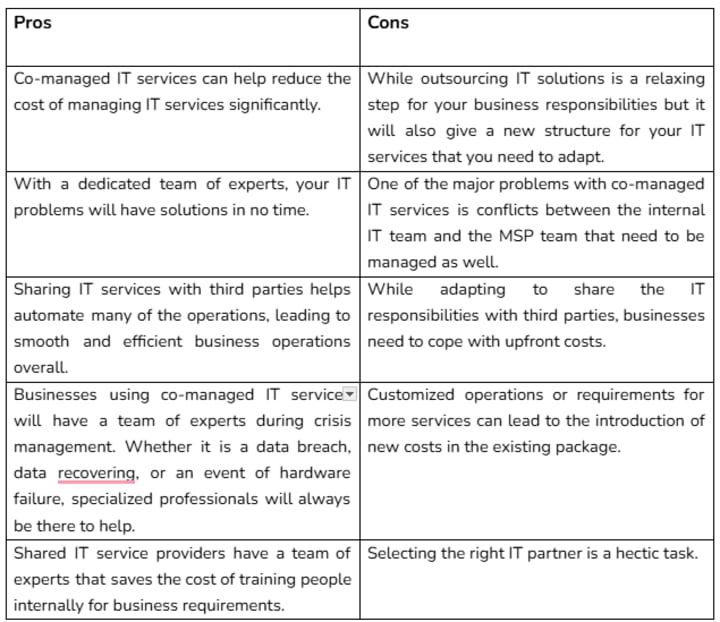
Pros & Cons of Co-Managed IT Service
Conclusion: Choosing Between Co-Managed & Traditional MSPs
Once you know your business IT requirements, you can easily choose between co-managed or traditional MSP.
As guided above, if your business may require upscaling or has limited IT resources, then opting for co-managed IT service providers can be a better option.
On the other hand, if your business stays stable most of the time and your IT business solutions can be done with a limited team, then managed IT services are the best option.
FAQs
What is the difference between managed IT services and co-managed IT services?
Managed IT services include an all-in-one team that handles clients’ IT infrastructure, security, and solutions for problems. In contrast, the co-managed IT services involve working with third parties for specific or entire IT solutions.
What are the main benefits of managed IT services?
Enhanced security, reduction of costs, and highly skilled experts as per business requirements are some of the benefits of using managed IT services.
About the Creator
Benedict Tadman
A results-driven Marketing Manager with 8+ years of experience in developing and executing innovative marketing strategies that drive brand growth and customer engagement.
Keep reading
More stories from Benedict Tadman and writers in Journal and other communities.
REST vs. GraphQL: Which Is Better for Third-Party API Integration?
In the world of software development, application programming interfaces (APIs) are the cornerstone of modern applications. They allow applications to communicate and share data, providing the foundation for seamless integration between various services.
By Benedict Tadman9 months ago in Journal
Getting Serious About Comedy (Part I)
If I were asked to remark on my life and the childhood that paved some road leading me to this point, I would have to say something about all the funny people who surrounded me for the last 26,872 days (and counting). Somewhere along that road, I became a big fan of laughter and the comedy that spawns it – and, I mean not only my own laughter, but the laughter of others, some of which I have actually been responsible for inducing.
By John Oliver Smith7 days ago in Humor


Comments
There are no comments for this story
Be the first to respond and start the conversation.