
While Your Case Is Under Review
While Your Case Is Under Review

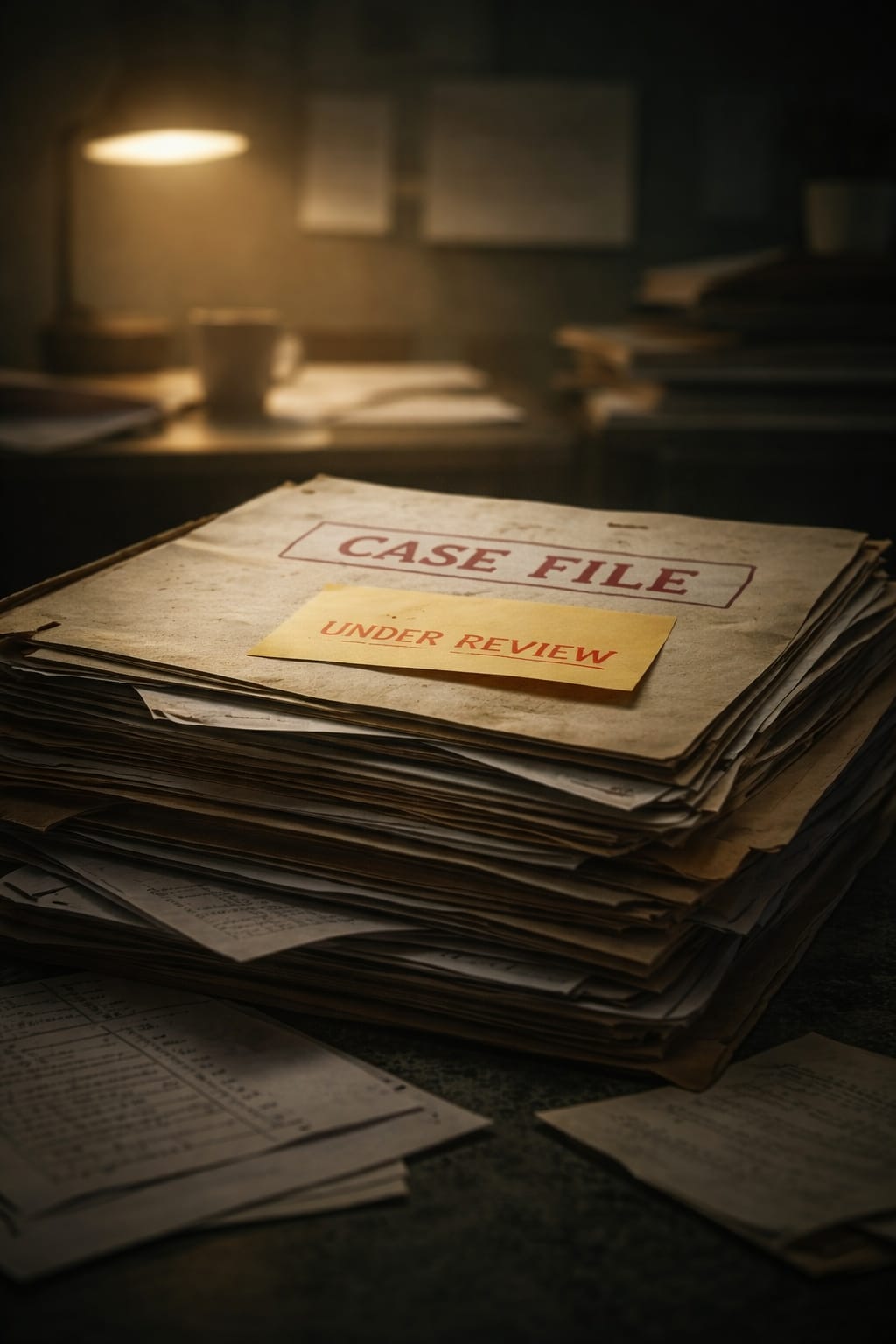
While Your Case Is Under Review
The message arrived almost immediately.
I had barely closed the browser window before my phone vibrated. An email—polite, efficient—thanked me for submitting my materials and assured me they had been received. It explained that my case was now under review and that I would be contacted if additional information was required.
Nothing else was needed from me at this time.
I reread the message twice, then a third time, scanning for something actionable. A next step. A name. A human signature. There was none. Just a confirmation number and a reminder to be patient.
The system had responded.
The system was working.
At first, I trusted that. The speed felt reassuring. A system that responds quickly must be organized. Serious. Attentive. I told myself that careful processes take time, that thoroughness and delay are often indistinguishable from fairness.
I didn’t yet understand that the waiting was not a pause between actions.
It was the action.
In the beginning, the waiting felt light. Inconsequential. I checked the portal the way someone checks the weather—out of habit, without expectation. Each time, the status was unchanged. Under review. The phrase was neutral, almost comforting. It suggested motion without revealing direction.
Days passed. Then weeks.
The first follow-up arrived requesting additional documentation. Information I had already submitted, now framed slightly differently. Dates reformatted. Descriptions clarified. Attachments re-uploaded. I complied immediately, careful to be precise and professional. I didn’t want to slow anything down.
Another automated email followed within minutes. Another thank-you. Another assurance that my materials were under review.
This became the rhythm.
Submission. Confirmation. Silence.
What unsettled me wasn’t resistance. No one challenged my account. No one questioned my credibility. There was no confrontation, no rejection, no visible skepticism. The system didn’t argue—it absorbed. Everything I offered disappeared neatly into it, leaving no trace of response.
It was difficult to explain this discomfort to people on the outside. “At least they’re looking into it,” they said. “These things take time.” And on paper, they were right. Every step made sense in isolation. Every delay was defensible. Every communication followed policy.
That was the problem. Nothing was wrong enough to protest.
The system did not deny me. It did not resolve anything either. It held me in a suspended middle where urgency slowly thinned into fatigue.
I began to notice how much of my life had quietly reorganized itself around that suspension. I stopped planning too far ahead. I hesitated before committing to anything that might demand my full attention, just in case another email arrived. My phone stayed within reach at all times. Notifications on. Volume up. I slept lightly.
The system never asked for this level of vigilance. It didn’t need to. Uncertainty did the work for it.
Time inside the process began to behave differently. Days felt indistinct. Weeks blurred together. The calendar moved forward, but nothing progressed. I started measuring time not in days, but in updates. Not in weeks, but in acknowledgments. The only proof that time was passing was the date at the bottom of each email.
I started documenting everything. Screenshots. PDFs. Copies of copies. I kept an archive of my own participation, as if redundancy might protect me from being erased. The act of saving felt like agency, even though it changed nothing.
Occasionally, a human voice appeared. Brief. Careful. Always framed as a representative of procedure, never as an individual. Their messages were courteous and deliberately vague. They thanked me for my patience. They acknowledged my concerns. They reminded me that these processes take time.
They never explained why.
I learned that questions were allowed, but answers were not guaranteed. That concern could be validated without being addressed. That language could sound responsive while remaining empty.
I don’t believe anyone intended harm. This wasn’t cruelty. It was design. The system wasn’t built to hurt people—it was built to be consistent. Predictable. Safe from liability. It prioritized neutrality over nuance, procedure over urgency.
But neutrality has a cost when one side is waiting.
Over time, the waiting began to show up in my body. Headaches without explanation. A tightness in my chest that came and went. A constant low-level alertness that made rest feel irresponsible. I was always slightly braced, as if something might happen at any moment, even though nothing ever did.
I began to self-police. I rewrote emails before sending them, removing anything that sounded emotional or impatient. I shortened questions. Softened language. Added phrases like whenever possible and I understand timelines vary. I learned to preemptively apologize for taking up space.
The system never asked me to do this.
I learned it anyway.
The longer the process continued, the harder it became to remember who I had been before entering it. The clarity I felt at the beginning dulled. My confidence thinned. I second-guessed details I had once been certain of. The system didn’t challenge my account, but it didn’t affirm it either—and the silence began to feel like commentary.
At some point, I realized the system didn’t need to reject me. It didn’t need to deny or defend. It simply needed to outlast me.
When the decision finally arrived, it came quietly. Another email. Another attachment. Another explanation wrapped in procedural language. It referenced timelines, standards, steps taken. It confirmed that policies had been followed and criteria applied.
It was technically correct.
It was also profoundly unsatisfying.
Nothing in the final communication acknowledged the waiting itself. The months of suspension. The erosion caused by prolonged uncertainty. The system accounted for actions, not consequences. For steps, not strain.
Reading it, I understood that nothing about my experience had been invisible—it had simply been irrelevant. The system was never designed to measure the human cost of delay. It wasn’t broken. It was focused elsewhere.
From the outside, the process looked orderly and fair. Documents reviewed. Procedures followed. Decisions rendered. The system could point to its own consistency as proof of integrity.
From the inside, something quieter had happened.
While my case was under review, time passed. Opportunities closed. Energy drained. Certainty eroded. None of this violated policy. None of it registered as an error.
The system did what it promised.
It processed.
And by the time it was finished, there was nothing left to appeal but the waiting itself.
About the Creator
Dakota Denise
Every story I publish is real lived, witnessed, survived, true or not. I never say which. Think you can spot truth from fiction? Comment your guesses. Everything’s true. The lie is what you think I made up.
Keep reading
More stories from Dakota Denise and writers in Journal and other communities.
Blazz and the Shepherds
Song Title: “Blazz and the Shepherds” Verse 1: Out on the streets, when the city sleeps, Blazz walks alone, secrets she keeps. In her hand, a notebook and pen, A detective’s mind, she’ll solve it again. Her heart beats with a rhythm so strong, She’s got the pulse of the city all along. And by her side, with fur so sleek, Fire Boy and Earth Girl, they never speak. Pre-Chorus: But they know the game, the chase and the crime, They’ve been trained for years, for this moment in time. With their eyes so sharp and ears to the ground, They sniff out the truth, where it’s never found. Chorus: Blazz and the Shepherds, running through the night, Their paws on the pavement, the city’s heart in sight. Fire Boy’s on the hunt, Earth Girl’s on the trail, Together they’ll catch the truth, they will never fail. Blazz and the Shepherds, chasing down the lies, In the shadows they stand, where the darkness hides. With loyalty and love, they’ll uncover the clues, Blazz and the Shepherds, the truth they’ll choose. Verse 2: Fire Boy’s quick, his nose in the air, He smells the danger, without a care. He’s been through it all, every twist and turn, With his snout to the ground, he’ll always discern. Earth Girl’s steady, her paws so light, She knows when something’s off, something’s not right. Her instincts are sharp, she senses the fear, With every step forward, the truth draws near. Pre-Chorus: Together they’re bound, a team like no other, Blazz and her dogs, like sister and brother. The city may twist, the cases may bend, But with her Shepherds, she’ll always defend. Chorus: Blazz and the Shepherds, running through the night, Their paws on the pavement, the city’s heart in sight. Fire Boy’s on the hunt, Earth Girl’s on the trail, Together they’ll catch the truth, they will never fail. Blazz and the Shepherds, chasing down the lies, In the shadows they stand, where the darkness hides. With loyalty and love, they’ll uncover the clues, Blazz and the Shepherds, the truth they’ll choose. Bridge: They’ve got a bond that’s deep and true, Not just a job, but a mission too. When the case is tough and the road is long, Fire Boy and Earth Girl, they’ll keep her strong. Blazz won’t stop, she won’t back down, With her Shepherds, she’ll turn it around. Together they’ll find what the world wants to hide, In every whisper, they’ll never collide. Chorus: Blazz and the Shepherds, running through the night, Their paws on the pavement, the city’s heart in sight. Fire Boy’s on the hunt, Earth Girl’s on the trail, Together they’ll catch the truth, they will never fail. Blazz and the Shepherds, chasing down the lies, In the shadows they stand, where the darkness hides. With loyalty and love, they’ll uncover the clues, Blazz and the Shepherds, the truth they’ll choose. Blazz and the Shepherds, walking side by side, With Fire Boy’s flame and Earth Girl’s pride. Through every case, they’ll never stray, They’ll bring the truth to light, night and day. Blazz and the Shepherds, forever true, In a world of shadows, they’ll always pursue. Chorus: Blazz and the Shepherds, running through the night, Their paws on the pavement, the city’s heart in sight. Fire Boy’s on the hunt, Earth Girl’s on the trail, Together they’ll catch the truth, they will never fail. Blazz and the Shepherds, chasing down the lies, In the shadows they stand, where the darkness hides. With loyalty and love, they’ll uncover the clues, Blazz and the Shepherds, the truth they’ll choose.
By Dakota Denise 10 months ago in Journal
Pakistan to Offload 500,000 Tons of PASSCO Wheat as ECC Tackles Surplus Stocks
Subtitle Pakistan’s top economic decision-making body, the Economic Coordination Committee (ECC) of the Cabinet, has approved a major strategy to offload 500,000 metric tons of wheat held in government warehouses by the Pakistan Agricultural Storage and Services Corporation (PASSCO) — a move aimed at tackling surplus stocks, cutting storage costs, and stabilizing domestic wheat prices.
By Salaar Jamaliabout 20 hours ago in Journal



Comments
There are no comments for this story
Be the first to respond and start the conversation.