
When the World’s Tech Stopped Breathing: How One Economic Shock Exposed the Fragile Heart of Modern Power
A single policy decision in Beijing nearly brought the global chip industry to its knees — and reminded us how easily the modern world can break.
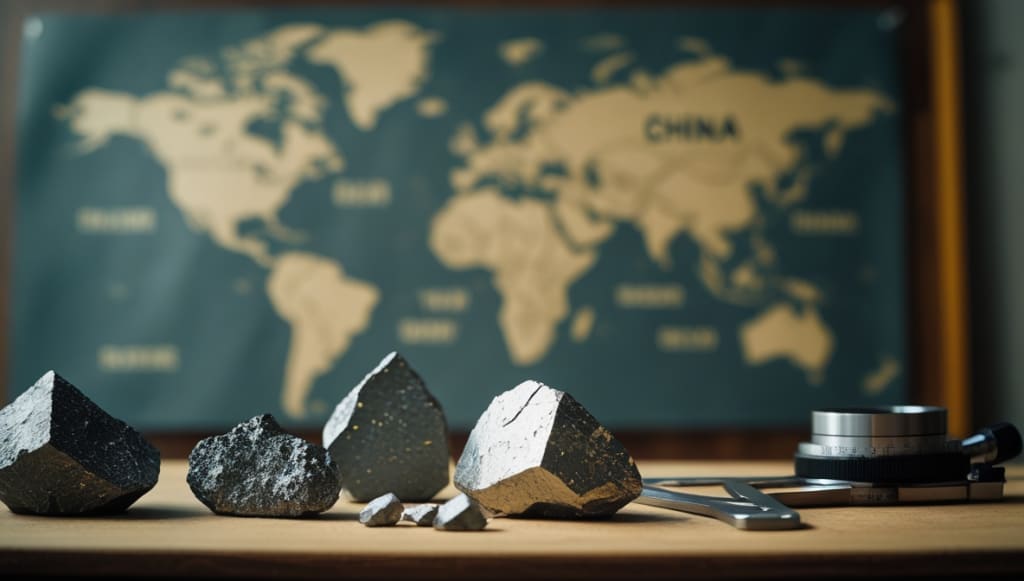
The Day the Tech World Held Its Breath
Imagine waking up one morning to find that the entire world’s supply of advanced computer chips — the ones inside your phone, your car, your hospital equipment, your AI tools, even the satellites above your head — had suddenly stalled.
Not slowing down.
Not warning us.
Just… stopping.
That’s the nightmare the world flirted with in late 2025 — not because of a natural disaster or a war, but because of dust.
Rare-earth dust.
On 9 October 2025, China made an announcement that sent shockwaves through every boardroom from Silicon Valley to Seoul: sweeping new export controls on rare earths, the strange-sounding metals that make everything from iPhones to guided missiles possible.
This wasn’t bureaucracy.
This wasn’t routine policy.
This was a weapon.
And the center of this geopolitical earthquake was not the U.S., not China, but a small, quiet nation known mainly for tulips, canals, and perfect engineering: the Netherlands.
At the heart of it all stood one company — ASML — and an uncomfortable truth:
The future of the modern world can be stopped by a single bottleneck.
A Weapon Made Not of Steel, but Dust
Rare earths sound exotic, but in truth, they’re not rare. What is rare is the ability to refine them at the purity needed for advanced manufacturing.
And China has spent decades making sure it controls that part of the chain.
By 2025, Beijing oversaw around 90% of global rare-earth processing. Not mining — processing, the crucial step that turns raw rock into materials pure enough for precision optics, magnets, motors, and lasers.
And that’s where the real leverage comes from.
China’s new rules weren’t about blocking shipments. They were more elegant — and far more dangerous.
The 0.1% Rule
If any product made anywhere in the world contained even 0.1% Chinese rare earths (which almost everything does), it required a Chinese export license before being shipped.
A machine made in the Netherlands and shipped to Taiwan?
It now needed Beijing’s approval.
A satellite component made in Germany but containing a Chinese-processed magnet?
Another license.
A chipmaking tool built in the U.S. but using cerium-polished lenses?
License.
Imagine a global supply chain suddenly waiting on one government office.
Imagine every tech company holding its breath for paperwork.
This wasn’t an embargo — it was a choke point.
A switch China could flip at any time.
ASML: The World’s Most Important Company Suddenly in Trouble
If you asked the average person in 2025 what the world’s most important company was, many would say Apple, NVIDIA, or Samsung.
But the most crucial was none of these.
It was ASML, a company in the Netherlands that makes the world’s only EUV lithography machines — massive, bus-sized miracles capable of carving the tiniest circuits humanity has ever made.
No ASML, no AI revolution.
No ASML, no 2-nm chips.
No ASML, no modern military technology.
Each machine costs more than $200 million — but without rare-earth magnets, rare-earth-polished optics, and rare-earth-dependent lasers, ASML cannot build a single one.
And those rare earths?
Almost all come from China.
The moment Beijing made its announcement, ASML found itself standing at the edge of a cliff.
Its CFO tried to reassure investors. But inside the tech world, panic was rising:
What if Beijing simply refused export licenses?
ASML’s supply line would slow.
Then stall.
Then stop.
And if ASML stopped, so did TSMC.
And if TSMC stopped, so did Apple, NVIDIA, Qualcomm, Intel, Samsung — everyone.
One rare-earth decision.
One fragile thread.
And billions of devices, jobs, companies, and technologies would come crashing down.
The Shockwaves Almost No One Saw Coming
Here’s the part that stunned even experts:
The first industries at risk weren’t just computers or smartphones.
It was everything.
Electric vehicles rely on rare-earth magnets in motors.
Wind turbines rely on rare-earth magnets in rotors.
Defense systems rely on rare earths for guidance and targeting.
Medical equipment relies on rare earths for imaging.
Spacecraft rely on them for navigation and communication.
The world runs on rare earths.
Rare earths run through China.
And China just showed it was willing to weaponize that reality.
A World Waiting for December
The 0.1% rule was set to go live in December 2025.
Every supply-chain manager in the world was counting down to it like it was an asteroid impact.
Some called it the “Semiconductor Doomsday Clock.”
Some called it “Chipocalypse Eve.”
Inside ASML, executives prepared “emergency continuity plans.”
TSMC scrambled to stockpile components.
The U.S. and Europe rushed into urgent talks.
No one wanted to imagine a world where chip production simply froze.
And then — suddenly — the world exhaled.
The Pause That Was Not a Peace
On 9 November 2025, after a meeting between Xi Jinping and Donald Trump, China unexpectedly announced a one-year suspension of the harshest rules.
Markets cheered.
Companies sighed in relief.
Commentators said the crisis was “over.”
But it wasn’t over.
Not even close.
China didn’t delete the weapon.
China didn’t abandon its leverage.
It simply put the weapon back in its holster — safety on, finger still resting on the trigger.
The full legal structure remains intact.
The licensing system remains active.
The power remains real.
This wasn’t peace.
It was a warning.
A reminder of who controls the world’s technological heartbeat.
A reminder of how thin our safety net is.
A reminder that modern power is no longer measured in missiles or armies — but in minerals and supply chains.
So What Happens Now?
Over the next decade, the rare-earth battle will shape everything — AI, electric cars, green energy, military tech, global alliances, and the balance of power itself.
The West now faces hard questions:
Can companies like ASML ever break free from Chinese dependency?
Can new rare-earth processors rise quickly enough?
And what happens the next time China decides to squeeze the world?
Because make no mistake:
This was a test run.
And the world got a glimpse of how easily everything we rely on can begin to fall apart.
Your Turn
What do you think is the West’s next move?
Can the semiconductor world truly diversify — or is dependency now permanent?
Share your thoughts in the comments.
About the Creator
Keep reading
More stories from Shahjahan Kabir Khan and writers in Journal and other communities.
The Invisible Price Tag: How Convenience Became the Most Expensive Commodity of the Digital Age
The Age of Effortless Living We were promised release, a truth in which everything required is only a tap away. Direct to our homes, we receive food items. Films are broadcast immediately. Moments later, cars arrive at our destinations. Every application and automation improves the speed, simplicity, and efficiency of life.
By Shahjahan Kabir Khan2 months ago in Journal
SEO Isn’t Dead — It Just Changed: Insights from Ayub Ansary’s Conference Session
Search Engine Optimization (SEO) has been a cornerstone of digital marketing for over two decades, continuously adapting to the shifting sands of search engine algorithms, user behavior, and technological advancements. Despite periodic cries of its demise, SEO remains a vital channel for organic visibility and traffic acquisition. The recent conference session featuring Ayub Ansary provides fresh, data-backed perspectives that challenge the notion of SEO as a fading discipline. Instead, it reveals an industry in flux—one that demands new strategies and higher standards to thrive.
By Muhammad Al Arabiabout 3 hours ago in Journal


Comments
There are no comments for this story
Be the first to respond and start the conversation.