
When Innovation Slows: Why Apple’s “Safe Choices” Are Helping Samsung Win
How risk-taking — or the lack of it — is quietly reshaping consumer loyalty.
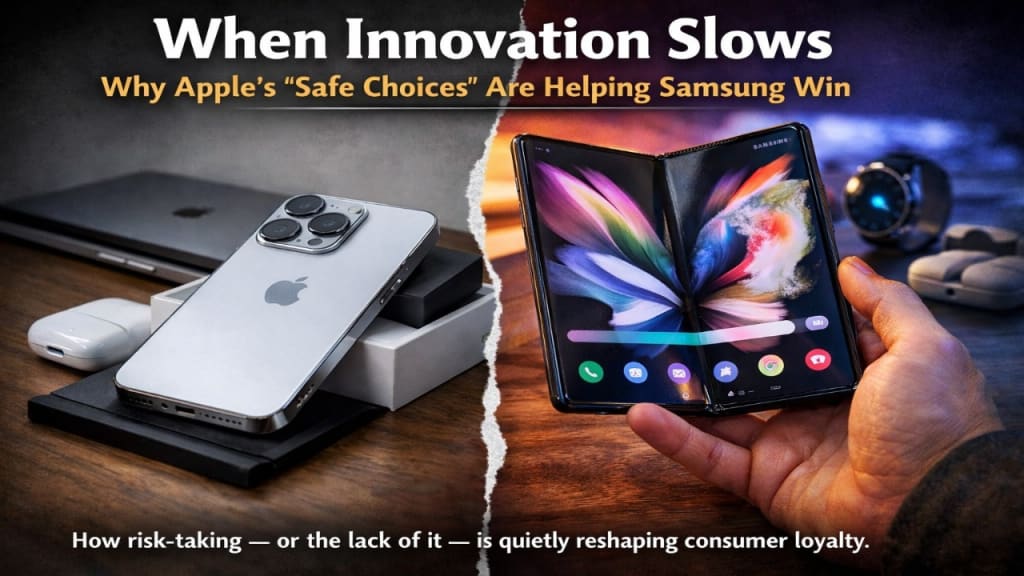
For most of the last two decades, Apple didn’t just release products — it set the rhythm of innovation.
Each launch felt like a moment. Each device felt inevitable, as if the future had simply arrived early in Apple’s packaging. People didn’t ask whether they needed the new iPhone. They asked how soon they could get it.
But lately, something feels different.
Apple is still powerful. Still profitable. Still admired.
Yet a growing number of users are no longer excited — they’re comfortable.
And in technology, comfort can be dangerous.
The Rise of “Safe” Innovation
Apple hasn’t stopped innovating. That’s important to say.
Its devices are polished, reliable, and refined. Battery life improves. Cameras get sharper. Chips grow faster. Ecosystems remain tightly integrated.
But most of these changes feel predictable.
The designs evolve slowly. Features arrive cautiously. Risk is minimized at every step. Apple’s strategy today seems built around protecting what already works rather than aggressively redefining what could come next.
From a business standpoint, it makes sense. When you serve hundreds of millions of users, bold risks can break trust as easily as they create excitement.
But emotionally, something has shifted.
For many users, Apple no longer feels like a company pulling them into the future. It feels like a company making sure nothing goes wrong.
Samsung’s Willingness to Experiment
While Apple plays defense, Samsung is doing something else entirely: experimenting in public.
Foldables. Tri-fold rumors. Stylus integration. AI-heavy features. Wild camera designs. New form factors that don’t always succeed — but try anyway.
Not every experiment lands. Some feel unfinished. Others appeal to niche users.
But that’s the point.
Samsung isn’t waiting for certainty. It’s testing ideas in the real world, learning from users, and signaling something important: we’re still searching for what comes next.
That energy resonates — especially with users who feel technology has become stagnant.
Innovation Is Emotional, Not Technical
Here’s the truth many companies forget:
People don’t fall in love with devices because they’re faster.
They fall in love because they feel new.
Innovation is emotional before it’s technical. It’s about surprise, curiosity, and the sense that a product might change how you live — not just how efficiently you scroll.
Apple’s recent releases feel expertly made, but rarely surprising. Samsung’s feel messier — but more alive.
And over time, that different shapes of loyalty.
The Loyalty Shift Is Subtle — But Real
No mass exodus is happening. iPhones still sell extremely well. Apple’s ecosystem remains unmatched in many ways.
But look closer, and you’ll notice a change in tone.
Longtime Apple users now say things like:
- “I’ll upgrade… but not this year.”
- “It’s still good, just not exciting.”
- “I’m curious what Samsung is doing.”
Curiosity is the first crack in brand loyalty.
Once users begin looking elsewhere — even casually — the emotional lock loosens. They stop defending the brand automatically. They start comparing.
Samsung benefits from that hesitation.
Playing It Safe in a Risk-Hungry Market
Apple’s cautious approach isn’t happening in a vacuum.
We’re living in an era of rapid AI advances, shifting form factors, and changing expectations about what devices should do. People don’t just want tools — they want possibilities.
Samsung leans into that uncertainty. Apple resists it.
Where Samsung asks, “What if?”
Apple asks, “What’s proven?”
Both strategies have value. But only one feels adventurous.
And right now, users are craving adventure.
The Cultural Divide Is Growing
This difference in approach has created a cultural split.
Apple users often value stability, simplicity, and seamless integration. Samsung users tend to celebrate customization, flexibility, and experimentation.
Neither is wrong — but the tension between them is growing.
Samsung fans see Apple as stagnant.
Apple fans see Samsung as chaotic.
But here’s what’s changing: neutrality is disappearing.
People are no longer just choosing phones. They’re choosing philosophies about how technology should evolve.
Innovation vs. Protection
Apple is protecting something valuable: trust.
It doesn’t want half-baked features. It doesn’t want unreliable hardware. It doesn’t want users feeling like test subjects.
But protection can slowly turn into hesitation.
And hesitation, over time, can look like fear — especially in an industry built on bold moves.
Samsung, by contrast, accepts imperfection as the price of progress.
That difference may define the next decade.
Can Apple Reignite Its Spark?
The story isn’t over.
Apple has surprised the world before — often when expectations were lowest. A single truly bold release could instantly change the narrative.
But to do that, Apple may need to accept something uncomfortable:
Not every innovation will be universally loved.
Not every risk will pay off immediately.
The Apple that once redefined phones, music, and computing wasn’t afraid of criticism. It moved first — and refined later.
If Apple wants to reclaim that identity, it may need to stop playing it quite so safe.
The Quiet Winner of Caution
For now, Samsung benefits from Apple’s restraint.
Not because Samsung is perfect — but because it feels hungry.
In technology, hunger matters.
It signals ambition. It invites curiosity. It keeps users watching.
As Apple protects its empire, Samsung explores the edges.
And in that space between safety and risk, consumer loyalty is slowly being rewritten — not with headlines, but with hesitation.
Sometimes, the biggest shift isn’t when a company fails.
It’s when it stops daring.
#Feature #Technology #Apple #Samsung #Innovation #Consumer Behavior #Tech Culture
About the Creator
Keep reading
More stories from Shahjahan Kabir Khan and writers in Journal and other communities.
The Return of the Tech Divide: Why Samsung Users and Apple Fans Are More Polarized Than Ever
Choosing a smartphone was once simple. You picked the option most suitable for your needs. You thought about price, camera quality, battery life, and maybe looks. The choice hardly mirrored your identity.
By Shahjahan Kabir Khan3 months ago in Journal
Chad Pratt and the Quiet Strength of Lifelong Running
Running is often portrayed as a competitive sport, a pursuit of speed, or a quest for medals. But for some, it becomes something more—a way to cultivate balance, clarity, and resilience. Chad Pratt exemplifies this philosophy. His lifelong commitment to running shows how steady movement, discipline, and focus can shape not only physical fitness but also emotional and spiritual well-being.
By Chad Pratta day ago in Journal
The Piggy Project
I’ve had so many names in this life I lose track of which ones were ever really mine and which ones I wore because someone needed me to. Some were handed to me before I had words to refuse them, before I knew what they meant, before I knew I could say no. Most weren’t meant to hurt. That doesn’t mean they didn’t leave marks. Marks that told me who I belong to, who I am by way of who claims me, recognizes me in the good and bad, who walks beside me.
By Fatal Serendipity7 days ago in Confessions




Comments
There are no comments for this story
Be the first to respond and start the conversation.