
When Creative Writing Mixes with Science to Express Facts and Feelings about Earth’s Ecology
"I know of no pleasure deeper than that which comes from contemplating the natural world and trying to understand it.” ― Sir David Attenborough

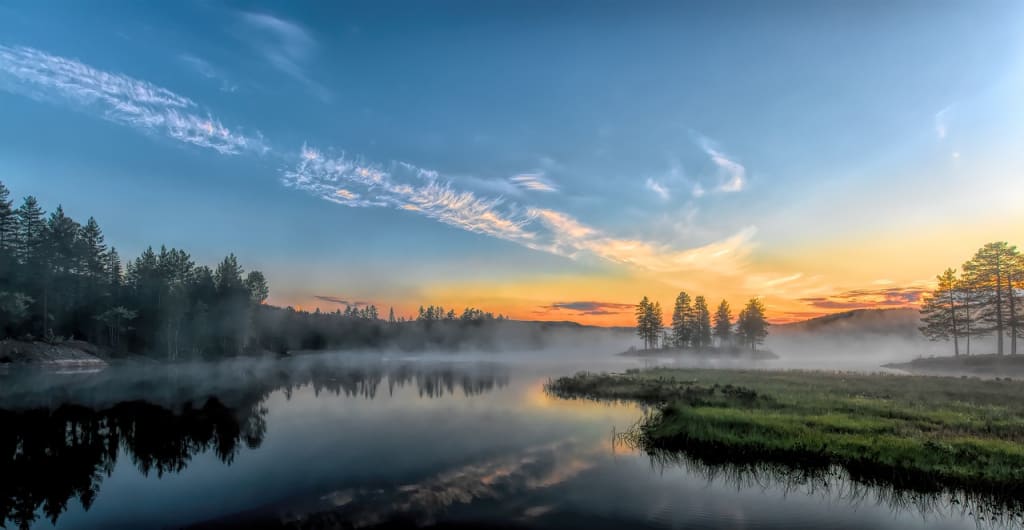
“We are at a unique stage in our history. Never before have we had such an awareness of what we are doing to the planet, and never before have we had the power to do something about that. Surely we all have a responsibility to care for our Blue Planet. The future of humanity and indeed, all life on earth, now depends on us… Sir David Attenborough
First, who can doubt that we face many problems and ecological challenges from global warming, pollution, food production, species extinction and more on a planet with finite resources? Yet, as ecology works, all the systems are interconnected from the smallest microorganism to the largest manmade plastic manufacturing plant.
Second, let's use the world of Imagination as only an ECO-FICTION genre can spin it! Tell the story with real Nature’s characters who are alive within their ecological settings with experiences and thoughts.
What is Eco-Fiction?
Eco-fiction is a special writing genre that allows a special bonding to Nature’s characters who tell their own narratives of belonging to and surviving in their environment. What better way to have a special relationship with Nature; thereby, making an emotional connection through their trials, tribulations and inclusions of all lives in a balanced natural environment. As they share their loves for their families and communities, so will the readers feel kinship and motivational affinity to protect Nature at its best.
So let’s put on our thinking caps, close our eyes and imagine!
For example, what could be more important than to visualize a unique water sprite with roots on his mission to find Cyclical Truths in the Earth’s ecosystems?
Give him the opportunity to narrate his own story combining imagination and fantasy with scientific reality. Let him share his affinity with plants and any other organic life form derived from carbon and hydrogen so he can communicate with other beings and express their stories from their realities. Most importantly, allow his experiences to help explain the many cyclical truths that are very real and essential to the Earth’s ecology as he encounters the words ‘sustainable development’ and ‘ethical consumerism.’
Perhaps, he is just an imaginary materialized water drop with two layers of skin, eye spots and retractable roots; but, at the end, we will care deeply for his manners, fears and hopes. What an amazing friend especially for children to get to know and respect! What a superhero for the Earth’s well-being!
I must admit there was an undeniable joy in writing many of these passages because I could write creatively to express some very serious connections, thoughts and feelings. As well, the narration is first person to give more credibility and vitality.
Engage with the power of personification
There is a unique power in figurative language known as personification when human characteristics are given to non-living things or ideas. Associations help to better relate to the object or idea and have a sense of empathy that it matters. What more precious bonding can there be than to consider water as a valuable friend, as a person and necessity for survival? You wouldn’t hurt or bully a good friend, right?
Here are a few situations where I feel personification helps to focus on water as a real entity in its own right for sustainability and protection:
…How else can you describe evaporation from the ocean as frolicking with friendly air molecules, rising higher into snowstorms and freezing unto a glacier?
…How else can you describe the joy of a plant metabolism bathed in sunlight and drinking nutrients though it roots, feeling its body structure becoming stronger cell by cell?
…How else can you describe the value of photosynthesis based on chloroplast cells within plants that create food from the sun’s energy as primary producers for secondary consumers like animals and humans?
…How else can you describe the importance of the decomposition of organic matter by bacteria in an endless carbon cycle mixed in with nitrogen air molecules?
…How else can you show the family and community life of microorganisms like rotifers and their special bonding to fresh water except by developing mutual feelings of respect for each other?
...Who can better describe the microscopic food chain than a microorganism called Stentor as part of the great ecological cycle? “This is one of the great Cyclical Truths … if one part lives, then the other part lives; if one part is destroyed then the other part will be destroyed in time? Isn’t co-operation wonderful, a true democracy through diversity?”
…How else can you show the importance of water in a human digestive system than to describe the process of being chewed alive and final eliminated through perspiration?
…How else can you show the narrow focus of scientists to explore within their own known nomenclature versus giving credit to unknown possibilities to be yet discovered in Nature?
…How else can you meet a carbon molecule with his ancient heritage and share his trials and transformations into plastic? What if a plastic polymer could talk?
…How else can the horror of pollution be experienced except at an individual level and loss of a personal community with a forewarning of larger systems?
…How else is there a better way way to personify people as a block called humankinds which contain their inquiry, progress and power; however, the onus is left to the individual person to be responsible to make a difference outside the block?
...Whose truth is more real than a living water sprite saying at the end, “When you drink fresh water, do you see the earth inside the glass? Well, you should.
What better way through imagination to contain a journey over centuries inside a glass of water in your hand today that is even more crucial for survival in a man-made industrialized environment?
In the end, science and imagination weave a fascinating eco-fiction story that only a water sprite with roots can tell; that, in order to survive, we need to balance our Earth’s ‘Cyclical Truths’ and protect its ecological ecosystems. Most importantly, I hope children can accompany his words and respect our natural environment even more around every chapter.
Introducing: The Incredible Journey of a Water Sprite with Roots ... on his Mission to Discover Cyclical Truths
Kindle edition: https://www.amzn.com/B08289W67V
Annemarie
Excerpt (upon entry into a fresh water pond): “Well, as I move gradually through the waters, what I see is both marvelous and astounding beyond any perceptions I have ever seen before. I could never even imagine that so many life-forms could exist of such great variety. Most seem to be only single cells, but they move and pulsate enough to give signals of life. Some are obviously one-celled plants like the diatoms that hang suspended like ornate jewels; some are algae cells, green multi-forms, some single, some linked in long wavering chains. But they are living organisms, requiring light and carbon dioxide, without which they would die like any land plant.”
About the Creator
Annemarie Berukoff
Experience begets Wisdom: teacher / author 4 e-books / activist re education, family, social media, ecology re eco-fiction, cultural values. Big Picture Lessons are best ways to learn re no missing details. HelpfulMindstreamforChanges.com
Keep reading
More stories from Annemarie Berukoff and writers in Journal and other communities.
Wanted: Creative Writing for A Kinder Superhero for a More Moral Social Media
Do you ever wonder why there is a general fascination with superheroes, especially for young people in their mastery of maturity? This complicated question must be examined in reference to ancient mythology, today’s shared consciousness within social media, and creative writing to create a kinder, gentler superhero for our times.
By Annemarie Berukoff4 years ago in Humans




Comments
There are no comments for this story
Be the first to respond and start the conversation.