
What’s Fuelling the Growth of the Aerosol Drug Delivery Devices Market? Respiratory Diseases, Smart Devices & Home Care Trends
Aerosol delivery of medication is set to be an important building block of patient-centric care for a growing list of respiratory and systemic ailments.

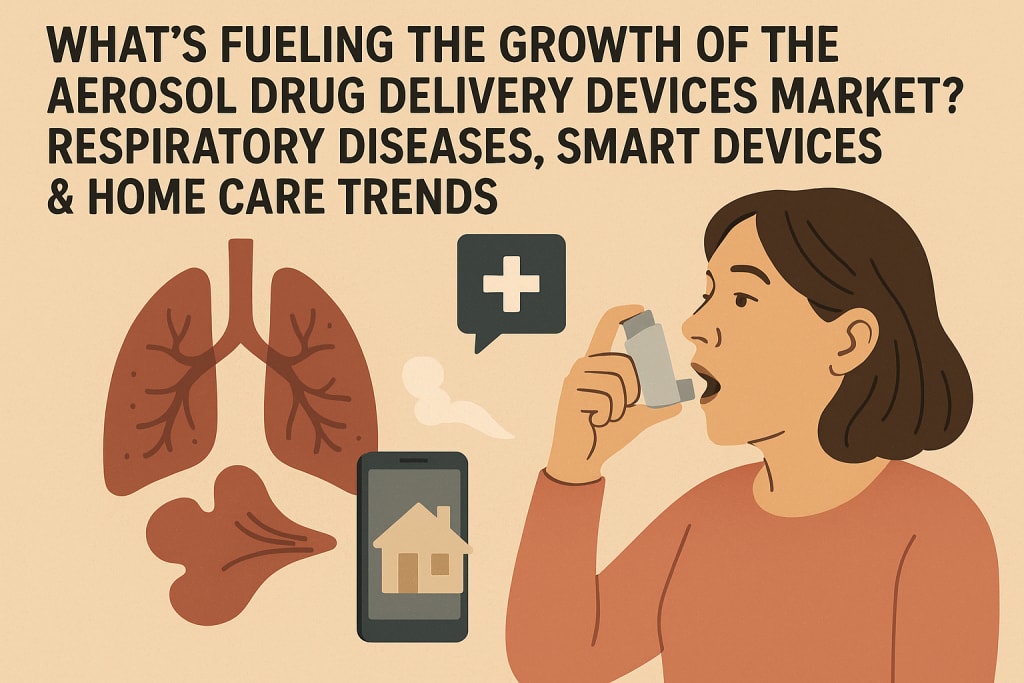
Aerosol Drug Delivery Devices Market: A Look At What’s Fuelling Growth
The Aerosol Drug Delivery Devices Market is expected to witness strong growth in the coming years driven by the increased number of respiratory ailments globally, demand for home healthcare & self-administration, and innovations in smart, user-friendly inhalation products.
Market size is anticipated to reach USD 62.1 billion by 2030 as the scope of inhalation therapies expands beyond asthma & COPD to areas such as infectious diseases, vaccines, pain management, and more.
Key growth factors
1. Escalating Burden of Respiratory Ailments Globally
The incidence of respiratory diseases is on the rise, with chronic ailments such as COPD, asthma, pulmonary fibrosis, and emphysema showing no sign of abating. There are currently over 262 million asthma cases worldwide per WHO and chronic obstructive pulmonary disease (COPD) is the third-leading cause of death globally.
The high incidence and prevalence of these diseases is resulting in consistent demand for inhalers, nebulizers, and metered-dose aerosol systems, particularly in aging populations and high-pollution areas (APAC, Latin America).
Emergence of lung complications as a sequela of COVID-19 and long-COVID respiratory syndromes is further bolstering the adoption of aerosol-based treatments for both acute and chronic care.
2. Smart Inhalation Devices Gain Ground
The next-gen aerosol delivery devices are becoming as much about data, connectivity, and actionable insights as they are about non-invasive, localized delivery. Smart inhalers and connected nebulizers are increasingly being used to not just administer drugs but also track adherence, monitor and optimize dosing accuracy, and more.
Key tech-enabled trends driving innovation in this space are:
* Bluetooth-integrated dose tracking & reminders
* Sensors to track inhalation technique and patterns
* Mobile apps for real-time insights, tips, and EHR sync
* AI-powered platforms that provide predictive analytics for disease monitoring
Digital therapeutics linked to aerosol therapies are also being developed by companies like Teva (Digihaler®), Propeller Health, and Adherium, with proven impact on reducing hospitalizations, improving long-term management and outcomes, etc.
3. Growing Adoption of Home Healthcare & Self-Administration
The need for & desire to manage one’s own chronic conditions from home is increasing year by year, and aerosol drug delivery has positioned itself well to meet this demand. Nebulizers and dry powder inhalers (DPIs) are being designed to be portable, fast to setup and use, and lightweight, enabling patients to:
* Self-administer the therapy without clinical supervision
* Use at home instead of relying on hospital-based services for routine respiratory care
* Achieve better quality of life by following a flexible treatment regimen
The uptake of home-based care has been particularly high in geriatric care, pediatric care, and in regions where hospitals are inaccessible or unaffordable.
4. Expanding Therapeutic Indications: Beyond Asthma & COPD
Aerosol drug delivery is also finding increasing adoption beyond just the lungs, with R&D programs looking at its use for:
* Pulmonary delivery of insulin and other drugs for diabetes
* Aerosolized antibiotics, antivirals, and mucolytics for cystic fibrosis and viral respiratory infections (flu, COVID-19)
* Inhaled vaccines for infectious diseases such as COVID-19, tuberculosis
* Systemic drug delivery via the lungs for pain management, neurological disorders, etc.
The lungs are being tapped as a non-invasive route for both rapid-onset systemic delivery as well as administering drugs traditionally given by injections or oral formulations.
5. Companies & Market Competition
Key market players and companies include:
* Philips Respironics – home nebulizers and portable aerosol therapy devices
* GlaxoSmithKline (GSK) – leader in blockbuster inhalation drugs (Advair, Trelegy, etc.)
* AstraZeneca – inhaled biologics and digital DPIs
* Teva, Boehringer Ingelheim, 3M Drug Delivery Systems – smart inhaler leaders
Startups and med-tech innovators are also contributing significantly to the space, with offerings ranging from compact, lightweight, app-connected inhalers to AI-enhanced DPI platforms for patient-specific pulmonary care.
Challenges and Roadblocks
Despite the positive outlook, the market is not without its challenges, which include:
* Regulatory hurdles around digital therapeutics and drug-device combos
* Reimbursement issues around smart inhalers, connected nebulizers, etc.
* Accessibility barriers in LMICs due to high price tags and lack of supporting healthcare infrastructure
Overcoming these barriers will be crucial for the space to realize its full potential and deliver on its promise of providing greater access to next-generation aerosol therapies.
In Conclusion: Driving Innovation in Drug Delivery
The aerosol drug delivery devices market is at an inflection point, where clinical innovations, digital healthcare, and patient needs & preferences are converging. The demand for non-invasive, effective, & efficient drug delivery is seeing aerosol devices take a central position in chronic disease care, acute care interventions, and even vaccine distribution.
From smart inhalers to home-use nebulizers, aerosol drug delivery of the future is set to be connected, compact, and highly personalized to help patients breathe easy in more ways than one.
Get Sample PDF Copy at https://www.theresearchinsights.com/request_sample?id=234
About the Creator
Paxton Templeton
I’m a storyteller at heart with a passion for turning data into compelling narratives. With a focus on industry trends, market insights, and growth statistics, I bring clarity to complexity
Keep reading
More stories from Paxton Templeton and writers in Journal and other communities.
Wellness Meets AI: Digital Health Coaching Market Poised for Strong Growth Through 2030
The Digital Health Coaching Market is poised for significant growth, driven by the integration of AI technologies, wearable compatibility, and increasing consumer demand for personalized, preventative health solutions. The market is expected to reach a value of over USD 22.06 billion by 2030, with a CAGR of 12.51%, as employers, payers, providers, and digital health platforms rapidly develop smarter, more adaptive, and scalable digital health coaching products. Key innovations include AI-driven insights, NLP for conversational interfaces, predictive health analytics, and multimodal coaching platforms combining chat, video, voice, and in-app prompts to drive adoption and engagement.
By Paxton Templeton7 months ago in Journal
The goals I did not achieve
Every writing goal I made for the year is a wash. It has been this way for a while, but I think it's important to be open about my failures and the reality of how life can get in the way. This is especially true considering the several times I have posted on Vocal about my writing goals, how I was changing my approach, and where I was hoping to be for the upcoming year. I will probably do that again in a couple months, but for now, it is time to acknowledge where I am today.
By Kay Husnick25 days ago in Journal
The Lost Soviet Mission to the Moon. How a Single Typo Caused a Catastrophe.
The Cold War pushed space programs to the edge. You saw rockets rise as symbols of power. You also saw secrets fall into silence. One mission aimed at the Moon never returned. Its failure stayed buried for years. Declassified records now tell a harsh story. A small typing error set off a chain reaction. The result ended a lunar dream.
By Wilson Igbasi6 days ago in Journal
The Devil's Cut
“Comrade, finally you’re awake.” The voice was smooth, sensual. A flickering incandescent bar was all that lit the white, sterile room. All Vladimir remembered was everything going black. He tried to move his arms and found them strapped to the gurney.
By Matthew J. Fromm6 days ago in Fiction


Comments
There are no comments for this story
Be the first to respond and start the conversation.