
What Is a Cover Letter for a Resume? A Complete Guide for Job Seekers
Learn what a cover letter is, why it matters, how to write one that gets noticed, and whether hiring a professional is worth the investment.


When you're job hunting, your resume is your greatest marketing asset. But even the best resumes can fall flat if not paired with a compelling cover letter. So, what is a cover letter for a resume? Simply put, it's your opportunity to make a personal pitch to a potential employer — one that introduces your skills, highlights your value, and aligns you with the job you’re applying for.
In this guide, we’ll break down the purpose of a cover letter, how to write one, what to include, how it differs from your resume, and answer common questions like whether you can use one cover letter for multiple applications. You'll also learn expert writing tips and what to expect if you choose to hire a professional.
What Is a Cover Letter?
A cover letter is a formal document sent alongside your resume during a job application. Its primary goal is to introduce yourself, express interest in the position, and explain why you’re a strong match for the role. Think of it as your written elevator pitch — short, targeted, and persuasive.
Unlike a resume, which lists your work history and skills in bullet points, a cover letter allows you to tell a story. It gives hiring managers insight into your communication skills, personality, and motivation.
Why Cover Letters Matter in Today’s Job Market
Many job seekers ask: “Do you need a cover letter if your resume is already strong?” The short answer is yes — and here's why.
Unlike your resume, which summarizes your experience, a cover letter speaks directly to the hiring manager. It communicates why you're interested in the position, how your background aligns with the company's needs, and what you bring to the table beyond just titles and dates.
Here are a few other reasons cover letters for job applications still matter:
They show you’ve done your research about the role and the company.
They give you a chance to address gaps or transitions in your career.
A personalized cover letter gives you a head start over candidates using generic applications.
Can I Use One Cover Letter for Each Application?
This is one of the most frequently asked questions from job seekers.
Technically, yes — but strategically, no.
While you can reuse a basic structure or template, each cover letter should be customized for the specific role and company.
Employers can instantly spot generic content, and it often works against you. To stand out in competitive hiring pools, you must:
Address the company by name
Mention specific job titles
Reference relevant responsibilities or keywords from the job description
A customized cover letter for each application shows genuine interest and effort — which is often enough to land you in the “interview” pile.
What Should a Cover Letter Include?
Let’s clarify what to include in a cover letter. Whether you're a new graduate, a career switcher, or a seasoned professional, every effective cover letter should contain the following:
1. Header and Greeting
Include your name, contact information, the date, and the hiring manager’s details. Address the letter directly if possible (“Dear [Hiring Manager’s Name]”).
2. Opening Paragraph
State the role you’re applying for and grab attention with a strong opening line. Mention a mutual connection or a compelling reason you’re interested in the company.
3. Middle Paragraph(s)
This is the heart of your letter. Use 1–2 short paragraphs to describe:
Relevant skills and accomplishments
Specific examples (projects, KPIs, or campaigns)
How you align with the company’s goals
4. Closing Paragraph
Express enthusiasm about the opportunity, thank the reader, and include a clear call to action (e.g., “I look forward to the opportunity to speak further”).
Cover Letter vs Resume: What's the Difference?
Understanding the difference between a cover letter and resume helps ensure each tool does its job.
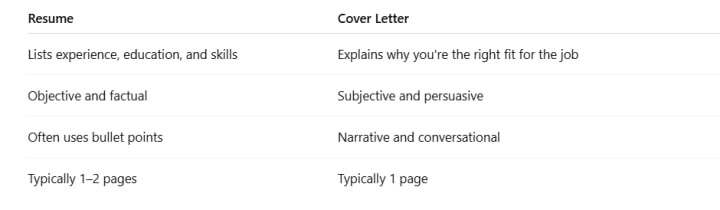
Cover letters are not a repeat of your resume. Instead, they should complement your resume by connecting your qualifications directly to the job’s requirements.
What Is the Purpose of a Cover Letter?
One of the most common questions is: what is the purpose of a cover letter?
The goal is to tell your career story in a way that answers the employer’s most pressing question:
“Why should we consider you for this job?”
When done well, a customized cover letter:
Connects your background to the company’s mission
Explains career changes or resume gaps
Highlights achievements that match the job description
Shows personality, professionalism, and passion
In short, the importance of a cover letter lies in how it humanizes your application and gives context to your accomplishments.
What Does a Cover Letter Look Like?
A professional cover letter format follows a clean, easy-to-read structure:
less
Copy
Edit
Your Name
Your Address
Email | Phone | LinkedIn
Date
Hiring Manager’s Name
Company Name
Company Address
Dear [Hiring Manager Name],
[Opening Paragraph]
[Middle Paragraph(s)]
[Closing Paragraph]
Sincerely,
[Your Name]
Avoid complicated designs, fancy fonts, or excessive colors. The focus should be on clarity, content, and customization.
FAQ Section
1. What is a cover letter and why is it important for a resume?
A cover letter is a brief, customized document that accompanies your resume. It introduces you to employers, explains your interest in the job, and highlights your most relevant skills. It’s important because it adds context and shows you’ve tailored your application to the role.
2. What should I include in a cover letter for a job application?
Include a greeting, a brief introduction stating the role, your top qualifications, specific achievements related to the job, and a strong closing. Don’t forget to personalize it for the company and position.
3. How does a cover letter differ from a resume?
A cover letter is narrative and personalized, while a resume is structured and fact-based. The letter explains why you're a fit; the resume shows how you're a fit.
4. Do all job applications require a cover letter?
Not all, but most professional roles do. Even if not required, submitting a well-written cover letter gives you a competitive edge — especially in crowded job markets.
5. Can a cover letter improve my chances of getting hired?
Yes — a tailored cover letter shows initiative, effort, and genuine interest. It helps your resume stand out by giving it context and voice.
Cover Letter Writing Tips: Do’s and Don’ts
Here are some expert-backed tips to make your cover letter more effective:
Do:
Customize it for each job
Use keywords from the job posting
Show measurable results and achievements
Keep it concise and relevant
End with a clear call to action
❌ Don’t:
Use the same letter for every job
Repeat your resume word-for-word
Focus only on your needs
Overshare or get too personal
Forget to proofread
A job-winning cover letter speaks directly to the employer's needs while presenting you as the solution.
Price of Professional Cover Letter Writing Services
Wondering how much it costs to have a cover letter professionally written?
Here’s a general breakdown:
Service Tier Price Range Inclusions
Entry-Level Services $25 – $50 Basic formatting, one draft
Mid-Tier Services $50 – $100 ATS optimization, 1–2 revisions
Premium/Executive-Level $100 – $120+ Tailored strategy, industry-specific customization, recruiter insights
Industry-specific targeting
Keyword-optimized formatting
Customized storytelling
One-on-one revisions
Pro Tip: Always choose a provider that asks for your resume and your target job to tailor content effectively.
Examples of Professional Cover Letters That Work
Example 1: Entry-Level Marketing Associate
"As a recent graduate with internship experience in social media strategy, I’m excited to apply for the Marketing Associate position at XYZ Corp. I’ve managed campaigns that grew engagement by 30% and aligned content calendars across platforms..."
Example 2: Career Change to Project Management
"After five years in logistics, I’m transitioning into project management. My track record in coordinating cross-functional teams and improving delivery times by 20% reflects the skills needed to thrive in this role..."
Final Thoughts: Is a Cover Letter Still Worth It?
The short answer? Absolutely.
The long answer? Only if it’s customized, well-written, and relevant.
To recap:
✅What is a cover letter for a resume? A personalized pitch.
✅ What is the purpose of a cover letter? To connect your story to the job.
✅ Can I use one cover letter for each application? You can — but it’s better to tailor each one.
✅ What should a cover letter include? Real value, specific proof, and personality.
✅ Can it help you land the job? More than you think — when done right.
✅ Is it worth paying a pro? If you want better results — absolutely.
About the Creator
Ramsha Riaz
Ramsha Riaz is a tech and career content writer specializing in AI, job trends, resume writing, and LinkedIn optimization. He shares actionable advice and insights to help professionals stay updated.
Keep reading
More stories from Ramsha Riaz and writers in Journal and other communities.
How to Use ChatGPT (Open AI) for Resume Writing
Creating a standout resume is more challenging than ever. Hiring managers use applicant tracking systems (ATS), competition is fierce, and expectations are high. That’s where AI tools come in—and ChatGPT is leading the way.
By Ramsha Riaz9 months ago in Journal
Author’s Advice
If you would’ve asked me 20 years ago did I know I’d become a writer and an author, I would’ve said “nope, ain’t happening”. As fate would have it I did become an author and I can honestly say I’m loving it so far. It really does feel good to be a writer. I’ve learned a lot on this journey and I feel like with even me being as new to this world as I am, there’s some wisdom I need to share with every other aspiring author.
By Joe Patterson4 days ago in Journal



Comments
There are no comments for this story
Be the first to respond and start the conversation.