


What exactly is a chart of accounts?
The chart of accounts is a tool that lists all of the financial accounts that appear in a company's financial statements. It allows a corporation to categorise all of its financial transactions throughout the course of a certain accounting period.
Companies frequently utilise the chart of accounts to manage their records by providing a comprehensive list of all the accounts in the company's general ledger. The graphic makes it simple to prepare data for evaluating the company's financial performance at any given period.
Accounting Chart of Accounts
The chart of accounts includes the name of each account listed, a brief description, and account-specific identifying codes. The accounts on the balance sheet appear first, followed by the accounts on the income statement.
Assets, liabilities, and shareholders equity make up the balance sheet accounts, which are further subdivided into several subcategories. Revenues and expenses are the accounts in the income statement, and these accounts are further broken down into sub-categories.
Organizing the Chart of Accounts
The accounts that are listed in a chart of accounts are often determined by the nature of the firm. In addition to the normal accounts that all businesses have, a taxi business will have some accounts that are specific to the taxi business. For example, because the taxi business is a service business that does not hold stock, it will include a fuel expense account that is not common to all businesses, but it will leave out an inventory account.
When displaying accounts in the chart of accounts, you should usually utilise a numbered system to make it easier to identify them. It's also easier to keep track of transactions when they're numbered. Small firms typically utilise three-digit numbers, whereas major businesses typically use four-digit numbers to allow for future expansion.
Each of the five primary categories is assigned a group of numbers, with blank numbers left at the end to allow for future additions of accounts. Also, the numbering should be consistent so that management can easily roll up corporate data from one period to the next.
The Chart of Accounts is divided into categories.
The balance sheet and income statement are the two primary financial statements, and each of the accounts on the chart of accounts relates to them.
Accounts on the balance sheet
When preparing a business's balance sheet, such accounts are required. The following are the accounts on the balance sheet:
1. Accounts of assets
The asset account lists all of the different types of assets that the company possesses. Intangible assets (such as trademarks, patents, and software) and current assets (such as cash on hand, accounts receivable, and inventory) may be included in the account.
Each asset account can be assigned a numerical value, such as 1000, 1020, 1040, 1060, and so on. The numbering follows the usual balance sheet structure, with current assets coming first, followed by fixed assets.
2. Accounts of Liability
Liability accounts give a list of categories for all of the debts owed to creditors by the company. Accounts payable, invoices payable, salaries payable, interest payable, and so on are examples of liability accounts that include the word "payable" in their name.
Liability accounts are organised in the same way as balance sheet accounts, with current obligations first, followed by long-term liabilities. Each liability account's numbering system can begin in the year 2000 and follow an easy-to-follow and compare sequence throughout accounting periods.
3. Accounts of owner's equity
After all of the liabilities have been deducted from the assets, the value left in the business is referred to as equity. The value of a company to its shareholders is measured by its owner's equity.
Common stock, preferred stock, and retained earnings are some of the components of the owner's equity accounts. For a large corporation, the numbering system for the owner's equity account can continue from the liability accounts and range from 3000 to 3999.
About the Creator
Amelia
Are you ready to skyrocket your online presence? Look no further! SEO Thrive, your go-to Digital Marketing Expert, here to take your brand to newheights
My Skills
SEO Optimization
Social Media Management
PPC Advertising
Analytics & Reporting
The goals I did not achieve
Every writing goal I made for the year is a wash. It has been this way for a while, but I think it's important to be open about my failures and the reality of how life can get in the way. This is especially true considering the several times I have posted on Vocal about my writing goals, how I was changing my approach, and where I was hoping to be for the upcoming year. I will probably do that again in a couple months, but for now, it is time to acknowledge where I am today.
By Kay Husnick23 days ago in Journal
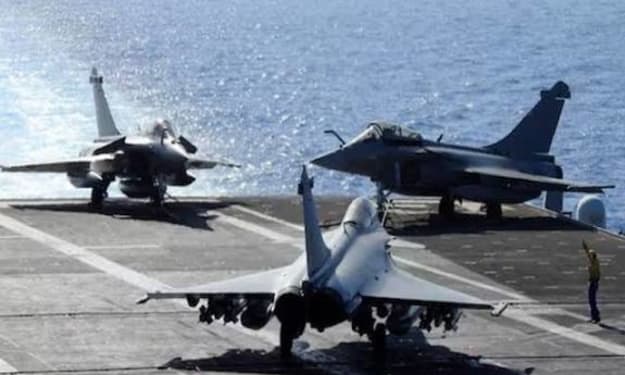
Indian weapons must on all 114 Rafale jets, govt tells Dassault
India’s defense modernization plans received a strategic boost as the government officially directed Dassault Aviation, the French manufacturer of Rafale fighter jets, to equip all 114 aircraft with Indian-made weapons. This move underlines India’s commitment to self-reliance in defense technology while strengthening the combat readiness of its air force. The Rafale jets, considered among the most advanced multi-role fighters globally, are now set to carry the nation’s indigenous missile systems, bombs, and electronic warfare packages, blending cutting-edge French airframe technology with homegrown armaments. The Rafale Program and Indigenous Weapons India’s Rafale acquisition, initially contracted in 2016, brought 36 jets into the Air Force inventory, with an additional 114 aircraft to be delivered in subsequent batches. While Dassault’s jets are equipped with state-of-the-art French systems, the Indian government has long emphasized the integration of locally produced weapons. These include BrahMos supersonic cruise missiles, Astra beyond-visual-range air-to-air missiles, and indigenous precision-guided bombs. By mandating the use of Indian weapons across all 114 Rafales, the government aims to reduce dependency on foreign arms supplies and ensure that India’s air force maintains operational flexibility in critical combat scenarios. A senior defense official stated, “Our aim is to ensure that the Rafale platform not only brings in technological superiority but also becomes a force multiplier for our indigenous weapons programs.” Strategic Implications The integration of Indian weapons on Rafale jets carries both operational and strategic significance. From an operational perspective, using indigenous weapons allows for standardized maintenance and training protocols across the fleet. It simplifies logistics, reduces costs, and ensures that India is not constrained by export restrictions or supply chain uncertainties from foreign manufacturers. Strategically, the decision sends a strong signal to both allies and adversaries. India demonstrates its growing capability in defense production and its intention to assert technological independence in critical military domains. Given the geopolitical tensions in the Indo-Pacific, particularly with China and Pakistan, equipping the Rafales with locally produced weapons enhances India’s deterrence posture. Challenges in Integration Integrating indigenous weapons with Rafale aircraft, however, is not without technical challenges. Aircraft and weapons systems must be seamlessly compatible, including software integration, aerodynamics, and avionics. The Air Force’s testing and evaluation teams, along with Dassault engineers, will have to ensure that Indian missiles, bombs, and sensors work flawlessly with French-designed flight systems. Past collaborations, such as integrating the BrahMos missile on Su-30MKI aircraft, offer a blueprint for success, but the Rafale’s advanced avionics and fly-by-wire systems necessitate meticulous engineering and rigorous testing. Officials assure that phased testing and gradual integration will ensure minimal disruption to the aircraft’s delivery schedules. Boosting India’s Defense Industry This directive aligns closely with India’s “Make in India” initiative, which aims to build a robust domestic defense manufacturing ecosystem. By mandating the use of Indian weapons, the government hopes to create opportunities for local defense firms, enhance research and development capabilities, and encourage private sector participation in high-tech defense projects. According to industry experts, this approach will provide a significant boost to companies involved in missile development, precision-guided munitions, and electronic warfare systems. It also signals potential for future export opportunities, as Rafale jets equipped with Indian weapons could be offered to other countries, increasing India’s global defense footprint. Diplomatic and Industrial Balance While this move strengthens India’s self-reliance, it also requires careful diplomatic balancing. Dassault Aviation, which must now adapt its jets to accommodate Indian weapons, plays a critical role in maintaining delivery timelines and contractual obligations. Successful collaboration will require constant communication and technical coordination between French and Indian engineers. In the long term, this partnership could evolve into a model for international collaboration, where global platforms are paired with indigenous systems to create hybrid solutions tailored to specific national needs. Looking Ahead India’s decision to equip all Rafale jets with local weapons is a bold step toward achieving strategic autonomy in defense. It demonstrates the country’s commitment to blending cutting-edge technology with self-reliance, ensuring that the Air Force is equipped with a versatile, powerful, and locally sustainable arsenal. As the delivery of Rafale jets continues, the coming years will likely see a seamless integration of India’s missiles, bombs, and electronic warfare systems into the fleet, creating a formidable air power platform that combines the best of French aeronautical engineering with India’s indigenous defense innovation. This initiative not only strengthens India’s air defense capabilities but also reinforces its position as a rising power in global defense technology. It’s a reminder that modern warfare increasingly depends on the ability to combine advanced platforms with locally developed systems—a strategy India is now executing with clarity and purpose.
By Fiaz Ahmed Brohi2 days ago in Journal
So You Decided To Become a Nurse Practitioner:
So you decided to become an "Advanced Practice" nurse. Congratulations!... is what I would say if this was a good idea. Grad school? In this economy? What were you thinking? Likely it was something along the lines of either 1) “I've seen these other chucklefucks do it— Why can't I?” or even 2) “I've got a nice career, I should shake it up. I miss feeling like I have no clue what I'm doing.”
By Sandor Szaboa day ago in Fiction



Comments
There are no comments for this story
Be the first to respond and start the conversation.