
What does the word, “Allah” mean in Islam?
Allah is the name of the God

What does the word, “Allah” mean in Islam?
Allah is the name of the God Almighty in the Arabic Language. Allah is the personal name of God. The word Allah is never used for any other being or thing. The names for God found in other languages are all attributive or descriptive and are often used in the plural, but the word ‘Allah’ is never used in the plural. This is because Islam advocates the belief in the absolute unity of God. In the absence of a parallel word in the English language, the original name ‘Allah’ has been retained throughout the translation. Allah is recognized through his attributes and there are over 99 such attributes mentioned in The Holy Quran, the book of Muslims. For example, Allah is Most Gracious, Most Merciful, Lord of All the Worlds, Master of the Day of Judgment, The Provider, and The Sustainer. These attributes are invoked in prayers and also every Muslim is encouraged to adopt attributes of Allah in the journey of life.
Islam is based on Tawhid (monotheism). Tawhid, the oneness of Allah, is an essential belief for all Muslims. Islam teaches that Allah, the one god, has 99 attributes. Although we can understand some of His attributes, His essence cannot be comprehended by a human's limited mental capacity. Allah has created mankind primarily so that they may know their creator through his creations.
Realization of the supremacy of Allah, although necessary for success in the hereafter, has not been enforced on man - it is a test that is based on the fact that man has been given free will. However, man's free will is limited, although he has the freedom to choose between rights and wrong, he cannot change parts of his destiny that Allah has pre-determined. Understanding the nature of Allah is essential as it has a substantial effect on a Muslim's duties to Allah.
The oneness of Allah is the one most important theological principal in Islam. The first of the five pillars, the declaration of faith, which is the first act that one does to embark on Islam, reiterates the necessity of the belief in the oneness of Allah. It begins with the negation of any god other than Allah:
"I bear witness that there is no god but Allah and that Muhammad is His messenger."
Beginning with negation rather than affirmation, in this case, serves to emphasize strongly the importance of the oneness of Allah.
The Quran, the words of Allah mediated to Prophet Muhammad by the angel Jibril (Gabriel), is full of references to the essential belief in one god:
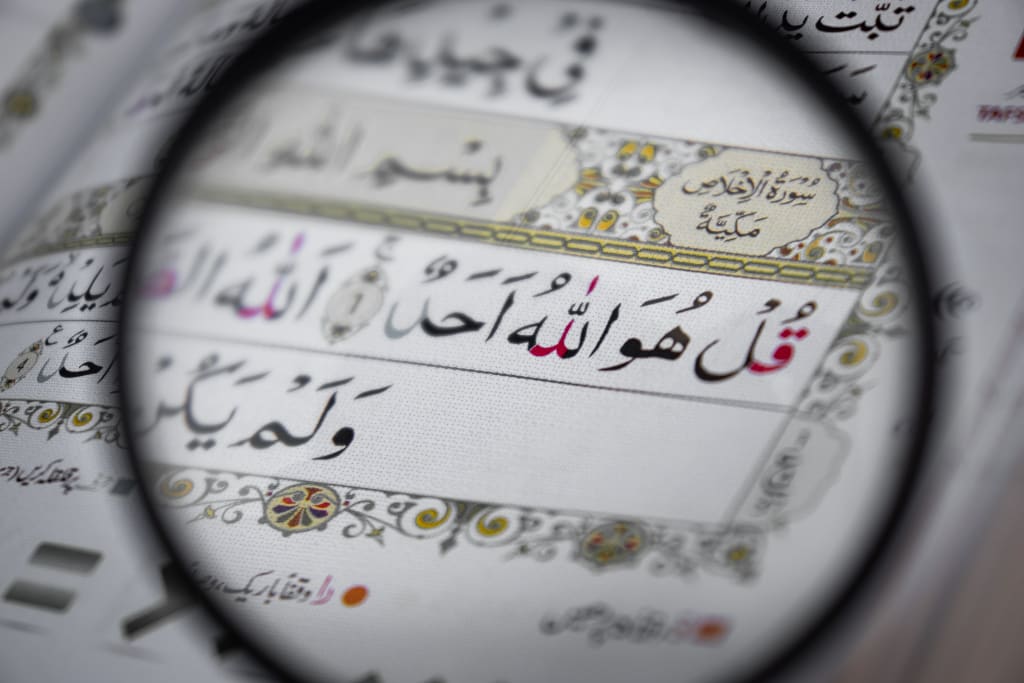
Say 'He is Allah the One' 112:1
Surely Allah alone is the creator of all things and he is the One, the Most Supreme 13:17
Say 'I am only a Warner, and there is no god but Allah, the One, the Most Supreme. 23:66
Holy is He! He is Allah the One, the Most Supreme 39:5
As well as proving the oneness of god through the Quran, logic too can help prove this as I shall explain. If you ask a believer in god, whether he believes in one god or ten, you will probably find that somewhere in his definition of the term 'God' he rules out the possibility of god being weak, inferior or compromising.
From this, we may say that something that is weak, inferior or compromising cannot be a God. Yet the very fact that there is more than one god suggests two contradictory possibilities; That the Gods are of equal power and therefore are compromising, or that their power is uneven resulting in some Gods being inferior to others. From this ontological argument one can conclude that there can only be one true god.
Going against the oneness of Allah, Shirk, is a very major sin:
"Surely Allah will not forgive that any partner be associated with him" 4:49
Regarding the attributes of Allah, Islam teaches that Allah although He has many attributes, cannot be fully understood by man. Man is restricted in thought into that which is manifest, Allah however is unique and above human manifestation.
Allah, the god of all humanity, is perceived differently in other religions. Since man would be limiting Allah by creating a physical image of Him Muslims do not. Allah is as I said unique and superior to His creations. Thus the biblical statement that was mentioned in Genesis Chapter 1 Verse 27 that God has created man in his own image is a view that is not shared by Muslims.
Other religions believe that God resembles creation- they believe in describing causes by their effects. An example of this is that we can describe a corpse to be horrifying (the effect) but we may also say that the person responsible for this death, the murderer, (the cause) is also horrifying - cause resembles effect. This theory can easily be put aside, for although it may be true for a limited number of examples, the vast majority can prove it wrong, i.e. a shoe does not resemble a shoe maker, etc.
Thus Islam does not try in any way to personify Allah. Whilst it may be true that two of His attributes are that He 'Sees' and 'Hears', this does not mean that He has eyes and ears like you and I, His hearing or seeing cannot be comprehended by us as finite beings.
Allah, the Almighty, is ideal. He is the 'Just' and the Judge, as well as the 'Avenger of Evil.' It follows that to test mankind one must judge fairly and punish those who do evil. An example of Allah's justness is that we are only accountable for our own actions, unlike the Christian concept of the original sin; for the Quran says that no bearer can bear a burden of another.
Muslims do not agree with the Judaeo (Jewish) Christian concept of God having the necessity to rest as they say he did after creating the world. All god needs to say is 'Be and it is.' Tiredness is a human attribute as is making mistakes; this is not applicable to god who is infallible. Allah is also pre-existent to all he has created, he is the first, and as Aristotle put it in his cosmological theory 'the prime mover.'
Allah, the Creator has perfect knowledge. Muslims believe in the omniscience of Allah, He knows all that is tangible and that is manifest, He knows the past and the future. Muslims rebuke the Christian belief that god does not have perfect knowledge, for example in the bible it says that God underestimated the intelligence of His creations- He did not think that man could build the tower of Babel (Genesis Ch11 v 5-7, Exodus Ch32 v 14). Muslims argue that having created everything, He knows all that there is to know.
To be a Muslim it is essential to believe in the destiny, whether good or bad, that Allah has set for us (known as Qadr in Arabic). The Quran says:
"Say, nothing shall befall us save that which Allah has ordained for us" 9:51
This however does not mean that man does not have free will, for if he did not Allah's justice would be compromised for you cannot judge a person if he does not have the freedom of choosing what he does. Allah, the 'Just', has given man both destiny and free will, the action of a human is interrelated with destiny and both are mutually necessary, as Imam Ali son of Abi Talib (AS) said:
"The predestined will of Allah and the action of a human are like the spirit and the body, the spirit without the body has no physicality and the body without the soul is a picture without movement. If the two are adjoined they become like Al-Qadr and action, for if there was no Qadr then you would not know the difference between creation and creator, and if there was action without it being willed and predestined by Allah than it would not happen."
Some things such as our deaths and disease are above human will, no matter what a person does, if for instance God has set the hour at which you are to die than it will be so:
"And no soul can die except by Allah's leave- a decree with a fixed term" 3:146
"They say 'If we had any part in the government of affairs, we should not have been killed here.' Say 'If you had remained in your homes, surely those on whom fighting had been enjoyed would have gone forth to their deathbeds." 3:155
Earnings are also an example of things that are pre-destined by Allah, a poor man could work all his life but never become rich whilst others are rich without effort. This generalized example serves to bring us on to a specific comment; Even though things such as our income are predestined by Allah we must strive to improve our conditions, for although they are willed by Allah, if we will it Allah may change his will:
"Surely Allah changes not the condition of a people until they change themselves" 13:11
Yet we came back to the age old question: Why did God create man? One always wonders about this question, if God is perfect what use would man be to him? None. Allah did not create man for his own benefit; he created man for the benefit of man: The hadith Qudsi says:
"O son of Adam, I did not create you for my own benefit, but that you benefit from me as your God, alone, for I am your saviour"
But how can we benefit from Allah? We can benefit from Allah by worshipping him, for if we worship Allah we will be rewarded. This is a reason in its self:
"And I have not created the Jinn and man but that they worship me" 51:57
Now the next thing that one can ask is 'How can we worship Him?' To worship Allah we have to accept that there is a God, this implies that God created man so that they may know Him, but is this the primary reason? The grandson of the Prophet, Imam Hussein bin Ali (AS), implies that it is when he said:
"O people, Allah did not create mankind but that they know Him, for if they know Him they will worship Him, and if they worship Him they will benefit from his grace"
However, one may look at the purpose of creation from a different aspect and thus end up with an altogether different answer as to what the primary reason is. If you go back to the question of how we can benefit from Allah, we may come up with a different reason, other than worship. All of creation is already at benefit.
Our existence is benefit. Being created is an example of Allah's mercy towards us. Thus one can conclude that we were created, fundamentally because Allah is merciful. However, although there are many different perspectives to the answer as to why we were created, they are all connected and in a way each of them is right.
In defining what is meant by a Muslim's duties, we may generalize that a Muslim's duty is to worship Allah. To elaborate further, Muslims do not see the term worship in the vague sense of praying and fasting, etc - worship can be any aspect of a Muslim's daily life depending on the intention. For example even a when a Muslim goes to get an education, provided that he intends to use it for good, it is seen as worship and will be rewarded.
Each of Allah's divine attributes has practical implications in the life of a firm Muslim. Clear, comprehension of the uniqueness of Allah's nature improves a person’s Taqwa, or belief in god. Having taqwa in our hearts throughout our daily life adds a feeling of contentment peace with one's self and constant happiness, for when they return to Allah He will say:
And thou, O soul at peace. Return to thy Lord well pleased with Him and He will be pleased with thee. 89:28-29
Realization that Allah knows all, hears all and sees all that we do is one of the most important aspects of Allah's nature that a Muslim can benefit from. Knowing that 'there are not two but that the third is Allah (hadith) increases what we might call our 'self-policing'. For example, when one is alone such as when a teenager is away from his strict parents, he may say that there is no one to fear so why bother praying? The answer to this is given in the following hadith:
"Fear Allah as if you can see Him, if you cannot imagine seeing Him, knows that He sees you."
Allah sees everything that we do and so we should be faithful in our duties even when we are alone.
For those who have a very high realization of the nature of Allah, they do not worship him for the fear of His hell, nor for the want of His paradise but because Allah is worthy of all praise. Imam Ali (AS), the cousin of the prophet says:
"O Allah, I did not worship you for the greed of your paradise nor for the fear of hell, but because you are worthy of all praise."
This is the ideal that all Muslims should aim for.
About the Creator
Keep reading
More stories from writers in Journal and other communities.
The goals I did not achieve
Every writing goal I made for the year is a wash. It has been this way for a while, but I think it's important to be open about my failures and the reality of how life can get in the way. This is especially true considering the several times I have posted on Vocal about my writing goals, how I was changing my approach, and where I was hoping to be for the upcoming year. I will probably do that again in a couple months, but for now, it is time to acknowledge where I am today.
By Kay Husnick20 days ago in Journal
Why Catholics Pray to Saints and What That Really Means
One of the most common misunderstandings about Catholicism is the belief that Catholics worship saints. This misconception often leads to confusion and criticism, especially from those unfamiliar with Catholic theology. In reality, prayer to saints has nothing to do with worship. It is rooted in how Catholics understand prayer, community, and the belief that life in Christ does not end at death.
By Sound and Spirita day ago in Journal


Comments
There are no comments for this story
Be the first to respond and start the conversation.