
Way Down East (1920)
A Review of the D.W. Griffith Film Starring Lillian Gish


Way Down East is a hundred-and-three-year-old masterpiece, starring the beautiful, virginal Lillian Gish as a young girl, Anne Moore, living with an elderly mother, who sent to her rich relatives "way down east"; where, like Mabel Normand's Mickey, or Unity as portrayed by Mary Pickford in Stella Maris, she is a "fish out of water." Her lack of graces and social caste is underscored by the narrative; which, oddly was a common plot device of the time. In Mickey, it is used for comic effects. In Stella Maris and Way Down East, the point is to emphasize the tragedy of the central character's situation. It is class-conscious, yet, condescends to the lower classes, as if they were simply fairy tale princesses cleaning out the ashes of the hearth, while their ugly step-sisters while the night away dancing. Once they meet "Mr. Right," a Prince Charming hailing from the "right" sort of stock, the right kind of people, they are allowed to cast off their rags, acquire beauty and social graces, and live "happily ever after" in a bourgeois dream of Victorian romance and staid, tried-and-true, conservative American values. That is not quite Stella Maris, but it seems the summation of Way Down East.
Gish is sent to her relatives, who in no way wish for her "dirty," uncouth presence to darken their doorways, but who relent perhaps out of a sense of familial obligation for what H.P. Lovecraft might have termed, "the decayed line." While she is with them, she meets the blackguard and womanizer Lennox Sanderson (Lowell Sherman), who quickly seduces her, and with whom she is quickly "married." But the marriage is a literal sham, organized by Lennox so he can "have" her; so he can exploit the little prole and then throw her away, as she is someone "beneath his station," and thus, if he actually did marry her, he'd "lose everything."
Pregnant, she goes to a shelter for unwed mothers, run by a calloused and cruel proper Victorian bigot of a woman (Emily Fitzroy), whose Dickensian contempt for her unwed charges shines through in a pseudo-comic performance bordering on caricature. (At any rate, she's a real frigid bitch, if you'll forgive the vulgarity.)
The baby dies, and we are treated to a pathetic scene wherein Anne attempts to "feed" it; a doctor enters eventually and informs her that her baby has died.
Anne is cast out, like a character from Dickens, to become a young woman vagabond, finally finding herself at the home of prosperous local farmer Squire Bartlett (Burr McIntosh). He's as much of a stern, unyielding, fanatical religious bigot as the woman who ran the home, but he accepts Anne Moore into his household as a "domestic" (Anne must remember her place, after all). Bartlett's son (Richard Barthelmess), the bold and dashing romantic lead, by contrast, is shown to be dreamy, of a poetic and thoughtful nature. Despite being already engaged, he begins to fall for Anne; although, as a beggar and domestic, much as in the early parts of Moll Flanders, she is "beneath his station". But the love between the social castes blooms at any rate and develops the integral plot point that is the denouement of the film. (Note: Both Barthelmess and Gish had previously been paired in the excellent Broken Blossoms (1919), though, the film, like much of Griffith's work, is too politically incorrect by modern standards.)
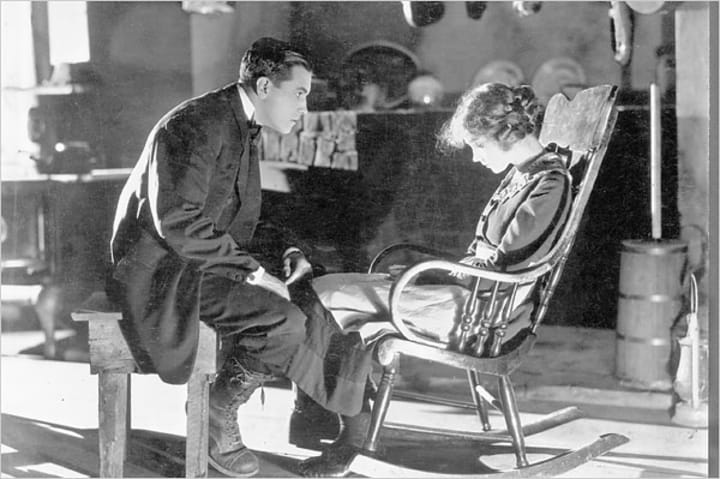
We have characterizations of the poor, of farm hands, that are played for comic effect. The grotesque hired hand (Hi Holler) who wants to "spruce up" before the arrival of Bartlett's niece Kate (Mary Hay), whom he is struck on, is a character played as a lampoon of "decent folk"; he is accorded little in the way of humanity, except to be a cartoon characterization of the working class. A "professor" (Creighton Hale) is also seen as something to be mocked, perhaps a stab at the intelligentsia, who may be perceived as critical of white, Christian, bourgeois values--or, at the very least, questioning them.
But this may be reading too much into it. The woman who ran the home for unwed mothers tragically comes "a-calling" at the Bartlett's, being an eccentric aunt and a nosy, troublemaking busybody. She informs the town gossip (Vivia Ogden) about Anne's past. The gossip is a woman who shows her true colors by dressing in an outmoded Victorian dress and bonnet; She's a pure product, psychologically and spiritually, of the old-world values of the patriarchal society that defines her being. And a prisoner of it, even though it seems to be creeping away.
She informs Squire Bartlett of Anne Moore's sordid past as an unwed mother. Anne, in her defense, accuses Lennox Sanderson (who has made a reappearance at the Bartlett's, and is trying to seduce another girl) of leading her astray, complaining that it was his "sin" just as much as it was hers. No matter. The fanatical and murderous Squire Bartlett, his fist raised like some pulpit-pounding Old Testament prophet, casts Anne out into the middle of a blizzard. She crosses a frozen river but gets stranded on an iceberg, heading over the deadly falls.
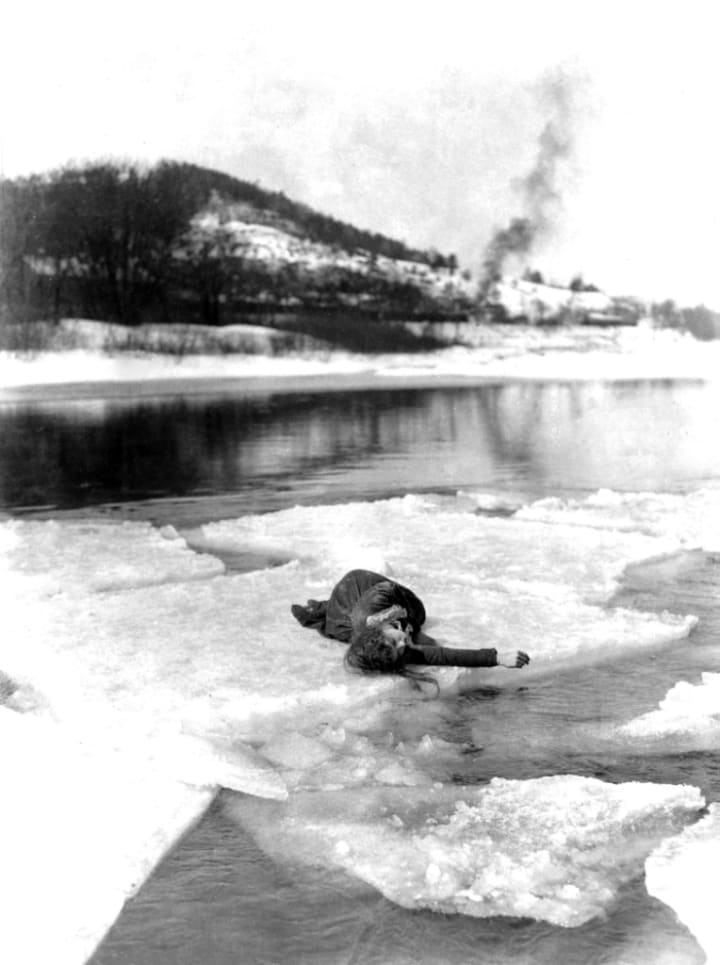
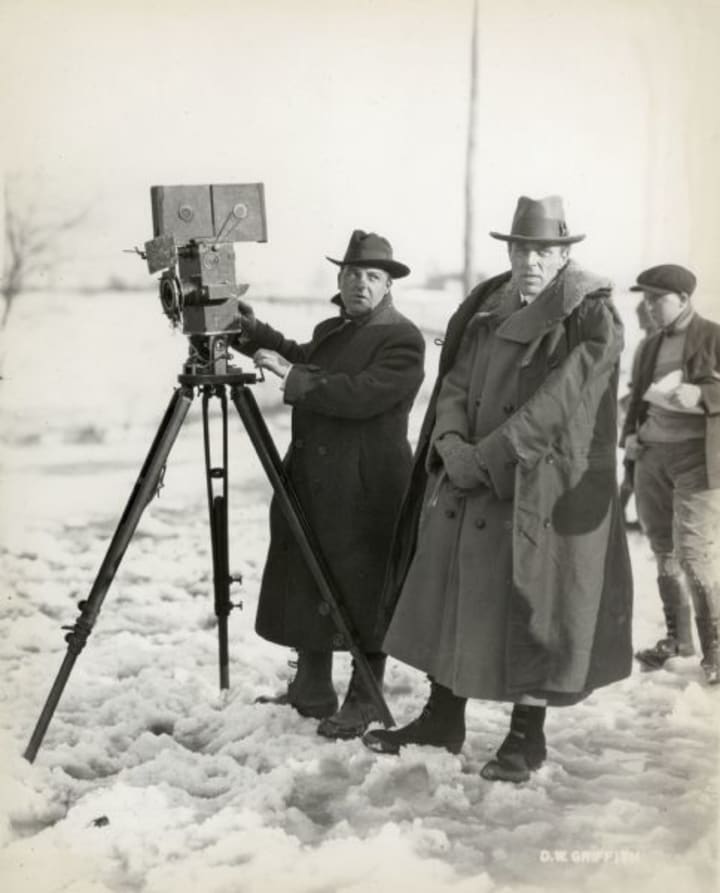
Bartlett's son runs to the rescue, and the rest of the film is eminently predictable. (Frostbite, incidentally, was part and parcel of the cost of the film's realism; Griffith got frostbite during filming on one side of his face. Furthermore, temperatures were so cold a literal fire had to be built beneath the camera, to keep the oil in it from freezing.)
The film has been made and remade four times and is based on the 19th-Century play by Lottie Blair Parker. Its two-and-one-half-hour length goes by quickly, and it is never boring. It's a Dickensian fairy tale that will appeal to many thinking viewers; it's also an invitation to examine the class struggle from the bottom up, and like Moll Flanders, it turns its eye on the hypocrisy of the time. But not loudly or ostentatiously; there seems to be no deliberate attempt at subverting the dominant paradigm here. As a matter of fact the ending, predictably, reaffirms the whole point of the movie: that class can only be transcended by marrying into privilege, and that people have no worth or value beyond what they own, or how they have behaved in accordance with what is socially the norm. The film's solution to the plight of the Anne Moores of the world is simply to be naturally beautiful enough to have Prince Charming fall in love with you, and then, "marry well."
Not a solution at all, really. Not in 1920. And certainly not in 2023.
Way Down East (1920)
About the Creator
Tom Baker
Author of Haunted Indianapolis, Indiana Ghost Folklore, Midwest Maniacs, Midwest UFOs and Beyond, Scary Urban Legends, 50 Famous Fables and Folk Tales, and Notorious Crimes of the Upper Midwest.: http://tombakerbooks.weebly.com
Treading Water
"Lies don't die they grow, and everything you try to hide eventually shows." - MGK "Treading Water." I first began Vocal in 2021, April to be exact. I had just turned 34 that Feburary and I was struggling with sobrity, anxiety and depression. The post is titled "55 days Sober." (its linked if you would like to read it. Its so weird to think that was written almost half a decade ago, so much has changed but so much hasn't. It's almost been two weeks since I turned 39 and I have so many mixed emotions. Thinking back to being 29, about to turn 30 thinking man I'm "old" but also not know the journey that would lay ahead.
By Kimmiekins4about 15 hours ago in Journal


Comments (1)
This was wonderful! I have never seen the film, but now I want to. Unwed mothers being portrayed in that time period as the heroine must have been unique. Thank you for sharing!