
Water molecules swirling around star!!
If you know the sun is younger than water? Water is their in and around the earth 🌍 ! Is their any other planets like our earth ?
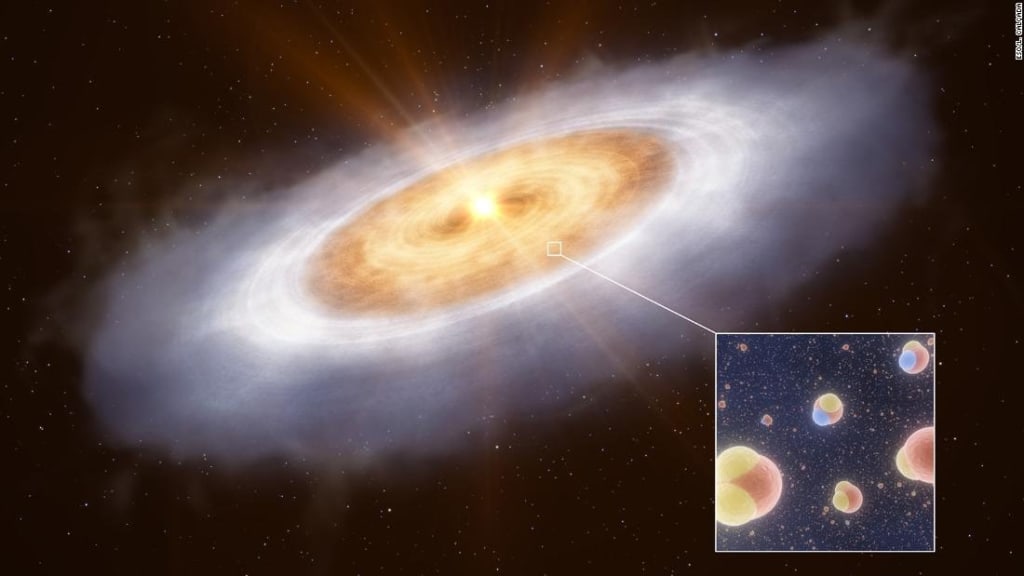
The detection of water molecules swirling around a star is an exciting development for astronomers as it provides insight into the formation and evolution of planetary systems.
Water is an essential ingredient for the formation of habitable planets, and its detection in the vicinity of a star suggests that there may be planets or other objects in the region that contain water as well.
The detection of water molecules is typically done through the use of spectroscopy, which is the study of the interaction between light and matter. Scientists can analyze the light emitted by the star and look for specific patterns or wavelengths that are associated with water molecules.
This discovery also raises the possibility of life existing beyond Earth. While the detection of water molecules does not necessarily indicate the presence of life, it does provide further evidence that the conditions necessary for life may exist elsewhere in the universe.
Overall, this discovery is a significant step forward in our understanding of the universe and the potential for life beyond our planet.
Which star ?
In recent years, several studies have reported the detection of water molecules in the atmosphere or circumstellar disks of stars such as TW Hydrae, V883 Orionis, and W Aquilae, among others.
It's worth noting that the detection of water molecules around a star does not necessarily mean that the star itself is the source of the water. Water can also be delivered to planetary systems through comets or asteroids, which may have formed in more distant regions and then migrated inward towards the star.
Regardless of the specific star, the detection of water molecules is an exciting development that provides valuable information about the formation and evolution of planetary systems.
Scientists observed a young star, called V883 Orionis, located 1,300 light-years away using the Atacama Large Millimeter/submillimeter Array of telescopes, or ALMA, in northern Chile.
The star Is surrounded by a planet-forming disk of cloud of gas and dust leftover from when the star was born. Eventually, material in the disk comes together to form comets, asteroids and planets over millions of years.
A team of researchers used ALMA to measure chemical signals in the planet-forming disk, and they detected gaseous water, or water vapor. Their detection allowed the astronomers to trace the water’s journey from the gas clouds that formed the star and will eventually give rise to planets.
What is ALMA?
ALMA (Atacama Large Millimeter/submillimeter Array) is a radio telescope array located in the Atacama desert of northern Chile. It consists of 66 individual radio antennas, each with a diameter of 12 meters, that work together as a single giant telescope to observe light in the millimeter and submillimeter wavelengths. ALMA is operated by an international partnership between Europe, North America, and East Asia in cooperation with the Republic of Chile. It is one of the most powerful astronomical instruments in the world, allowing astronomers to study the early universe, the formation of stars and planets, and the chemistry of interstellar space.
How old ?
Their findings, published Wednesday in the journal Nature, suggests that comets formed from the sun’s planet-forming disk could have brought water to Earth. That means the water on Earth could actually be older than our sun, which is 4.6 billion years old.
“We can now trace the origins of water in our Solar System to before the formation of the Sun,” said lead study author John J. Tobin, an astronomer at the National Radio Astronomy Observatory, in a statement.
Typically, water molecules are made of one oxygen atom combined with two hydrogen atoms.
NASA’s statement:
Moving outward from the solar system: The next closest star to Earth beyond the sun is Proxima Centauri, at a distance of 4.3 light-years (i.e., 4.3 x 6 trillion miles). It is one among billions in our galaxy, the Milky Way. The Milky Way is a pinwheel of stars 2,000 light-years “thick”, and 100,000 light-years in diameter. It holds over a hundred-billion (one followed by 11 zeros) stars. The next closest spiral galaxy is M31 in the constellation Andromeda. It is nearly 2 million light-years away (12 million-trillion or 1.2 x 10¹³ miles). M31 is near the limit of naked eye visibility. The Hubble telescope extends the limit of visibility out to 10 billion (10,000,000,000) light-years. From Hubble, we estimate that there are about 50 billion (50,000,000,000) galaxies in the observable universe! And if each galaxy contains a hundred-billion stars, then the observable universe contains 5,000,000,000,000,000,000,000 (“5” followed by 21 zeros or five “sextillion”) stars. By contrast, a cube of water, one inch on a side, contains about 600,000,000,000,000,000,000,000 (“6” followed by 23 zeros, or six-hundred sextillion) molecules! There are 120 times more water molecules in the cubic inch of water than there are stars in the observable universe!!!
Sun is younger than the water molecules!
In fact, a new study has said that it’s older than the Sun. The research is based on the discovery of water vapour around V883 Orionis, a young star, 1,305 light years away from Earth. Scientists said that the water surrounding the star has the same chemical markers as water on Earth.
About the Creator
A Moveable Feast
A trip down the Mekong is a sensory overload in the best way possible. Beyond the ancient temples and emerald jungles, a new era of "floating gastronomy" has transformed the river into a premier dining destination. This isn't just about eating on a boat; it is about a curated culinary journey that shifts with every mile of water. To truly savour the experience, you need to look beyond the standard buffet. Here is how to navigate the world of high-end river dining.
By Jeewanthi Armstrong3 days ago in Journal




Comments
There are no comments for this story
Be the first to respond and start the conversation.