
United States Single-Use Bioprocessing Market Poised for Robust Growth Amid Expanding Biologics Demand and Technological Advancements
Rising adoption of disposable bioprocessing systems among CDMOs and CMOs positions the region at the forefront of global innovation and scalability
The single-use bioprocessing market has entered a transformative era, marked by accelerating adoption across pharmaceutical and biotechnology industries. Valued globally at US$16.3 billion in 2023 and estimated at US$17.7 billion in 2024, the market is projected to surge to US$34.9 billion by 2029, advancing at a compound annual growth rate (CAGR) of 14.5%. The United States single-use bioprocessing market, as a pivotal regional segment, continues to lead this global shift due to its strong biopharmaceutical manufacturing base, rising biologics production, and focus on efficiency-driven process innovations.
Single-use bioprocessing (SUB) systems—designed with disposable components such as bags, tubing, and filters—have revolutionized biomanufacturing by reducing contamination risks, cutting capital costs, and enabling faster production cycles. These benefits have driven rapid adoption among contract development and manufacturing organizations (CDMOs) and contract manufacturing organizations (CMOs).
Market Dynamics: A Convergence of Efficiency and Innovation
The market’s strong growth trajectory is underpinned by the rising global demand for biologics, including monoclonal antibodies (mAbs), vaccines, gene therapies, and cell therapies. Biopharmaceutical manufacturers increasingly prefer single-use technologies for their flexibility, scalability, and cost-effectiveness. By eliminating cleaning and sterilization steps associated with traditional stainless-steel systems, SUB systems help accelerate product turnaround and reduce operational bottlenecks.
Increased Productivity and Reduced Contamination Risks
Single-use systems enable rapid batch turnover and improved process reliability. Their closed, disposable design minimizes microbial contamination and cross-batch interference—an essential feature in high-stakes biologic production environments. These systems not only enhance product consistency and quality but also ensure compliance with stringent regulatory standards for biologic therapies.
Growing Adoption Among CDMOs and CMOs
Outsourced biomanufacturing has become a strategic pillar for pharmaceutical companies aiming to optimize costs and expand capacity. As CDMOs and CMOs face mounting pressure to meet diverse client demands, single-use systems provide the flexibility and speed required for multi-product facilities. Their modular nature allows rapid reconfiguration between projects, reducing downtime and maximizing utilization.
Challenges: Material Integrity and Regulatory Complexities
Despite their advantages, single-use bioprocessing systems face hurdles related to leachables and extractables—chemical compounds that can migrate from polymer-based components into the product under certain conditions. These contaminants may compromise drug quality, stability, and patient safety. Comprehensive analytical testing and risk mitigation strategies are essential to ensure regulatory compliance.
Regulatory agencies have intensified scrutiny of material compatibility, demanding extensive data on extractables and leachables. This adds layers of complexity to manufacturing workflows, increasing development costs. Moreover, the lack of standardization in single-use component designs—such as connectors, tubing, and bag materials—creates interoperability challenges across systems from different suppliers. The absence of universal standards affects scalability, process validation, and supply chain efficiency.
Opportunities: Expanding Horizons in Emerging Markets
While North America remains the leading region in single-use bioprocessing adoption, emerging economies represent the next frontier for growth. Countries such as China, India, Brazil, and Mexico are witnessing accelerated investments in biopharmaceutical infrastructure, driven by expanding healthcare needs and supportive government policies.
The growing focus on biologics production in these markets offers a fertile ground for technology providers to establish manufacturing partnerships and expand their footprints. Companies that tailor solutions for local regulatory and logistical environments stand to benefit from substantial revenue opportunities.
Furthermore, the adoption of hybrid biomanufacturing models, combining single-use and traditional stainless-steel systems, is gaining traction in cost-sensitive regions. This approach enables flexible scaling while mitigating upfront investment risks.
Segmentation Insights: Bags, Containers, and Upstream Dominance
Single-Use Bags and Containers Lead the Market
Among product categories, single-use bags and containers accounted for the largest market share in 2023. These consumables replace traditional rigid carboys and glass containers, offering enhanced process reliability and operational simplicity. By eliminating the need for clean-in-place (CIP) and sterilize-in-place (SIP) operations, they significantly reduce turnaround times and costs. The widespread use of bags in storage, media preparation, and buffer handling continues to drive segmental growth.
Upstream Bioprocessing Drives Market Momentum
From a workflow perspective, the upstream segment—covering cell culture, fermentation, and media preparation—dominated the market in 2023. The rise of cell and gene therapies and monoclonal antibody production has amplified the need for scalable, disposable upstream systems. Single-use bioreactors, filters, and sensors have become integral to modern biologic production pipelines.
Regional Outlook: North America Leads, with Asia-Pacific on the Rise
North America continues to be the most mature and innovative market for single-use bioprocessing technologies. The region’s leadership is driven by strong R&D investments, a high concentration of biopharmaceutical manufacturers, and robust regulatory support. The rapid expansion of biologics and biosimilar production, coupled with the adoption of digital bioprocessing tools, positions the region as a global innovation hub.
Europe follows closely, driven by sustainable manufacturing initiatives and technological collaborations. Meanwhile, the Asia-Pacific region is projected to register the fastest growth rate through 2029, buoyed by local biologics production, rising clinical research activities, and government-driven initiatives to localize biopharma manufacturing.
Competitive Landscape: Innovation and Strategic Partnerships at the Core
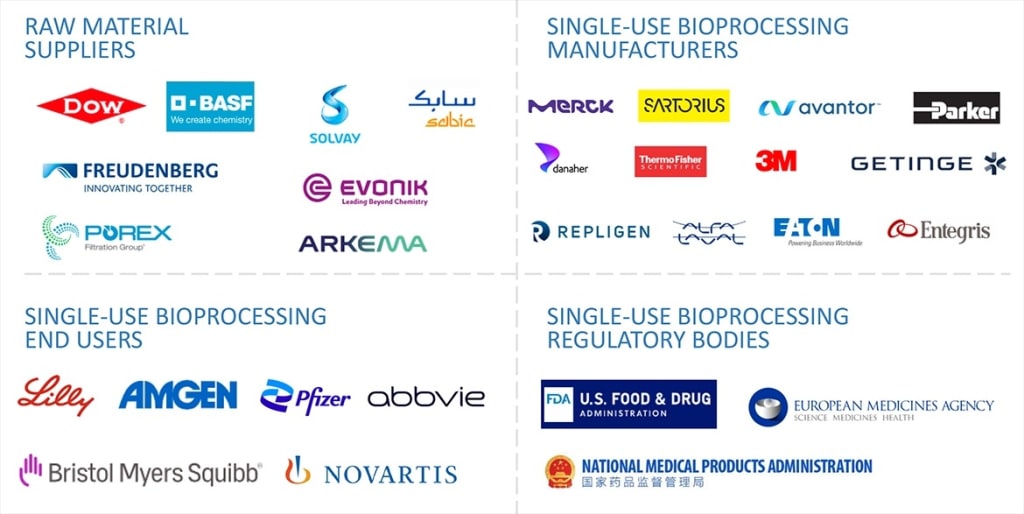
The market is characterized by strong competition among global players focusing on innovation, strategic acquisitions, and digital integration. Key companies include:
Sartorius AG (Germany)
Danaher Corporation (US)
Thermo Fisher Scientific Inc. (US)
Merck KGaA (Germany)
Avantor Inc. (US)
3M Company (US)
Repligen Corporation (US)
Entegris (US)
Getinge AB (Sweden)
Parker Hannifin Corporation (US)
These players are investing heavily in automation, process analytics, and sustainable materials to enhance product quality and environmental performance. Strategic alliances between equipment manufacturers and biopharmaceutical firms are accelerating innovation, enabling end-to-end single-use bioprocessing solutions.
Future Outlook: Toward a Flexible and Sustainable Biomanufacturing Era
As biologics continue to dominate pharmaceutical pipelines, single-use bioprocessing technologies will play an increasingly central role in the manufacturing landscape. The market’s evolution will be shaped by the convergence of digitalization, automation, and sustainability. Advanced data analytics and process control tools will further optimize bioprocessing efficiency, while efforts to develop eco-friendly disposable materials will address concerns about plastic waste.
With continued technological refinement and strategic collaboration across stakeholders, the single-use bioprocessing industry is poised for transformative growth—propelling the biopharmaceutical sector toward a more agile, scalable, and environmentally responsible future.
About the Creator
Keep reading
More stories from Juan Martinez and writers in Journal and other communities.
United States Medical Aesthetics Market Poised for Strong Growth Driven by Demand for Non-Invasive Procedures and Technological Innovation
The medical aesthetics market is undergoing a transformative period of expansion, marked by technological innovation, shifting consumer preferences, and broader acceptance of non-invasive cosmetic treatments. Valued at US$15.59 billion in 2023, the global market rose to US$17.16 billion in 2024 and is forecasted to grow at a robust CAGR of 12.8% between 2024 and 2030, ultimately achieving a projected valuation of US$35.32 billion by the end of the decade.
By Juan Martinez5 months ago in Journal
Author’s Advice
If you would’ve asked me 20 years ago did I know I’d become a writer and an author, I would’ve said “nope, ain’t happening”. As fate would have it I did become an author and I can honestly say I’m loving it so far. It really does feel good to be a writer. I’ve learned a lot on this journey and I feel like with even me being as new to this world as I am, there’s some wisdom I need to share with every other aspiring author.
By Joe Patterson5 days ago in Journal
Is Australia’s Outback Way the Loneliest Road in the World?
Across the vast interior of Australia lies a road that captures the imagination of travelers, explorers, and adventurers alike. Known as the Outback Way, this rugged route stretches approximately 2,700 kilometers from the coastal city of Laverton in Western Australia to Winton in Queensland. Because of its isolation, vast empty landscapes, and limited population along the route, many travelers describe it as the “loneliest road in the world.” But is this reputation truly deserved?
By Irshad Abbasi 2 days ago in Journal
A Transparent Look at Vocal Challenges and Top Stories
Almost three years ago, we shared a resource article that served as a place for people to suggest new challenge prompts. We thought it would be a good idea to refresh that thread, and take the opportunity to answer a few common questions about top stories, how challenges are judged and how submissions are reviewed.
By Vocal Curation Team4 days ago in Resources




Comments
There are no comments for this story
Be the first to respond and start the conversation.