
United States Regenerative Medicine Market Set to Transform Healthcare with Rapid Technological Advancements and Expanding Therapeutic Applications
Strategic partnerships, rising investments in cell and gene therapy, and growing adoption of personalized medicine drive strong market growth through 2028
The global regenerative medicine market, valued at US$13.5 billion in 2022, rose to US$16.0 billion in 2023 and is projected to advance at a resilient CAGR of 25.1% from 2023 to 2028, reaching a forecasted US$49.0 billion by the end of the period. The United States regenerative medicine market, representing the largest share within North America, is emerging as a dominant force due to increased clinical adoption, robust investment activity, and accelerating regulatory approvals. The market’s upward trajectory is primarily fueled by the growing emphasis on personalized medicine, expanding therapeutic scope, and the steady rise of collaborations among biotech innovators, research institutions, and pharmaceutical leaders.
Strong Growth Momentum in the United States Regenerative Medicine Market
The North American region—led by the United States—is expected to record a CAGR of 25.4% during 2023–2028, driven by the region’s expanding healthcare infrastructure, cutting-edge R&D ecosystem, and the widespread adoption of cell-based immunotherapies and stem cell treatments. The rising incidence of chronic and degenerative diseases, coupled with an aging population, has created a substantial demand for regenerative solutions that can restore or replace damaged cells, tissues, and organs.
Major U.S.-based institutions and companies are investing heavily in tissue engineering, stem cell banking, and gene editing technologies, paving the way for innovations that are redefining traditional treatment paradigms. The country’s strong clinical trial pipeline and supportive regulatory environment, led by the U.S. Food and Drug Administration (FDA), are catalyzing rapid product approvals and commercial launches.
Strategic collaborations between biotechnology firms and pharmaceutical companies are further shaping the market. Such partnerships enable resource sharing, accelerate clinical progress, and expand product portfolios across diverse therapeutic areas including oncology, musculoskeletal disorders, neurology, and cardiovascular diseases.
Market Dynamics: Key Drivers and Restraints
Driver: Growing Emphasis on Personalized and Precision Medicine
The increasing focus on personalized medicine represents a fundamental shift in healthcare. Regenerative medicine aligns seamlessly with this trend, offering targeted and patient-specific therapies. Precision medicine allows for treatments tailored to individual genetic profiles, lifestyle factors, and environmental influences.
In 2022, approximately 34% of all newly approved therapeutic molecular entities by the FDA were classified as personalized medicines. Among these, five novel gene or cell-based therapies were introduced for rare and complex conditions such as beta thalassemia, hemophilia B, cerebral adrenoleukodystrophy, refractory multiple myeloma, and non-muscle invasive bladder cancer. These breakthroughs have positioned the United States at the forefront of global regenerative medicine innovation.
Restraint: Ethical, Legal, and Cost Challenges
Despite rapid advancements, the field faces significant ethical and legal hurdles, particularly surrounding the use of embryonic stem cells. Ethical objections related to the destruction of human embryos have sparked debate across cultural and religious lines, influencing public perception and regulatory decisions. Moreover, the high cost of regenerative medicine treatments remains a critical challenge, limiting patient access and adoption.
Small-scale biotech firms and research organizations often struggle with the high expenses associated with clinical trials, advanced laboratory equipment, and compliance with good manufacturing practices (GMP). These financial barriers can slow innovation and reduce the market’s overall expansion rate.
Opportunity: Integration of 3D Bioprinting and Next-Generation Technologies
The emergence of 3D bioprinting has unlocked transformative potential within the regenerative medicine landscape. This technology enables the creation of functional biological tissues and organs by layering biomaterials, living cells, and bioactive molecules. 3D bioprinting is gaining traction in the development of orthopedic tissues, bones, and organ-like structures, enhancing precision, scalability, and cost efficiency.
Ongoing innovations in materials science, bioengineering, and imaging technologies are fostering the creation of tissue-engineered products with greater functionality and biocompatibility. Such advancements are expected to significantly boost the market’s potential over the next five years.
Challenge: Limited Reimbursement Policies
One of the most pressing barriers to widespread adoption of regenerative therapies is the absence of clear reimbursement frameworks. The lack of standardized policies across healthcare systems hinders both providers and patients, restricting accessibility to advanced treatments. As a result, industry stakeholders are advocating for comprehensive reimbursement structures to support long-term market sustainability and patient affordability.
Market Segmentation Overview
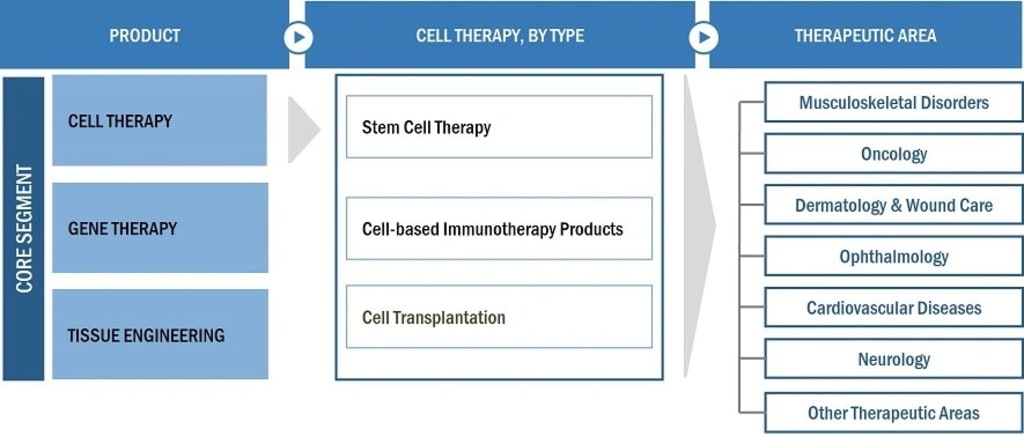
The regenerative medicine market encompasses multiple product categories, including gene therapy, cell therapy, and tissue engineering products. Among these, the cell therapy segment accounted for the largest market share in 2022. The segment’s dominance stems from increased clinical applications in oncology, musculoskeletal regeneration, and autoimmune disease management, alongside a surge in GMP-certified cell therapy production facilities.
From a therapeutic perspective, the musculoskeletal disorders segment led the global market in 2022, driven by rising cases of orthopedic conditions and ongoing research into cartilage, bone, and tendon regeneration. The oncology and neurology segments are also expected to witness accelerated growth due to expanding clinical validation of cell-based therapies and gene-editing solutions.
Geographical Insights
The global regenerative medicine market is segmented across North America, Europe, Asia Pacific, Latin America, the Middle East, and Africa.
In 2022, North America—led by the United States—dominated the global market due to extensive research funding, strong biotech infrastructure, and high adoption rates of advanced therapies. The Asia Pacific region is projected to record the fastest growth rate, driven by increasing healthcare investments, improving access to advanced technologies, and rising disposable incomes.
Competitive Landscape
Prominent market participants are focusing on innovation, mergers, and acquisitions to strengthen their portfolios. Key players include:
Novartis AG (Switzerland)
Biogen, Inc. (US)
Gilead Sciences, Inc. (US)
Sarepta Therapeutics, Inc. (US)
SMITH+NEPHEW (UK)
Amgen, Inc. (US)
These companies are heavily investing in cell and gene therapy research, advancing pipeline products, and forming alliances to accelerate clinical development and commercialization.
Outlook: A Transformative Decade Ahead
The United States regenerative medicine market stands at the threshold of a transformative decade, with significant advancements expected in gene editing, tissue regeneration, and stem cell-based therapies. The convergence of biotechnology, artificial intelligence, and nanotechnology will further expand therapeutic possibilities, offering durable solutions for previously untreatable conditions.
While ethical concerns and high costs present challenges, the strong regulatory backing, increasing venture capital funding, and rapid technological progress are expected to sustain long-term growth. As research institutions and companies continue to collaborate, the market is poised to redefine healthcare delivery and unlock a new era of curative and personalized medicine.
In conclusion, the United States regenerative medicine market’s rapid evolution, bolstered by innovation and investment, signals a paradigm shift toward restorative healthcare. With its unparalleled scientific ecosystem and clinical expertise, the United States will remain the epicenter of regenerative medicine innovation—setting the global benchmark for the development and deployment of life-changing therapies.
About the Creator
Keep reading
More stories from Juan Martinez and writers in Journal and other communities.
United States Biosimilars Market Set for Robust Expansion Amid Rising Demand for Affordable Biologic Alternatives
The global biosimilars market, valued at US$32.75 billion in 2024, grew to US$35.04 billion in 2025 and is forecasted to advance at a strong CAGR of 7.5% from 2025 to 2035, reaching an estimated US$72.29 billion by the end of the period. The market’s momentum is primarily attributed to increasing regulatory approvals, a steady pipeline of product launches, and the expiration of patents on high-value biologics. The rising global prevalence of chronic diseases, combined with cost containment pressures in healthcare systems, is pushing both public and private stakeholders to adopt biosimilars as cost-effective, high-quality alternatives to biologic drugs.
By Juan Martinez3 months ago in Journal
The goals I did not achieve
Every writing goal I made for the year is a wash. It has been this way for a while, but I think it's important to be open about my failures and the reality of how life can get in the way. This is especially true considering the several times I have posted on Vocal about my writing goals, how I was changing my approach, and where I was hoping to be for the upcoming year. I will probably do that again in a couple months, but for now, it is time to acknowledge where I am today.
By Kay Husnick24 days ago in Journal
Agatha Christie’s Seven Dials Mystery Netflix Review
Netflix has dipped into the vault of one of the undeniable Masters of Mystery and pulled out a fresh adaptation. This time, it’s Agatha Christie’s Seven Dials—technically book two in the Superintendent Battle series, but the first one getting the streaming treatment.
By Bella Anderson2 days ago in Journal
The Devil's Cut
“Comrade, finally you’re awake.” The voice was smooth, sensual. A flickering incandescent bar was all that lit the white, sterile room. All Vladimir remembered was everything going black. He tried to move his arms and found them strapped to the gurney.
By Matthew J. Fromm5 days ago in Fiction


Comments
There are no comments for this story
Be the first to respond and start the conversation.