
United States Airspace and Procedure Design Market Size & Forecast (2026–2034)
How Modern Airspace Architecture Is Powering the Future of U.S. Aviation

Introduction
The United States operates one of the most complex, congested, and technologically advanced airspace systems in the world. With commercial airlines, cargo operators, military aviation, business jets, general aviation, and emerging drone ecosystems all competing for limited sky capacity, the importance of efficient airspace and procedure design has never been greater.
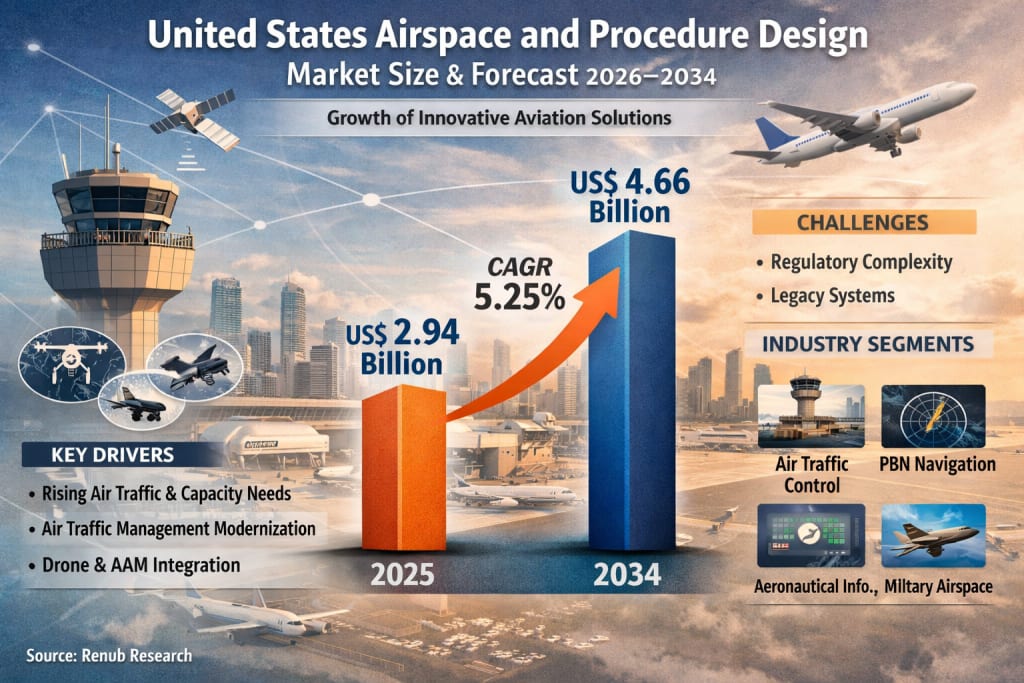
According to Renub Research, the United States Airspace and Procedure Design Market is expected to grow from US$ 2.94 billion in 2025 to US$ 4.66 billion by 2034, registering a compound annual growth rate (CAGR) of 5.25% during 2026–2034. This steady expansion reflects increasing air traffic demand, large-scale air traffic management modernization, infrastructure development, and the accelerating adoption of performance-based navigation (PBN).
Airspace and procedure design now sits at the heart of national aviation strategy, enabling capacity expansion, safety improvements, environmental sustainability, and seamless integration of next-generation air vehicles.
United States Airspace and Procedure Design Market Outlook
Airspace and procedure design refers to the systematic planning, structuring, and optimization of controlled airspace and flight procedures to ensure safe, orderly, and efficient aircraft movement. It includes air routes, terminal airspace design, approach and departure procedures, and PBN-based navigation frameworks that govern all phases of flight.
In the United States, demand for these services is driven by the sheer scale and complexity of aviation operations. The national airspace system supports thousands of airports and accommodates scheduled passenger flights, air cargo services, military missions, emergency operations, business aviation, and recreational flying. Additionally, new airspace users—such as drones and advanced air mobility (AAM) vehicles—are further increasing design complexity.
Ongoing initiatives focused on digitalization, fuel efficiency, noise mitigation, and operational safety continue to strengthen market demand. As aviation stakeholders prioritize efficiency and sustainability, airspace and procedure optimization remains critical to ensuring the smooth functioning of U.S. aviation infrastructure.
Key Growth Drivers in the United States Airspace and Procedure Design Market
Rising Air Traffic and Capacity Constraints
Passenger traffic growth, expanding airfreight volumes, and increased business aviation activity are placing immense pressure on the national airspace system. Major hub airports face congestion during peak periods, while regional airports experience fluctuating demand patterns.
Airspace and procedure design addresses these challenges by optimizing routes, redesigning terminal airspace, and implementing efficient arrival and departure procedures. These measures enhance capacity without compromising safety. PBN-based routes reduce track miles, improve predictability, and enable closer aircraft spacing.
Every day, the Federal Aviation Administration Air Traffic Organization manages over 44,000 flights and serves more than 3 million passengers across an airspace covering nearly 29 million square miles. This scale makes optimized design essential for maintaining operational reliability and airline on-time performance.
Air Traffic Management Modernization and PBN Adoption
The U.S. aviation sector is undergoing a structural shift from ground-based navigation to satellite-based PBN systems using RNAV and RNP technologies. These advanced procedures support continuous climb and descent operations, reducing fuel consumption, emissions, and noise—key policy priorities.
Digital air traffic management systems now rely on data-driven decision-making and collaborative planning, increasing the need for specialized airspace analysis, validation, and implementation services. As most aircraft fleets become PBN-capable, demand for professional procedure design expertise continues to rise.
In December 2025, the FAA announced major investments to modernize the national air traffic control system, including an initial US$ 12.5 billion allocation with long-term spending expected to exceed US$ 20 billion by 2028. These investments significantly strengthen market prospects for airspace and procedure design solutions.
Integration of Drones and Advanced Air Mobility (AAM)
The rapid development of unmanned aircraft systems (UAS) and AAM technologies is transforming airspace usage. Procedure design enables safe segregation or integration through geofencing, altitude layering, and traffic management frameworks.
As drone operations expand across inspection, delivery, and public safety use cases—and as AAM demonstrations accelerate—the need for sophisticated airspace architecture is becoming increasingly urgent. In December 2025, the U.S. Department of Transportation unveiled a national AAM strategy aimed at enabling scalable and safe integration, further reinforcing demand for airspace design expertise.
Key Challenges in the United States Airspace and Procedure Design Market
Regulatory Complexity and Stakeholder Coordination
Airspace modernization requires coordination among airlines, airport operators, air navigation service providers, military authorities, regulators, and local communities. Environmental assessments, noise considerations, public consultations, and region-specific operational requirements often slow implementation timelines.
These regulatory complexities can delay procedure deployment and increase project costs, posing a challenge to rapid modernization.
Legacy Infrastructure and Mixed Equipage
Despite modernization efforts, legacy systems remain a constraint. Not all aircraft are equipped to support advanced PBN procedures, leading to mixed-equipage environments. Integrating new designs with existing air traffic control systems and operational practices requires careful planning, limiting uniform implementation across the national airspace.
United States Air Route Traffic Control Centers (ARTCC) Market
Air Route Traffic Control Centers play a vital role in managing high-altitude en-route aircraft movements across long distances. Growth in commercial, cargo, and cross-country flights is driving upgrades in automation, satellite surveillance, and traffic flow management systems.
Modernized ARTCCs aim to reduce delays, optimize fuel efficiency, and maximize airspace capacity. Rising traffic complexity and technological advancements continue to strengthen this market segment.
United States Air Traffic Control Towers Market
Air traffic control towers oversee takeoff, landing, taxi, and ground movements at airports. Growth is driven by airport expansions designed to accommodate rising passenger demand. Airports across the U.S. are investing in advanced tower technologies to alleviate congestion and enhance safety, supporting steady market expansion.
United States Aeronautical Information Management (AIM) Market
The transition from paper-based to digital aeronautical information systems is accelerating. Real-time data, system-wide information management, and PBN integration are central to modern flight operations. Airlines, airports, and air navigation service providers increasingly rely on accurate, up-to-date information, driving growth in the AIM market.
United States Airspace and Procedure Design Hardware Market
This segment includes navigation systems, simulation platforms, radar interfaces, flight validation tools, and design workstations. Modernization of air traffic infrastructure, satellite navigation integration, and increasingly complex airspace configurations are key growth drivers. Advanced hardware platforms remain essential for precision, validation, and regulatory compliance.
Commercial and Military Airspace Design Markets
The commercial segment focuses on improving airline efficiency, reducing delays, lowering fuel consumption, and minimizing environmental impact. Government environmental policies and PBN adoption further support growth.
The military segment requires specialized airspace architectures to support training, readiness, and defense operations. Modernization of defense aviation, civil-military coordination, and unmanned systems integration continue to drive demand.
Regional Market Highlights
California: Complex airspace, major international hubs, military operations, and strong environmental priorities make California a leading market.
Texas: Rapid population growth, airport expansion, and significant military airspace drive demand.
New York: High traffic density and closely spaced airports require highly optimized procedures.
Washington: Innovation-driven aviation policies, challenging terrain, and mixed civil-military operations support advanced procedure design.
Market Segmentation Overview
By Airspace:
Air Route Traffic Control Centers, TRACON, ATCT, Remote Towers, AIM
By Component:
Hardware, Software
By End User:
Commercial, Military
Top States:
California, Texas, New York, Florida, Illinois, Pennsylvania, Ohio, Georgia, New Jersey, Washington, and others
Competitive Landscape
Leading companies covered with multi-dimensional analysis include:
Adacel Technologies Limited
Leonardo S.p.A.
Frequentis AG
Honeywell International Inc.
L3Harris Technologies Inc.
RTX Corporation
Saab AB
Thales Group
Each company is evaluated across overviews, leadership, recent developments, SWOT analysis, revenue performance, and strategic positioning.
Final Thoughts
The United States Airspace and Procedure Design Market is entering a period of sustained, strategic growth. With air traffic volumes rising, next-generation aircraft emerging, and digital air traffic management becoming the norm, optimized airspace design is no longer optional—it is essential.
Backed by strong federal investment, technological advancement, and long-term modernization goals, the market is well-positioned to expand from US$ 2.94 billion in 2025 to US$ 4.66 billion by 2034, as highlighted by Renub Research. As safety, efficiency, and sustainability remain top priorities, airspace and procedure design will continue to shape the future of U.S. aviation.
About the Creator
Beginner Blogging: How You Can Learn to Make Money Online One Post at a Time
I still remember staring at a blank screen, wondering if anyone would ever read my words. Like many people, I started beginner blogging with no roadmap, no audience, and no idea that this simple decision could eventually lead to making money online.
By LaMarion Zieglera day ago in Journal


Comments
There are no comments for this story
Be the first to respond and start the conversation.