
United States AI in Healthcare Market Poised for Transformative Growth, Driven by Early Detection Needs and Technological Advancements
Rising investments, aging demographics, and evolving clinical demands propel innovation across diagnostic, treatment, and data management applications
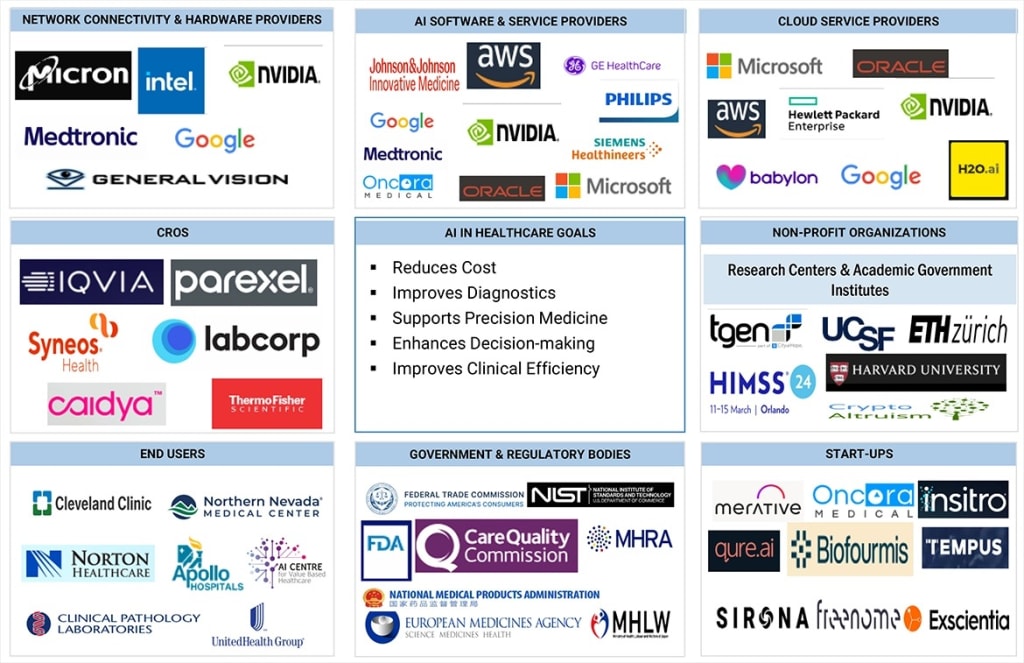
The United States Artificial Intelligence (AI) in Healthcare Market is undergoing a profound transformation, reflecting both the maturity of advanced AI tools and the evolving priorities of healthcare delivery systems. Globally, the AI in healthcare market, valued at US$14.92 billion in 2024, surged to US$21.66 billion in 2025, and is projected to achieve a remarkable CAGR of 38.6% from 2025 to 2030, ultimately reaching US$110.61 billion by the end of the forecast period.
Download PDF Brochure of Artificial Intelligence (AI) in Healthcare Market
This growth trajectory is fueled by the convergence of multiple forces: an expanding elderly population, increasing prevalence of chronic diseases, and the urgent need for faster and more accurate diagnosis and treatment. AI technologies, especially those leveraging machine learning, natural language processing, and image analysis, are increasingly being integrated into diagnostic workflows, treatment planning, and patient management systems.
Rising Need for Early Detection and Precision Diagnosis
The need for early detection remains one of the most powerful drivers of AI adoption in healthcare. Timely diagnosis significantly enhances survival outcomes, particularly for conditions like cancer, dementia, and cardiovascular disease. However, late-stage detection continues to burden healthcare systems with higher treatment costs and lower patient outcomes.
AI-based diagnostic solutions—powered by machine learning and computer vision—are transforming this landscape. These systems analyze complex imaging data and identify subtle disease patterns that might elude traditional diagnostic techniques. In the United States, where healthcare providers face increasing pressure to improve efficiency while controlling costs, such tools have become indispensable. Hospitals and research institutions are increasingly investing in predictive analytics platforms that can flag disease risk earlier, guide preventive care, and support precision medicine initiatives.
In addition to improving accuracy, AI tools contribute to reducing diagnostic turnaround times, allowing healthcare providers to make faster, evidence-based decisions. From radiology to pathology and genomics, AI systems are redefining how clinicians interpret data, enabling more personalized and proactive treatment strategies.
Overcoming Reluctance Among Healthcare Professionals
Despite rapid technological advancements, reluctance among medical practitioners to fully embrace AI technologies continues to pose a restraint to market growth. Concerns about job displacement, reliability of AI outputs, and lack of integration with existing medical workflows have slowed widespread adoption in certain areas.
Addressing this resistance requires a dual approach—comprehensive training for healthcare professionals and collaboration between AI developers, hospitals, and regulatory bodies. The focus must shift toward highlighting AI’s role as a complementary tool that enhances, rather than replaces, clinical expertise.
Major industry players are increasingly investing in user-friendly interfaces and interpretable AI systems that can provide clinicians with transparent reasoning behind their recommendations. This trend, coupled with strong emphasis on data governance and ethical AI practices, is expected to ease adoption barriers and foster greater trust in AI-driven healthcare solutions.
Opportunities: Rise of Human-Aware and Patient-Centric AI
As global demographics shift, with the proportion of individuals aged 65 and older expected to double by 2050, healthcare systems worldwide are under mounting strain. The United States is no exception, facing escalating demands for elderly care, chronic disease management, and long-term support services.
This demographic reality presents a major opportunity for human-aware AI systems—technologies designed to understand and respond to human emotions, behaviors, and needs. Such systems can enable continuous monitoring of elderly patients, predict health deterioration, and provide personalized intervention recommendations. For example, AI-driven wearable devices can track vital signs in real-time, while conversational AI assistants can support medication adherence and reduce hospital readmissions.
Governments and private organizations are investing in AI-based telehealth platforms to extend care access to remote and underserved communities. These platforms improve resource allocation, streamline patient monitoring, and reduce operational costs. As healthcare policy increasingly emphasizes value-based care, the integration of human-aware AI will become a cornerstone of efficiency and patient satisfaction.
Challenges: Data Scarcity and Quality Issues
A critical obstacle hindering the full potential of AI in healthcare is the scarcity of high-quality data. AI systems rely heavily on large, diverse, and well-annotated datasets to generate reliable predictions. However, healthcare data is often fragmented across multiple systems, limited by privacy regulations, and inconsistent in format.
This fragmentation leads to incomplete models and reduces the generalizability of AI algorithms. Furthermore, data privacy concerns and high costs associated with data standardization present additional barriers. To address these issues, organizations are increasingly turning to synthetic data generation, federated learning, and advanced data-sharing frameworks that maintain patient privacy while enabling broader access for research and development.
The World Health Organization’s 2023 guidelines on AI regulation emphasize patient safety, data transparency, and algorithmic accountability. These guidelines serve as a global benchmark and have already influenced policy reforms and regulatory oversight in key regions.
Segment Insights
The machine learning segment currently dominates the AI in healthcare space, driven by its broad application across predictive analytics, medical imaging, and clinical decision support. Enhanced computational power, availability of large datasets, and improved algorithmic sophistication have fueled this growth.
From a functional standpoint, the diagnosis and early detection segment represents the largest share of the AI in healthcare market. The segment’s growth is attributed to heightened awareness of preventive healthcare, increasing diagnostic imaging volumes, and the need for reducing diagnostic errors.
AI technologies are also rapidly expanding into areas such as treatment personalization, post-treatment monitoring, pharmacy management, and administrative automation—further streamlining healthcare operations and improving patient experiences.
Regional and Competitive Landscape
North America remains the most mature region for AI integration in healthcare, underpinned by robust infrastructure, government initiatives, and major investments by technology giants. Leading corporations, including Microsoft Corporation, NVIDIA Corporation, GE Healthcare, Oracle, Amazon Web Services, and Google, continue to spearhead innovation through strategic partnerships and acquisitions.
In parallel, startups such as Viz.ai, Tempus, and SOPHiA GENETICS are redefining the competitive landscape with AI-powered platforms for precision medicine, clinical workflow automation, and diagnostic imaging. Collaborations between hospitals, research institutions, and tech developers are accelerating pilot programs and clinical validations across oncology, cardiology, and neurology.
As adoption expands, stakeholders are increasingly focused on ethical AI deployment, ensuring transparency, accountability, and equitable access to advanced technologies.
Outlook
The United States Artificial Intelligence (AI) in Healthcare Market is positioned at a defining juncture. The synergy between technology innovation, clinical demand, and policy support is creating a robust foundation for sustainable growth. By 2030, AI is expected to be deeply embedded in nearly every aspect of healthcare—from primary diagnostics and drug discovery to patient engagement and operational management.
With continuous advancements in data infrastructure, algorithmic transparency, and clinician education, AI stands ready to deliver on its promise: a healthcare system that is smarter, faster, more inclusive, and profoundly human-centered.
About the Creator
Keep reading
More stories from Juan Martinez and writers in Journal and other communities.
United States Healthcare BPO Market Surges Amid Growing Outsourcing Trends and Technological Advancements
The healthcare business process outsourcing (BPO) sector is undergoing a major transformation, with the global healthcare BPO market valued at US$417.7 billion in 2025, up from US$337.6 billion in 2024. It is projected to grow at a compound annual growth rate (CAGR) of 10.7%, reaching an estimated US$694.3 billion by 2030. The United States healthcare BPO market remains at the forefront of this expansion, driven by a combination of regulatory shifts, digital transformation, and the increasing need to reduce operational costs across healthcare systems.
By Juan Martinez3 months ago in Journal
The goals I did not achieve
Every writing goal I made for the year is a wash. It has been this way for a while, but I think it's important to be open about my failures and the reality of how life can get in the way. This is especially true considering the several times I have posted on Vocal about my writing goals, how I was changing my approach, and where I was hoping to be for the upcoming year. I will probably do that again in a couple months, but for now, it is time to acknowledge where I am today.
By Kay Husnick24 days ago in Journal
The Phoenix from the Ashes:
Toxic relationships, in their myriad forms, are insidious vines that can slowly strangle the life out of individuals, leaving them emotionally depleted, psychologically bruised, and often struggling to understand how they ended up entangled in such a destructive web. Whether romantic, familial, or platonic, these relationships are characterized by patterns of manipulation, control, disrespect, and a consistent lack of empathy. Escaping their grasp can be a grueling process, but it's a journey that ultimately leads to profound self-discovery and lasting personal growth. The lessons learned from overcoming toxic relationships are invaluable, shaping our understanding of ourselves, our boundaries, and what we truly deserve in life.
By Wilson Igbasi3 days ago in Journal



Comments
There are no comments for this story
Be the first to respond and start the conversation.