
Under Investigation? How to Prepare Your Business for State or Federal Fraud Probes
Federal vs State Fraud Investigations: What Every Business Must Know Before It's Too Late

What would you do if tomorrow you received a letter from the DOJ or Virginia AG saying you’re under investigation for fraud?
Most business owners can’t answer that—because they never think it will happen to them.
One employee complaint.
One audit.
One contract mistake.
That’s all it takes to trigger a state or federal probe — and most companies don’t realize it until agents are collecting files or freezing accounts.
Still think it couldn’t happen to you?
Here’s the truth: If your business works with government contracts, federal grants, healthcare billing, maritime shipping, or even just crosses state lines, you're already on the radar. And if you don’t know the difference between a state fraud case and a federal one — you’re playing a dangerous game without the rules.
This guide walks you through everything you need to know—from how these investigations actually begin, to how federal and state fraud cases work differently, to what your business can do right now to protect itself.
Because when it comes to fraud investigations, the only thing worse than doing something wrong... is not being prepared when they say you did.
Why Businesses Get Investigated for Fraud
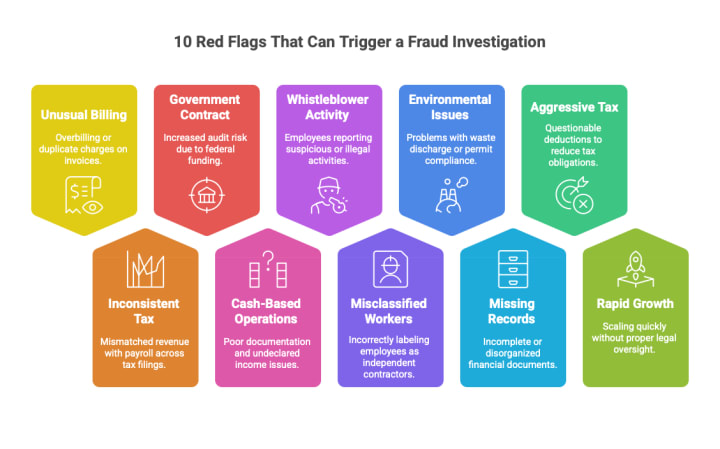
Mistakes, not only intent, often spark investigations—especially when federal or state funds are involved. Here are the top red flags:
- False billing
Example: Overstating hours on state-funded contracts or charging for work never performed.
- Tax underreporting
Misclassifying employees as contractors to dodge taxes or deleting invoices over a certain dollar amount.
- Grant misuse
Using federal or state grants for unauthorized purposes like paying unrelated vendors or inflating use.
- Environmental violations
Discharging pollutants in waterways; this is a federal Clean Water Act issue.
- Money laundering
Large, unexplained cash inflows through business accounts flagged by banks.
- Whistleblower reports
Employees, ex-workers, or competitors reporting suspicious behavior under the False Claims or Qui Tam statutes.
Even minor errors—like missing signatures or inconsistent number formatting— can trigger in-depth audits that uncover bigger issues. Ignoring them is a gamble.
Federal vs. State Fraud Investigations: What Really Changes
These two systems diverge sharply in terms of who, how, and how hard they dig:
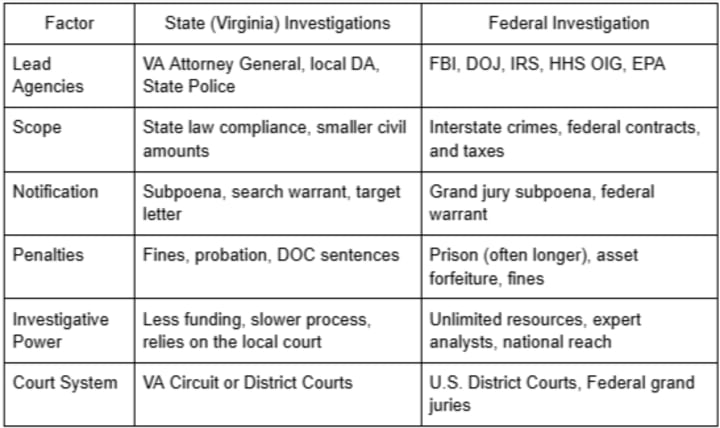
Federal investigations are more aggressive, more secretive, and harder to fight. If you work with federal grants or cross-state operations, federal probes become a serious risk.
Common Entry Points: How Your Business Might Get Targeted
Knowing the “how” can be equally important as the “who.” Let’s walk through some realistic examples:
- Grand jury subpoenas (Federal) - In a wire or mail fraud case, agents may quietly move in with subpoenas for emails and bank records—without initially contacting you.
- Audit triggers (State + Federal) - Discrepancies between tax filings and billed amounts trigger audits from the VA Department of Taxation or IRS. One audit can spiral into a full investigation.
- Tip-offs & whistleblowers - Internal employees use protections under state law or federal False Claims Act to expose shady billing or contracting behaviors.
- Environmental red flags - Satellite or drone monitoring spots water discoloration at your dock, prompting an EPA or DEQ review of permit violations.
- SAR/STR alerts in banking - Banks that flag large, unusual deposits are legally obligated to report them, often initiating internal scrutiny.
In every case, the first contact may come out of nowhere—but once they start, it’s only a matter of time.
Step-by-Step: What Happens When You’re Under Investigation
Here’s a high-level breakdown of the typical federal investigation lifecycle:
1. Intake & Monitoring
- No formal notification
- Data collection via subpoenas, whistleblowers, audits
2. Initial Contact
- You receive a grand jury subpoena, target letter, or agents live visit
- Always stop—don’t answer questions without counsel
3. Information Exchange
- Documents and interviews are exchanged through counsel
- Missteps here can escalate the case
4. Prosecution or Settlement
- Negotiation via your attorney, sometimes resolved without charges
- If no agreement—indictment and trial
State investigations follow a similar path—search warrant, questioning, formal charges—but often move slower and are more flexible.
Takeaway: Don’t answer, ask for counsel, preserve documents, and involve legal help immediately.
The Fatal First Mistake: Speaking Without a Lawyer
Here’s why the first phone call is critical:
- Recorded conversations can be played back in court
- Misphrasing (e.g., “I thought it was okay”) suggests intent
- Unfiltered documents may inadvertently highlight wrongdoing
- Improper handling of subpoenaed data could lead to obstruction charges
You don’t have to be guilty to get convicted—it just needs to look that way. The smartest step you can take is to get legal representation right away.
Three Immediate Action Steps You Must Take
Action #1: Hire a Business Attorney Immediately
Find someone experienced in white-collar defense—ideally with both state and federal experience in areas like:
- Tax, wire, mail fraud
- Medicaid or government contract violations
- Maritime and environmental offenses
Action #2: Isolate and Preserve Information
- Pull relevant documents, create an evidence log
- Freeze potential deletion by locking affected emails/accounts
- Don’t alter or clean any files
Action #3: Develop a Strategy with Your Attorney
- Map out relevant documents, witness lists, data sources
- Plan how to respond to subpoenas and what to fight
- Monitor ongoing investigation so you’re steps ahead
These quick actions can mean the difference between containment and crisis.
Building a Culture of Compliance: What You Should Be Doing Now
Your best defense isn’t reactive—it’s proactive prevention. Start here:
1. Internal Audits & Self-Assessment
- Review finances, billing, compliance yearly (preferably with outside counsel)
- Special checklists for government contract compliance and environmental regulations
2. Strong Internal Controls
- Segregate duties (approval, billing, payment)
- Require written documentation and dual sign-offs
- Use audit-friendly accounting software
3. Employee Training & Reporting Systems
- Train staff on red flags and escalation paths
- Offer anonymous whistleblower channels
- Include fraud clauses in employment agreements
4. Compliance Documentation
- Keep an audit-ready file of contracts, invoices, approvals
- Order files and digital logs so everything can be retrieved quickly
These measures don’t just reduce risk—they signal to investigators that you’re serious about compliance.
Why You Need a Local Expert — Not Just Any Lawyer
White-collar fraud is not general criminal law—it’s its own universe:
- Involves thousands of documents and data points
- Interpreted under both state and federal statutes
- Involves interplay with multiple regulatory agencies (IRS, EPA, HHS, VA AG’s office)
- Often requires expert testimony or forensic accounting
That’s why you need a legally trained Business Attorney in Virginia or where you reside who can:
- Negotiate with federal prosecutors or VA officials
- Conduct internal investigations that protect attorney-client privilege
- Prepare for both civil/misdemeanor/state-level defense strategies
- Go to trial if charges are unavoidable
Final Challenges Every Business Needs to Overcome
- Complexity of funding rules (Medicaid, state/federal grants)
- High volume of financial data (bank records, ledgers, invoices)
- Multiple jurisdictions (state vs federal, cross-border issues)
- Agency overlap (Agencies sharing info, joint investigations)
- Timeline pressure (Federal grand jury deadlines vs state court)
Without a strategic legal approach, these factors compound quickly.
Conclusion: Would You Be Ready if the Government Came Knocking?
The difference between a contained incident and a full-scale legal disaster comes down to:
- Early risk detection
- Rapid legal response
- Proactive internal protections
When you answer that you’re prepared for tomorrow, you’re not gambling anymore.
So here’s the real question: If tomorrow morning you woke up to the news that your business was under federal or state fraud investigation, would you know what to do?
About the Creator
Angelina Dave
Angelina Dave is a passionate writer and advocate focused on themes of equality, social justice, humanity, and the fight against racism.
Keep reading
More stories from Angelina Dave and writers in Journal and other communities.
How to Protect Your Business During a Federal Investigation?
Have you ever wondered what would happen if the government started digging into your business? Not because you did something wrong—but because someone flagged a transaction, a contract, or a former employee made a complaint?
By Angelina Dave10 months ago in Journal
Author’s Advice
If you would’ve asked me 20 years ago did I know I’d become a writer and an author, I would’ve said “nope, ain’t happening”. As fate would have it I did become an author and I can honestly say I’m loving it so far. It really does feel good to be a writer. I’ve learned a lot on this journey and I feel like with even me being as new to this world as I am, there’s some wisdom I need to share with every other aspiring author.
By Joe Patterson5 days ago in Journal




Comments
There are no comments for this story
Be the first to respond and start the conversation.