
Tracking the Trends: What’s Powering the Sodium-ion Battery Market
The sodium-ion battery market is expected to experience substantial growth and reach a market size of USD 369.69 million in 2024. The projected compound annual growth rate of 16.3% between 2024 and 2030 reveals the market will experience substantial expansion.

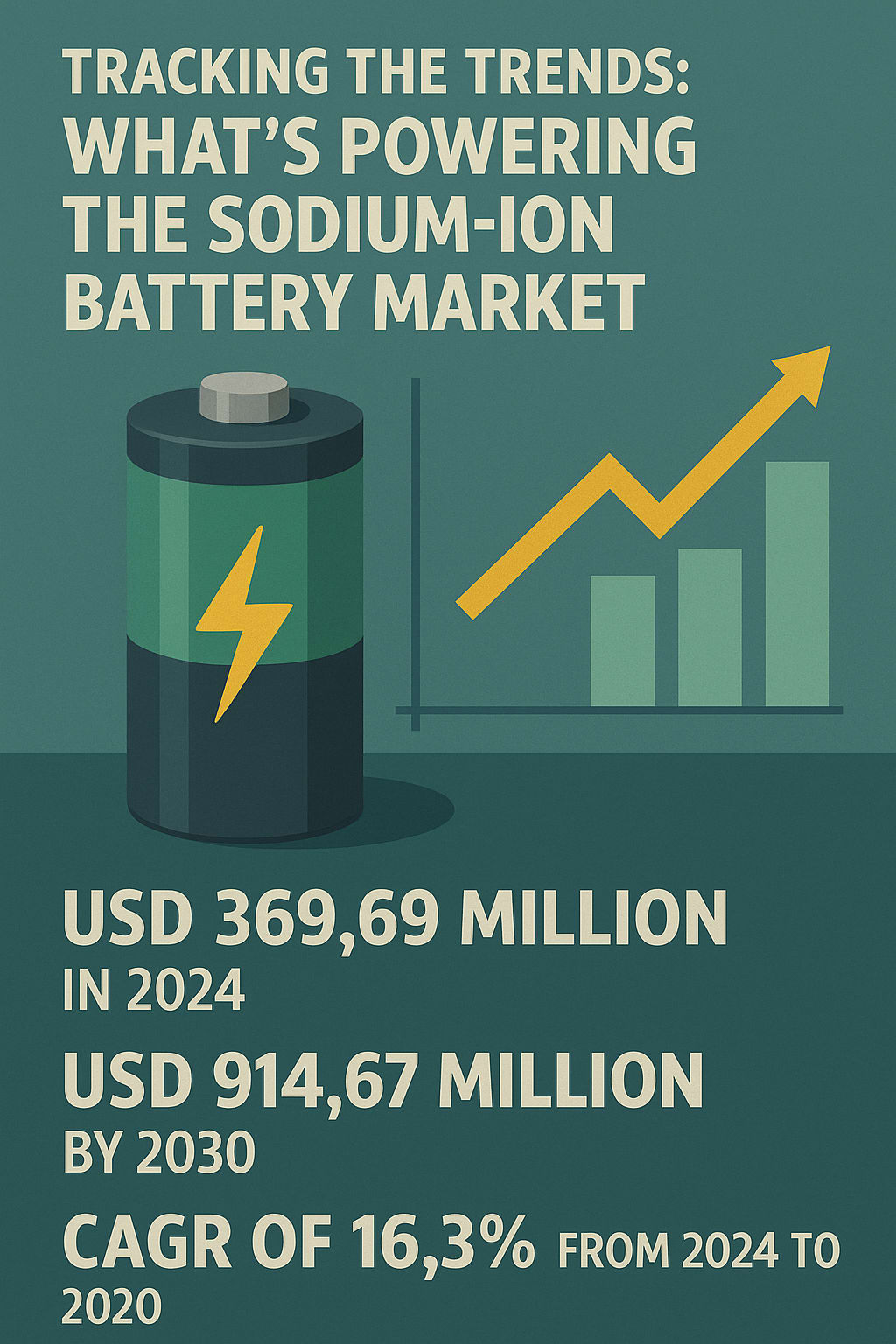
The rising global need for energy storage systems directs more attention to options apart from lithium-ion batteries. The sodium-ion battery (Na-ion) stands out as a leading technology because it combines economic benefits with environmental sustainability and plentiful raw materials. The sodium-ion battery market is advancing quickly even though it remains in its early development phase compared to lithium-ion batteries. The ability to predict energy storage's future trajectory requires a thorough comprehension of the major trends driving its current momentum.
Abundant and Affordable Materials
The sodium-ion battery market is being driven by the widespread availability of sodium and its low price point. Sodium deposits are found abundantly throughout the world whereas lithium resources are limited to particular areas like South America’s Lithium Triangle. Global access to sodium enables a supply chain that stands strong against geopolitical and economic challenges which commonly plague lithium procurement.
Sodium extraction from salt enables unlimited access to this resource through seawater. Sodium's low cost substantially decreases battery production expenses, presenting a vital benefit for large stationary energy storage systems where economic factors are crucial.
Technological Advancements and Commercial Readiness
New electrode material technology and advanced electrolytes have substantially elevated sodium-ion battery performance. The battery technology challenges of low energy density and shortened cycle life are being overcome through the development of new cathode materials such as Prussian blue analogs and hard carbon anodes. The latest improvements in sodium-ion battery technology enable them to approach lithium-ion battery performance levels for specific uses.
Leading companies such as CATL (Contemporary Amperex Technology Co. Limited) have revealed sodium-ion battery prototypes and declared their intentions to commence commercial production. CATL launched its initial sodium-ion battery model in 2023 with an energy capacity reaching 160 Wh/kg which parallels the performance of certain lithium iron phosphate (LFP) batteries. The company has developed a plan for how Na-ion cells will be integrated into both electric vehicle platforms and grid storage technologies.
Sodium-ion batteries create strategic opportunities for use in fixed power storage systems and vehicles with limited speed requirements.
Sodium-ion batteries cannot yet match lithium-ion batteries for high-performance electric vehicles but they deliver significant benefits in particular market areas. Renewable energy sources such as solar and wind power make stationary energy storage systems their primary application area. The ability to optimize sodium-ion batteries for extended cycle life and enhanced safety makes them perfect for power grid stabilization and peak load shaving operations.
Low-speed electric vehicles like e-scooters, e-rickshaws and urban delivery vehicles represent an early commercialization opportunity. Such applications benefit from cost-effectiveness and safety features while requiring lower energy densities and temperature stability which sodium-ion technology delivers.
Environmental and Safety Benefits
The transition toward sodium-ion batteries is driven by environmental concerns. Mining sodium results in less environmental damage compared to lithium mining which creates ecological harm along with high water usage. Na-ion batteries avoid the need for cobalt and nickel which are commonly linked to unethical extraction methods and environmental harm.
Safety is another major advantage. Sodium-ion batteries demonstrate reduced risk of thermal runaway and enhanced safety performance in high and low temperature settings. Na-ion batteries perform effectively across different locations such as developing regions and off-grid areas.
Investment and Government Support
The research sector for sodium-ion batteries benefits from increasing investment from public and private sources. Research initiatives and demonstration projects are receiving funding from governments throughout Europe, Asia, and North America to speed up the commercialization of this technology. Startups alongside battery manufacturers continue to obtain substantial funding to expand production capabilities and improve manufacturing techniques.
Multiple consortiums across Europe are currently developing sodium-ion battery pilot projects to support wider efforts that aim to establish local battery production while decreasing dependence on imported lithium.
The Road Ahead
Though the sodium-ion battery market continues to develop its potential market position indicates it will serve as an important partner to lithium-ion batteries in sectors where economic efficiency and environmental safety are prioritized over peak energy density. Sodium-ion batteries will become essential for global energy storage once technological challenges are addressed and economies of scale improve. The upcoming years will decide the extent of sodium's contribution to a sustainable and durable energy transition.
About the Creator
Paxton Templeton
I’m a storyteller at heart with a passion for turning data into compelling narratives. With a focus on industry trends, market insights, and growth statistics, I bring clarity to complexity
Keep reading
More stories from Paxton Templeton and writers in Journal and other communities.
The Digital Foundry: Mapping Growth in AI for Manufacturing
Data and algorithms now drive the fundamental changes in manufacturing rather than traditional materials like steel, fire, or oil. Welcome to the Digital Foundry: AI enables production lines to become intelligent systems that enhance efficiency and innovation while building resilience at a large scale.
By Paxton Templeton8 months ago in Journal
The goals I did not achieve
Every writing goal I made for the year is a wash. It has been this way for a while, but I think it's important to be open about my failures and the reality of how life can get in the way. This is especially true considering the several times I have posted on Vocal about my writing goals, how I was changing my approach, and where I was hoping to be for the upcoming year. I will probably do that again in a couple months, but for now, it is time to acknowledge where I am today.
By Kay Husnick23 days ago in Journal
The Councils of the Church and Why They Were Important
The Catholic Church has faced countless challenges since its founding, from doctrinal disputes to external persecution. One of the most important ways the Church has maintained unity, clarified its teachings, and preserved the faith is through ecumenical and local councils. Church councils are formal gatherings of bishops and Church leaders to deliberate on matters of doctrine, discipline, and practice. These gatherings have shaped Christianity as we know it today, ensuring that the Church remains faithful to the teachings of Christ and the apostles.
By Sound and Spirit4 days ago in Journal



Comments
There are no comments for this story
Be the first to respond and start the conversation.