
The Digital Foundry: Mapping Growth in AI for Manufacturing
Manufacturing has evolved because Artificial Intelligence (AI) shifted from a distant idea to the essential basis for smarter and more responsive production systems.

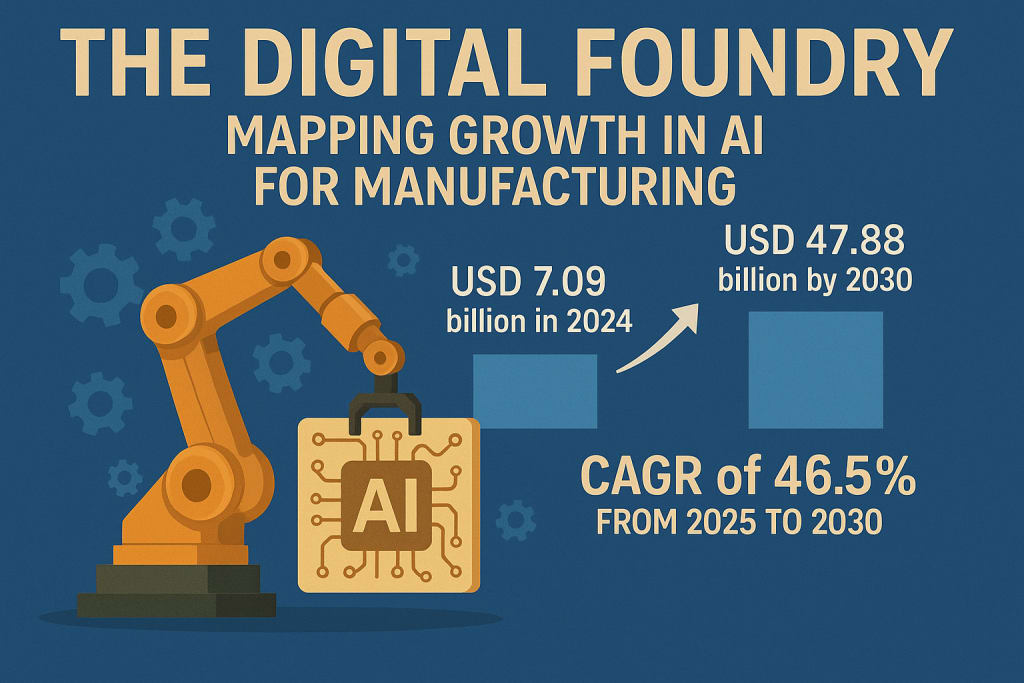
Data and algorithms now drive the fundamental changes in manufacturing rather than traditional materials like steel, fire, or oil. Welcome to the Digital Foundry: AI enables production lines to become intelligent systems that enhance efficiency and innovation while building resilience at a large scale.
The artificial intelligence manufacturing market globally should achieve USD 5.32 billion in valuation by 2024 while forecasting a growth rate of 46.5% during the period from 2025 to 2030. Production facilities are experiencing this upward trend because of the integration of advanced cutting-edge technologies such as advanced analytics along with immersive technologies like augmented and virtual reality intelligent packaging solutions and additive manufacturing techniques. Numerous digital transformation efforts throughout multiple sectors are preparing for forthcoming AI-driven services while strengthening market potential.
From Automation to Intelligence: The AI Evolution
Manufacturers adopted automation technologies during the past ten years to boost production while decreasing their reliance on human labor. AI advances beyond automation capabilities by incorporating learning processes as well as predictive and decision-making functions into machines and systems.
Unlike traditional automation, AI can:
• Predict equipment failures before they happen
• Optimize production schedules in real time
• Identify defects at a microscopic level
Modify operational processes to respond to market changes and supply chain interruptions
Industry 4.0 represents the transition from smart machines to self-regulating factories.
Key Areas Driving AI Adoption in Manufacturing
⚙️ Predictive Maintenance
Machine downtime costs manufacturers billions annually. AI sensors combined with machine learning models enable companies to monitor equipment conditions while detecting irregularities and predict potential failures which helps to maintain higher uptime and reduce maintenance expenses.
🛠 Quality Control & Visual Inspection
The production line benefits from computer vision systems that analyze thousands of images to conduct real-time inspections instantaneously. AI inspection systems detect defects with greater speed and accuracy compared to human inspectors which leads to better consistency and less waste.
📊 Supply Chain Optimization
Manufacturers utilize AI to mitigate volatility by enhancing supply chain visibility and enabling real-time demand forecasting and inventory management. During times of worldwide instability these capabilities prove vital to keep production processes running smoothly.
🧠 Process Automation & Decision Intelligence
AI-driven process automation goes beyond repetitive tasks. The system reviews production data to suggest workflow improvements while minimizing energy consumption and optimizing resources on the fly and continues to refine its performance through learning mechanisms.
🌍 Sustainability & Energy Efficiency
Manufacturers utilize AI to reach their sustainability goals through energy usage monitoring and heating/cooling system optimization while pinpointing carbon reduction chances throughout production.
Market Momentum and Key Players
The swift adoption of digital technologies in manufacturing spurs extensive investment and innovative developments. Siemens, GE Digital, IBM, Bosch, and Rockwell Automation stand at the forefront of developing AI-enabled manufacturing platforms. AI-driven startups now offer plug-and-play products to support smaller manufacturers who want to modernize their operations.
Both governmental bodies and industry partnerships support efforts to develop AI technologies in manufacturing through workforce training, ethical AI applications, and small-medium enterprise (SME) implementation.
Challenges on the Factory Floor
The potential benefits of AI in manufacturing are significant but its adoption faces multiple challenges.
• High integration costs with legacy systems
• Data silos that prevent full visibility
AI applications show significant skill shortages in data science and industrial operations.
• Cybersecurity risks as factories become more connected
Manufacturers need to establish detailed AI strategies and promote teamwork across departments while also putting resources into change management and employee education to address these challenges.
The Road Ahead: Toward the Autonomous Factory
The concept of the “lights-out factory”—which operates autonomously with self-regulation and continuous optimization—is now achievable reality. AI is actively building the foundation although most manufacturing facilities have not yet reached that stage. The coming years will see the rise of systems that go beyond command execution to comprehend directives while continuously optimizing and adapting on the fly.
Latest Press Release: https://www.prnewswire.com/news-releases/artificial-intelligence-in-manufacturing-market-size-worth-47-88-billion-by-2030---exclusive-report-by-the-research-insights-302462946.html
About the Creator
Paxton Templeton
I’m a storyteller at heart with a passion for turning data into compelling narratives. With a focus on industry trends, market insights, and growth statistics, I bring clarity to complexity
Keep reading
More stories from Paxton Templeton and writers in Journal and other communities.
The Predictive Edge: AI in Diagnostics Takes Center Stage
AI technology is expanding the limits of early disease detection capabilities while enhancing risk prediction and decision-making processes through imaging and genomic applications. AI has moved from being a supplementary tool to becoming the primary force in diagnostic processes within global healthcare systems that demand increased efficiency and personalized care.
By Paxton Templeton9 months ago in Journal




Comments
There are no comments for this story
Be the first to respond and start the conversation.