
Top-6 Remote Trends Shaping Customer Experience in 2020
In today's "Customer-first" economy, customer experience (CX) encompasses nearly every aspect of a company’s offering. But what do we mean by customer experience? In simplistic terms, CX is the internal and subjective response customers have to any direct or indirect interaction with a company. Here are a few eye-opening statistics that throw light on why it's important for businesses to be 'customer-obsessed' today: • Gartner predicts that "89% of businesses are expected to compete mainly on customer experience." The report claims that "Customer experience is the new battlefield." Rightly so. • Tailor-made CX influences on-the-spot purchasing. A recent study claims that "49% of buyers made impulse purchases after receiving a more personalized experience." • With customer experience being an integral part of converting customers and bringing them back, it’s probably no surprise that "87% of marketing, CX, and analytics professionals say that customer experience is very or extremely important to their business." • Around 79% of marketing professionals who have developed a strategy say that their primary objective for it is to improve customer retention/satisfaction. Clearly, delivering an extraordinary customer experience has become the norm; it is no longer an 'option.' In this blog, we will deep-dive to understand why brands are making customers their priority. Here goes the list.


Top-6 Strategies on how Businesses can Prioritize their CX Journey

There's no doubt that 2020 is an exciting year for customer experience. To that end, consider the following points when developing your 2020 digital CX strategy:
1. "Live Chat" Software: With companies and customers right in the thick of a global pandemic, delivering a seamless, consistent, and convenient customer experience has never been more important. This is where live chat software can make all the difference between a "good" CX and a "great" one. Let's look at a real-life example to understand this better:
• Nordstorm's live chat services may not be available 24x7, but it allows customers to leave important details such as name, contact, email address, etc. so that their queries can be addressed. The live chat software routes the request to the relevant team, and a live agent gets in touch as soon as possible:

Plus, notice how the live chat services are transparent and honest in approach, and empowers customers to self-serve - a priceless advantage, especially in the time of a global pandemic:
Image Source
2. The Psychological Side of CX: Oftentimes, brands completely miss the boat when it comes to addressing their customer experience' psychological foundation. Traditionally, brands have been seen to focus all their energies into product innovation - which is important - but not at the cost of their customers. In all the hustle and bustle, brands tend to forget all about making customers feel acknowledged and appreciated - a huge mistake. Why? Because customers who feel a deep, emotional connection with a brand can become life-long advocates. Take a look at Birchbox' example which routinely sends out heart-warming emails to thank their customers:

• Organic skincare brand, "Juice Beauty" steps up their CX game by conceptualizing a "Customer Appreciation Event" and offering tempting discounts and offers to their loyal fan base:

• J Crew's letter-style emails are full of heart and care, making the customers feel like they're literally the brand's center of the universe:

• BarkBox's short-and-sweet email to 'Dog Lovers' on National Dog Day is humorous and witty, which is sure to strike a chord with the customer:
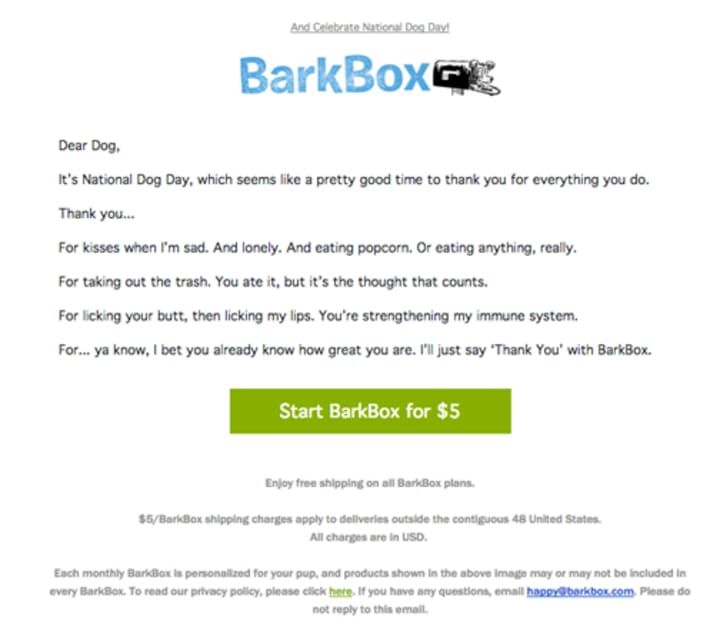
All things said and done, being thoughtful and being human when interacting with customers can help brands foster meaningful, value-driven relationships.
3. Role of "AI & AR" in Boosting Sales & Satisfaction:
"Almost 70% of consumers expect retailers to launch an AR app."
Today's digitally-connected user base expects companies to deliver powerful digital channels that engage Artificial Intelligence (AI), Augmented Reality (AR), and Emotional Intelligence is equal measure. In fact, integrating these emerging technologies has emerged as a competitive advantage for one too many brands.
Augmented Reality and Artificial Intelligence can help deliver a 360-degree immersive experience to the customers in a visual format. Sephora's digital strategy is an interesting case in point. The brand offers customers the convenience of experimenting with makeup virtually, scouting for the correct foundation basis their skin tone, and sampling a fragrance via a touchscreen! Here are a few snapshots of Sephora's Virtual Assistant:

Here's what Mary Beth Laughton, Sephora's executive vice president of Omni retail says:
"It's about being open to new ideas, and working with partners to develop the right solutions--and being willing to do things that maybe our clients don't even know that they want yet. That's how we approach things, and as long as we're doing it through the lens of our customers and finding ways to simplify and enhance their shopping experience, we're willing to put focus there."
Key takeaway: Clearly, AI and AR are innovating and revolutionizing CX at every step of the user's journey and to the latter's satisfaction.
4. Customers Air Concerns with "Voice Feedback":
Voice Feedback programs are all the rage now. And for a good reason. Building a voice-led feedback loop can help brands make iterations to their service on-the-fly and enhance the overall CX by leaps and bounds.
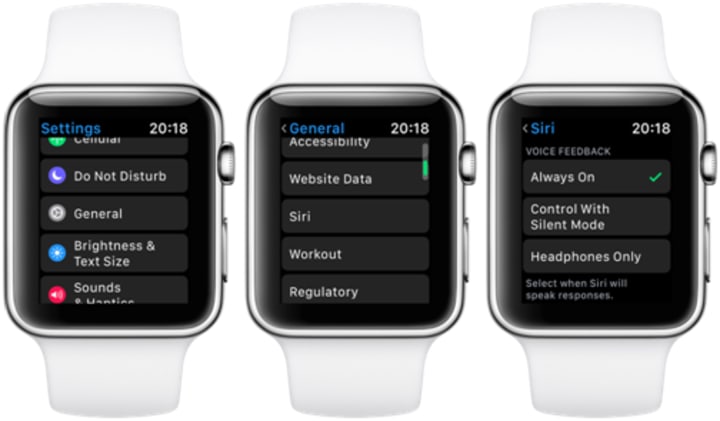
At its core, a successful Voice Feedback program uses AI to analyze a customer's actual voice recording. More importantly, it factors in critical elements such as the customer's tone, pitch, and even volume to get a pulse of the customer's sentiment and emotions. Tech giant Apple allows customers to customize the Voice Feedback option on its Apple Watch series and the wildly popular virtual assistant, 'Siri:'
Another brand - MapMyFitness - uses this intuitive feature brilliantly by sending out audio cues and workout statistics to help customers stay informed, that too, without staring at their screens:

Key takeaway: Voice Feedback can help brands gauge how they measure up to a user's expectations. All they need to do is literally 'listen' to their customers and incorporate all the real-time, valuable feedback they're receiving relating to the company's offerings.
5. Make it "Personal": Personalization
"90% of consumers find personalized experiences appealing, and 80% believe they are likely to purchase from a brand that offers these curated experiences."
Truth be told, brand recognition/loyalty and hyper-personalization are mutually inclusive entities - one cannot survive without the other. This makes sense as customers prefer receiving relevant communication that resonates with their expectations. This not only breeds customer loyalty but also boosts revenues and increases the conversion rate.
Nike sits at the top of our list when it comes to delivering impactful, customized omnichannel customer experiences. For example, NikePlus members can use the constantly evolving Nike app to scan barcodes inside each shoe on display, gather in-depth information about products such as available sizes and colors, and view real-time online and in-store inventory:

That's not all. Customers can easily return, exchange, or purchase products with Nike's Curb Services. Plus, users can open digital lockers using their phones:

Key takeaway: Personalized and tailor-made services can help brands deliver superior, anticipatory experiences to their users in addition to driving positive brand engagement, emerging as clear-winners in the user's hearts and minds.
6. "Social Media CX" is Everything:
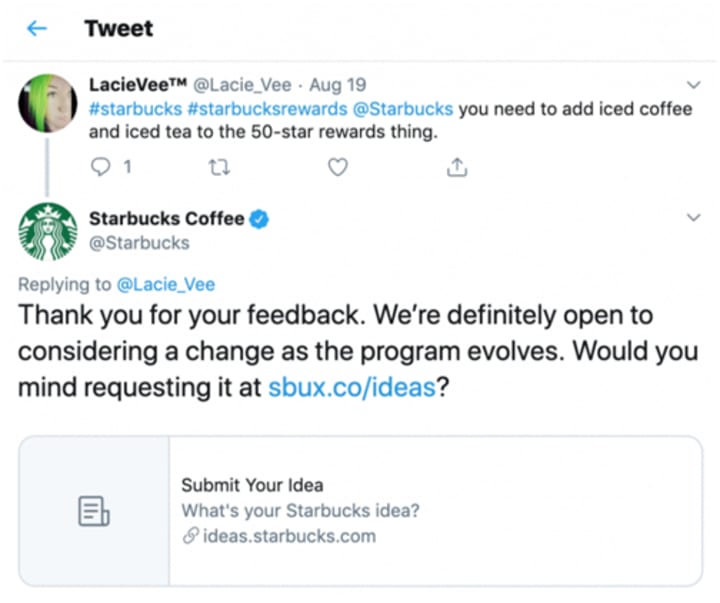
If experience is anything to go by, more and more customers are quick to communicate with brands on a variety of social media channels such as Facebook, Twitter, Instagram, etc. And why? These platforms are convenient, easy-to-use, and offer instant support. This is exactly why brands need to consistently monitor their social media channels and connect with users by leveraging the User-Generated Content in an optimal manner. Starbuck's social media strategy is nothing short of envious. Take a look at the following examples and decide for yourself:

Plus, the brand takes customer feedback seriously as it has created a dedicated website where customers can voice their suggestions and air their concerns:
Wrapping Up
Here's my two cents on the current CX climate: The future of customer experience is definitely one that encapsulates the strategic use of emerging technologies (think: AI, AR, live chat, etc.) through digital-first remote tools and empowers customers with hyper-personalized, feedback-driven experiences. Paradoxically, a technology-centric approach is humanizing customer services and, in turn, helping companies create true 'brand fanatics.'
About the Creator
Keep reading
More stories from Emma Williams and writers in Journal and other communities.
Undeniable Advantages of Email Marketing for Real Estate Agents
Why use email marketing? Recent statistics revealed that email marketing produces a very high ROI of 4,300 percent. In other words, you can earn $38 for every dollar that you spend in email marketing. Is that not enough reason to ditch all your old marketing tools for email marketing?
By Emma Williams6 years ago in Journal
The goals I did not achieve
Every writing goal I made for the year is a wash. It has been this way for a while, but I think it's important to be open about my failures and the reality of how life can get in the way. This is especially true considering the several times I have posted on Vocal about my writing goals, how I was changing my approach, and where I was hoping to be for the upcoming year. I will probably do that again in a couple months, but for now, it is time to acknowledge where I am today.
By Kay Husnick17 days ago in Journal
When Is the Best Time to Visit Morocco With Kids?
As a mom, I know how different traveling with kids can feel compared to solo or adult-only trips. When my family and I first planned our Morocco adventure, I had one big question: When is the best time to visit Morocco with kids?
By Ariel Cohen5 days ago in Journal



Comments
There are no comments for this story
Be the first to respond and start the conversation.