
Top 5 Smart Waste Technologies Making a Difference in 2025
From smart bins to AI-powered sorting—technologies reshaping the future of urban waste


Global cities produce more than 2.2 billion tons of solid waste annually, and this number is projected to reach 3.4 billion tons by 2050 according to the World Bank. In 2025, rapid urbanization and population growth have further increased the pressure on waste management systems. Municipalities and industries are now looking beyond traditional collection methods to smart waste management solutions that use IoT, AI, robotics, and data analytics to reduce inefficiencies and environmental impact.
This shift is not only about cleaner streets but also about reducing costs, improving recycling rates, and ensuring compliance with environmental standards. With the help of waste collection monitoring software, organizations can track, analyze, and optimize their processes in real time.
1. IoT-Enabled Smart Bins
Smart bins are among the most widely adopted technologies in smart waste management. These bins are fitted with sensors that detect the fill level, temperature, and sometimes even the type of waste deposited.
Key Features
- Fill-Level Sensors: Notify collection teams when bins are nearly full.
- Temperature Sensors: Prevent fire hazards in industrial and municipal waste storage.
- Connectivity: Real-time data is sent to a central platform through mobile or cloud networks.
Benefits
- Reduces unnecessary collection trips.
- Helps avoid overflow and unsanitary conditions.
- Provides accurate data for route optimization.
For example, cities using smart bins combined with waste collection monitoring software have reported a 30–40% reduction in collection costs by avoiding empty-bin pickups.
2. AI-Based Waste Sorting Systems
Sorting waste manually is labor-intensive, unsafe, and often inefficient. In 2025, many recycling plants have shifted toward AI-based automated sorting systems.
How It Works
- Computer Vision: Identifies different waste materials on conveyor belts.
- Robotic Arms: Pick and separate recyclable items such as plastics, metals, and paper.
- Machine Learning Models: Continuously improve sorting accuracy with more data.
Benefits
- Increases recycling rates by improving sorting accuracy.
- Reduces human exposure to hazardous materials.
- Operates continuously, ensuring faster processing of large waste volumes.
These systems can achieve sorting accuracy of over 90%, which makes recycling more efficient and cost-effective compared to traditional methods.
3. Waste Collection Monitoring Software
One of the most significant innovations in 2025 is the widespread adoption of waste collection monitoring software. This software integrates IoT sensors, GPS, and analytics platforms to give complete visibility into waste collection operations.
Key Functions
- Real-Time Tracking: Monitors vehicles, routes, and bin status.
- Data Analytics: Provides reports on waste volume trends and collection frequency.
- Predictive Insights: Forecasts when specific areas will require servicing.
Benefits
- Optimizes collection schedules to save fuel and labor costs.
- Improves transparency and accountability for municipalities.
- Enhances environmental sustainability by reducing unnecessary trips.
This type of software is now seen as the backbone of many smart waste management solutions, ensuring coordination between bins, trucks, and disposal facilities.
4. Robotics and Automation in Recycling Facilities
Automation has expanded beyond sorting and is now being used across recycling facilities to handle bulk waste efficiently.
Applications
- Automated Conveyors: Move and distribute waste for faster processing.
- Shredding and Compacting Robots: Reduce the volume of waste before recycling or disposal.
- Quality Control Robots: Inspect recycled products to ensure compliance with standards.
Benefits
- Lowers reliance on manual labor for repetitive and hazardous tasks.
- Ensures consistency and speed in recycling operations.
- Supports the circular economy by improving the quality of recycled materials.
Facilities using robotic automation have reported processing capacity improvements of up to 50%, making them essential for handling rising waste volumes in 2025.
5. Waste-to-Energy (WTE) Technologies
With landfill space becoming limited, waste-to-energy plants are playing a vital role in converting waste into usable energy. These systems use advanced incineration, pyrolysis, or gasification to generate electricity and heat.
Process
- Collection: Non-recyclable waste is collected and sorted.
- Conversion: Waste is burned or chemically processed into syngas.
- Energy Generation: The output is converted into electricity or heat.
Benefits
- Reduces dependency on landfills.
- Produces renewable energy from waste streams.
- Cuts greenhouse gas emissions compared to open dumping.
By 2025, WTE plants are expected to contribute up to 12% of global renewable electricity generation, making them a critical part of sustainable waste management strategies.
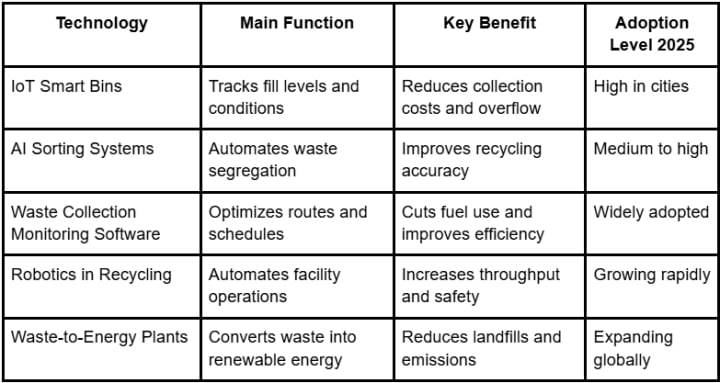
Comparative Table: Impact of Smart Waste Technologies in 2025
Challenges in Smart Waste Adoption
While these technologies offer major benefits, some challenges remain:
- High Initial Investment: Smart bins and robotics require significant capital.
- Integration Issues: Linking different platforms and devices can be complex.
- Data Security: IoT-based waste systems must ensure secure data handling.
- Public Awareness: Adoption depends on educating people about proper waste disposal.
Future Outlook
By 2030, experts predict that over 70% of global cities will integrate at least one form of smart waste management solution. Integration of AI, IoT, and waste collection monitoring software will play a central role in improving sustainability and reducing operational costs.
Conclusion
Waste generation continues to rise, but advanced technologies are changing how cities and industries handle it. From IoT-enabled bins and AI-powered sorting to robotics and waste-to-energy systems, 2025 is seeing a new era of efficiency in waste management. With the adoption of smart waste management solutions and waste collection monitoring software, organizations can improve sustainability, reduce costs, and meet environmental goals.
FAQs
1. What are smart waste management solutions?
Smart waste management solutions use IoT, AI, and automation to improve waste collection, sorting, and processing efficiency.
2. How does waste collection monitoring software work?
It uses sensors, GPS, and analytics to track vehicles, bins, and routes, ensuring optimized collection schedules.
3. Are smart bins cost-effective for cities?
Yes, smart bins reduce unnecessary trips and overflow, saving fuel and labor costs in the long run.
4. What role does AI play in waste management?
AI improves waste sorting accuracy, increases recycling rates, and supports automation in recycling facilities.
5. Can waste-to-energy replace landfills completely?
Not entirely, but it significantly reduces landfill dependency while producing renewable energy.
About the Creator
William Smith
I am an informative tech blogger exploring a wide range of topics, including web, mobile, IoT, etc.
Keep reading
More stories from William Smith and writers in Journal and other communities.
Offshore vs. Onshore Development: Which Model Fits Your Business Needs?
In today’s fast-paced tech world, businesses face a critical choice when building software: do they work with teams close to home, or look across borders? Both models—onshore and offshore—have unique advantages and potential drawbacks. Making the right choice can affect project costs, timelines, and even the final quality of your product. To put it in perspective, by 2025, the global offshore development market is expected to surpass $500 billion, showing how many companies rely on remote teams to scale efficiently.
By William Smith5 months ago in Journal
The Quiet Comeback of Men's Gold Jewellery
For years, men’s fashion leaned heavily toward minimalism. Clean lines, neutral tones, and understated accessories dominated wardrobes across the globe. Gold jewellery, once associated with bold statements or specific cultural aesthetics, seemed to fade into the background. But recently, something has shifted. Men’s gold jewellery is making a quiet yet confident comeback.
By Md Mehedi Hasan Rifad3 days ago in Journal
A Knight of the Seven Kingdoms Series Review (Season 1)
As one of the biggest properties in fantasy, A Song of Ice and Fire remains immensely popular with audiences. After reaching far into the past with House of the Dragon, a second spin-off was on the cards. A Knight of the Seven Kingdoms serves up a bite-sized slice of action and drama, but it still claims a spot among the best small-screen titles.
By Robert Cain6 days ago in Geeks



Comments
There are no comments for this story
Be the first to respond and start the conversation.