
Top 5 Keys To Unlocking Great Decisions
The Ultimate Guide to Decision-Making Frameworks for High Performers

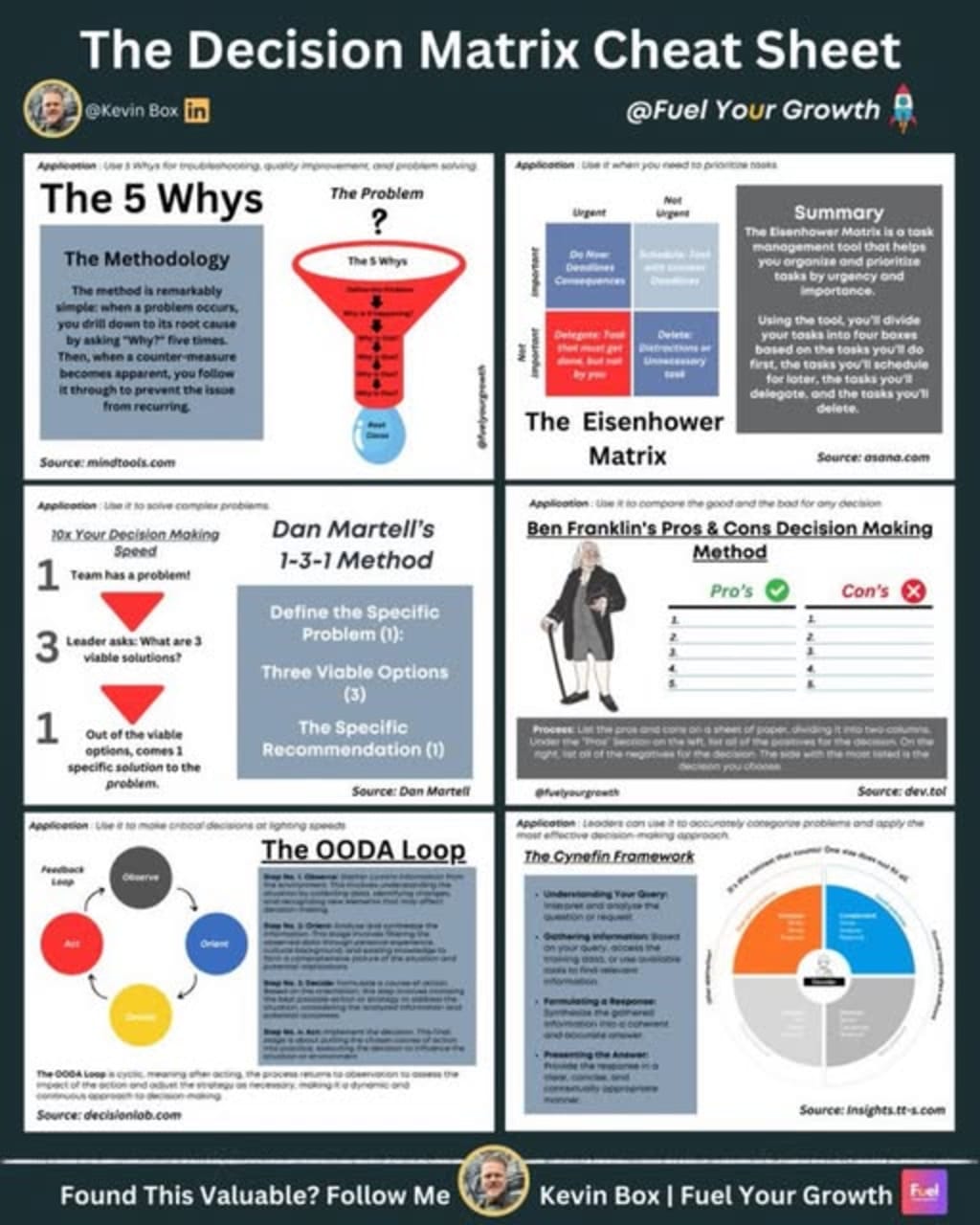
In today’s fast-paced world of entrepreneurship, leadership, and digital transformation, decision-making is no longer just a skill—it’s a superpower. The people who thrive, scale businesses, solve massive problems, and lead transformative teams aren’t always the most talented—they’re the best decision makers.
If you’ve ever felt stuck in “analysis paralysis,” overwhelmed by choices, or burned out from mental clutter, this article is for you. We’ll walk through seven powerful decision-making frameworks—including The 5 Whys, The Eisenhower Matrix, The 1-3-1 Method, The OODA Loop, and more. Each tool is practical, actionable, and proven to sharpen clarity and boost execution.
Let’s break free from indecision and fuel your growth—starting now.
1. The 5 Whys – Getting to the Root of the Problem
Application: Use it for troubleshooting, process improvement, and problem-solving.
Imagine your business faces a recurring issue—say, your users are churning. Instead of jumping to conclusions, ask “Why?”—five times. Each answer brings you closer to the root cause.
The Methodology:
The 5 Whys is a simple yet profound tool created by Sakichi Toyoda and used by Toyota Motor Corporation during the evolution of its manufacturing methodologies. Here’s how it works:
State the Problem: “Users are canceling their subscriptions.”
Ask Why: “Why are users canceling?”
Drill Deeper: Repeat until you identify the root cause.
Take Action: Once identified, resolve the underlying issue—not just the symptom.
Why It Works:
This method digs beneath surface-level symptoms to uncover systemic issues. It builds a culture of curiosity and continuous improvement.
2. The Eisenhower Matrix – Decide What Matters Most
Application: Use it to set priorities and practice focused productivity.
Named after former U.S. President Dwight D. Eisenhower, this matrix separates tasks into four clear quadrants:
Urgency Importance Action
Urgent + Important Crises, deadlines Do it now
Not Urgent + Important Planning, strategy Schedule it
Urgent + Not Important Interruptions, some emails Delegate it
Not Urgent + Not Important Time wasters Delete it
Why It Works:
Most people are reactive. But the best leaders are proactive. They invest energy into Quadrant II—important but not urgent tasks like relationship-building, strategy, and wellness.
“What is important is seldom urgent, and what is urgent is seldom important.”
– Dwight D. Eisenhower
3. Dan Martell’s 1-3-1 Method – Fast-Track Your Team’s Decisions
Application: Use it to make team decisions faster and more autonomously.
Dan Martell, a renowned SaaS investor and entrepreneur, developed this method to empower teams and cut down on unnecessary meetings.
Here’s the Framework:
1 – Define the specific problem.
3 – Propose three viable solutions.
1 – Present your single best recommendation.
Instead of asking the leader what to do, team members come prepared with well-thought-out suggestions and take ownership.
Why It Works:
This framework:
Accelerates decision speed
Trains team members to think strategically
Reduces micromanagement
Builds leadership from within
4. Ben Franklin’s Pro & Con List – Classic Wisdom for Balanced Decisions
Application: Use it to weigh trade-offs and think clearly under pressure.
When Benjamin Franklin faced difficult decisions, he used a simple system: a T-chart with Pros on one side and Cons on the other.
Pros Cons
Easier workflow Higher cost
Scalable Needs training
Faster output May break existing systems
How It Works:
Draw a vertical line down the middle of a page.
List all pros on the left.
List all cons on the right.
Evaluate with weighted logic or intuition.
Why It Works:
This method allows emotional and rational perspectives to align. It creates structure for subjective choices and encourages balanced thinking.
5. The OODA Loop – Make High-Stakes Decisions with Military Precision
Application: Use it to navigate rapid change and competitive environments.
Developed by military strategist John Boyd, the OODA Loop (Observe, Orient, Decide, Act) is a dynamic decision cycle used in combat—and now in business strategy.
The Four Steps:
Observe – Gather raw data and sensory input.
Orient – Analyze context, culture, past experience, and bias.
Decide – Choose a hypothesis or action.
Act – Execute and test your decision.
The beauty of the OODA Loop is its iterative nature. As new data emerges, you re-enter the cycle—fast and flexible.
Why It Works:
Perfect for high-stakes, high-speed decisions in volatile markets. It turns chaos into strategy.
6. The Cynefin Framework – Making Sense of Complexity
Application: Ideal for leaders dealing with uncertainty, ambiguity, and nonlinear challenges.
Developed by Dave Snowden, the Cynefin (kuh-NEV-in) Framework helps you understand what kind of situation you’re in so you can respond appropriately.
The Five Domains:
Clear (Obvious): Best practices apply. Sense → Categorize → Respond.
Complicated: Expert diagnosis needed. Sense → Analyze → Respond.
Complex: Patterns emerge after probing. Probe → Sense → Respond.
Chaotic: Act to stabilize immediately. Act → Sense → Respond.
Confused (Apex): Unclear which domain you’re in.
Why It Works:
Many leaders misdiagnose complexity as complication—and fail. Cynefin allows leaders to match the right response to the right context.
The Hidden Power of Frameworks
All these frameworks—from ancient wisdom to modern psychology—share one thing in common: they reduce cognitive load.
In a world overflowing with information and stimuli, our mental RAM is maxed out. Decision-making frameworks create clarity, reduce stress, and increase alignment across teams.
When used properly, they:
- Save time
- Improve consistency
- Eliminate emotional bias
- Build confidence
- Empower others to lead
How to Choose the Right Decision-Making Model
Here’s a quick guide:
Scenario Best Framework
Root cause of a recurring issue 5 Whys
Prioritizing daily or weekly tasks Eisenhower Matrix
Team communication & empowerment 1-3-1 Method
Making trade-offs or ethical decisions Pro & Con List
Crisis or fast-paced competition OODA Loop
Navigating uncertainty or chaos Cynefin Framework
Real-World Applications: From CEO to Student
These models aren’t just for executives in boardrooms. Whether you’re:
A startup founder raising capital
A marketing manager setting KPIs
A parent deciding on a school for your child
A student choosing between career paths
Frameworks are your best friend. They create structure where there’s confusion. They bring logic to emotion. And they save you from regret.
Final Thoughts: Decisions Define Destiny
You don’t need to be perfect. But you do need to be deliberate.
Every great leader—Steve Jobs, Warren Buffett, Oprah Winfrey, Elon Musk—understood the value of high-quality decisions. They used frameworks, trusted patterns, and surrounded themselves with systems that made clarity inevitable.
So the next time you’re stuck, overwhelmed, or unsure…
Pull out this cheat sheet.
Pick a model.
Apply it with courage.
And remember: Growth doesn’t come from knowing more—it comes from choosing better.
Found this valuable? Share it with your team, your mentor, or someone stuck in analysis paralysis.
Because the faster you decide, the faster you grow.
Let’s make better decisions—together.
If you'd like a downloadable PDF or a visual infographic version of this He launched. His sneaker line now ships to 12 countries.
About the Creator
Omasanjuwa Ogharandukun
I'm a passionate writer & blogger crafting inspiring stories from everyday life. Through vivid words and thoughtful insights, I spark conversations and ignite change—one post at a time.
Keep reading
More stories from Omasanjuwa Ogharandukun and writers in Journal and other communities.
Stereotypes About Women Who Keep Dogs as Pets
In the modern world where social media, pop culture, and everyday interactions shape how we perceive people, pet ownership is not just a lifestyle choice—it's a personality trait. And when it comes to women who keep dogs as pets, the stereotypes are both entertaining and revealing.
By Omasanjuwa Ogharandukun6 months ago in Journal
How Mobile App Development Atlanta Firms Handle UX Challenges?
UX problems rarely announce themselves early. They show up after launch, when users hesitate, abandon flows, or quietly stop engaging. By then, the cost of fixing them is higher and the patience of stakeholders is thinner. Atlanta app firms that consistently deliver successful products have learned this the hard way, and their approach to UX reflects that experience.
By Nick William5 days ago in Journal


Comments
There are no comments for this story
Be the first to respond and start the conversation.