

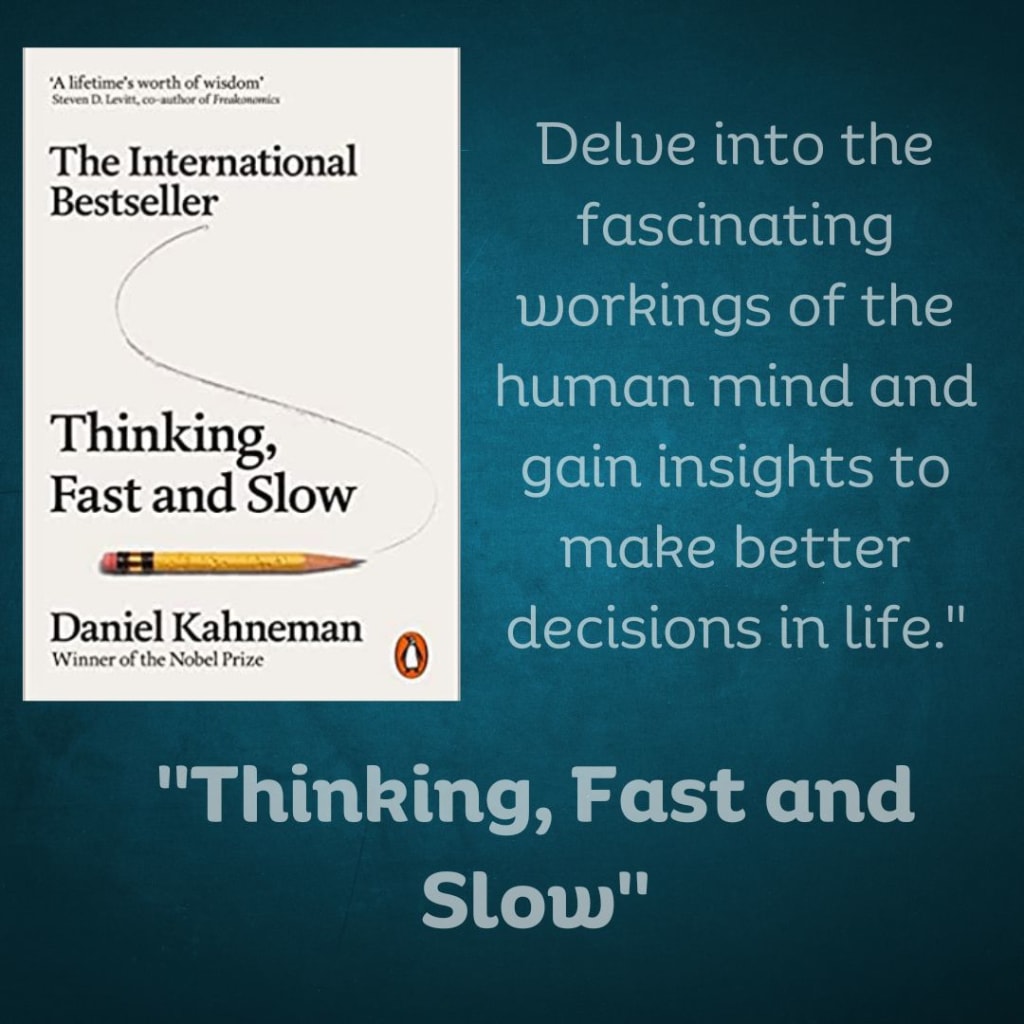
Are you curious about the inner workings of your mind? Do you ever find yourself making impulsive decisions without really understanding why?
Look no further than DanielKahneman'sn book, “Thinking, Fast and Slow.” In this Thinking Fast and Slow Review dive into the fascinating concepts presented in this must-read for anyone interested in psychology or personal growth.
Join us as we unlock the secrets of our minds and discover how to make a more informed choice
Introduction to "Thinking, Fast and Slow"
Daniel Kahneman’s-Thinking, Fast and Slow is a New York Times Bestseller and has been praised by many as a must-read.
The book delves into the study of human behavior and decision-making, providing readers with an in-depth look at how we think.
Kahneman divides thinking into two systems: System 1 thinking is fast, automatic, and emotional, while System 2 thinking is slower, more deliberative, and more logical.
He argues that our reliance on System 1 thinking often leads to errors in judgment.
The book provides numerous examples of how we can improve our Thinking by slowing down and using System 2 thinking when making decisions.
For example, Kahneman advises against relying on intuition when making important decisions, as intuition often relies on System 1 thinking which can lead to errors in judgment.
Overall, “Thinking, Fast and Slow” provides readers with a wealth of insight into the workings of the mind.
It is a significant read for anyone interested in understanding how we think and make decisions.
Overview of the Two Systems of Thinking
The human mind is an amazing thing. It is constantly working, even when we are unaware of it, and it is always trying to make sense of the world around us. The mind is split into two main Thinking systems: the ‘fast’ and the ‘slow’ systems.
The ‘fast’ system is the part of the mind that makes quick, automatic decisions based on gut feeling or intuition.
The ‘slow’ system is the part of the mind that takes time to think things through logically and rationally. This system is used when we need to make more considered decisions, such as when we are trying to solve a problem or figure out a new concept.
Both of these systems are important and have their strengths and weaknesses. The key is to learn when to use each one and how to balance them both to make the best decisions possible.
System 1: Fast Thinking
The mind is constantly processing information and making judgments, even when we’re not aware of it. This is thanks to what cognitive psychologist Daniel Kahneman calls “System 1” Thinking. System 1 is fast, automatic, and emotional.
It’s the Thinking that happens outside of our conscious control, like when we automatically jump out of the way of oncoming traffic.
Kahneman argues that our decisions are often driven by System 1 thinking, even when we think we’re being logical and rational. This can lead to errors in judgment, such as overconfidence and confirmation bias.
However, understanding how System 1 works can help us avoid these pitfalls and make better decisions.
System 2: Slow Thinking
According to Kahneman, our brains have two systems: System 1 is fast, automatic, unconscious, and emotional; System 2 is slow, deliberative, logical, and unemotional.
System 2 thinking is important for tasks that require focus and concentration, such as solving math problems or driving a car.
When we are engaged in system 2 thinking, we know and can control our thoughts and actions.
However, system 2 thinking is costly in terms of mental effort and can be easily disrupted by outside influences. For example, if we are trying to solve a math problem but get distracted by a noise or someone talking to us, our train of thought is interrupted, and it becomes difficult to concentrate on the task at hand.
Thus, when engaging in system 2 thinking, it is important to minimize distractions and have a clear goal in mind. By doing so, we can optimize our cognitive resources and improve our chances of success.
Unconscious vs. Conscious Decision Making
There are two types of decision-making: unconscious and conscious. Unconscious decision-making is when we make decisions without thinking about them.
We usually do this when we’re doing something routine, like driving to work. We don’t have to think about every small detail because we’ve done it so many times before.
Conscious decision-making is when we’re consciously aware of our choices. We might do this when we’re choosing what to eat for dinner or when we’re deciding whether or not to go on a date with someone. We have to think about all the options and weigh the pros and cons before deciding.
So, which type of decision-making is better? It depends on the situation. If you’re doing something you’ve done a million times before, it’s best to go on autopilot and let your unconscious mind take over. But if you’re faced with a new situation with many possible outcomes, it’s best to slow down and think things through carefully before making a decision.
Examples of Each System
The dual-process theory of the mind posits that there are two distinct ways of thinking: “fast” and “slow.” The fast system is intuitive, automatic, and emotional, while the slow system is logical, deliberative, and analytical.
Both systems have strengths and weaknesses, and each one is better suited for certain tasks than others. For example, the fast system is great for quickly recognizing patterns and making snap judgments.
Still, it could be better at complex problem-solving or considering all the evidence before making a decision. On the other hand, the slow system is much better at those things but can be painfully slow when all you need is a quick answer.
So which one should you use? It depends on the situation. If you’re trying to solve a problem or make an important decision, it’s best to use the slow system. But the fast system is probably your best bet if you’re trying to recognize a familiar face in a crowd or come up with a clever retort to someone’s insult.
Improve Your Thinking Processes
Nobel Prize-winning psychologist Daniel Kahneman explores the two different ways. System 1, which is speedy, automotive, and emotional, and System 2, that’s slower, more deliberative, and extra logical.
Kahneman argues that our brains are not well-equipped to deal with the complexities of modern life, and as a result, we often make irrational decisions. However, there are things we can do to improve our thinking processes.
Here are some tips on how to improve your thinking processes:
1. Be aware of your biases: All of us have biases that distort our Thinking. For example, we may need to be more confident in our abilities or more quick to judge others. By being aware of our biases, we can correct them.
2. Take your time: When faced with a decision, it is important to take the time to think it through carefully. Rushing into a decision is likely to lead to poor choices.
3. Get some perspective: It can be helpful to get input from others when making a decision. This allows us to see the situation from different perspectives and make a better choice.
4. Be willing to change your mind: We should be bold in changing our minds if new evidence arises that contradicts our previous beliefs. Holding onto outdated beliefs can lead us astray.
Download Free Book pdf on My Website
Advantages and Disadvantages of Both Systems
There are advantages and disadvantages to both the fast, impulsive Thinking of the System 1 brain and the more deliberate, logical Thinking of System 2.
On the plus side, System 1 is very good at quickly identifying patterns and making split-second decisions. This can be helpful in emergency situations when time is of the essence. Additionally, this kind of Thinking can lead to “gut feelings” or “intuition,” which can sometimes be accurate even when we don’t have all the facts.
System 2 thinking is careful and deliberative. It’s better at solving complex problems and taking into account all of the available information. This mode of Thinking is often slower, but it can be more reliable than System 1 in many situations.
So which system is better? The answer may depend on the situation. In some cases, it might be advantageous to think quickly and impulsively. But in other cases, it might be better to take our time and think things through.
Summary
Thinking, Fast and Slow is a bestseller that has been translated into 35 languages. It has sold more than 3 million copies and has been praised by psychologists, economists, and business leaders around the world.
In the book, Kahneman describes the two systems of thought that operate in the human mind: System 1 is fast, automatic, emotional, and intuitive, while System 2 is slow, deliberate, logical, and analytical.
Kahneman argues that our minds are not as rational as we think. We are often swayed by our emotions and quick judgments without realizing it. This can lead to bad decision-making in both our personal lives and professional lives.
The book provides readers with tools to make better decisions by understanding how our minds work.
In summary, “Thinking, Fast and Slow” is a groundbreaking book that provides readers with insights into the workings of the human mind. It is essential reading for anyone who wants to improve their decision-making skills.
About the Creator
Read Dude
Hello Bookish!
Book Blogger | Reviewer
Join me as we turn the pages and unlock the wonders of literature.
Visit My website:https://readdude.com/
What Happens to Your Eyes Under a 450nm Spike
You don’t see the spike itself. You see white light. Clean. Neutral. Bright. But embedded inside much of modern LED lighting is a narrow concentration of energy centered around 450 nanometers — a region of high-energy visible blue light. It became standard not because it was biologically ideal, but because it was efficient.
By illumipure7 days ago in Journal




Comments
There are no comments for this story
Be the first to respond and start the conversation.