
The world order likes to introduce itself as a set of principles.
In practice, it behaves more like a marketplace with aircraft carriers parked outside.

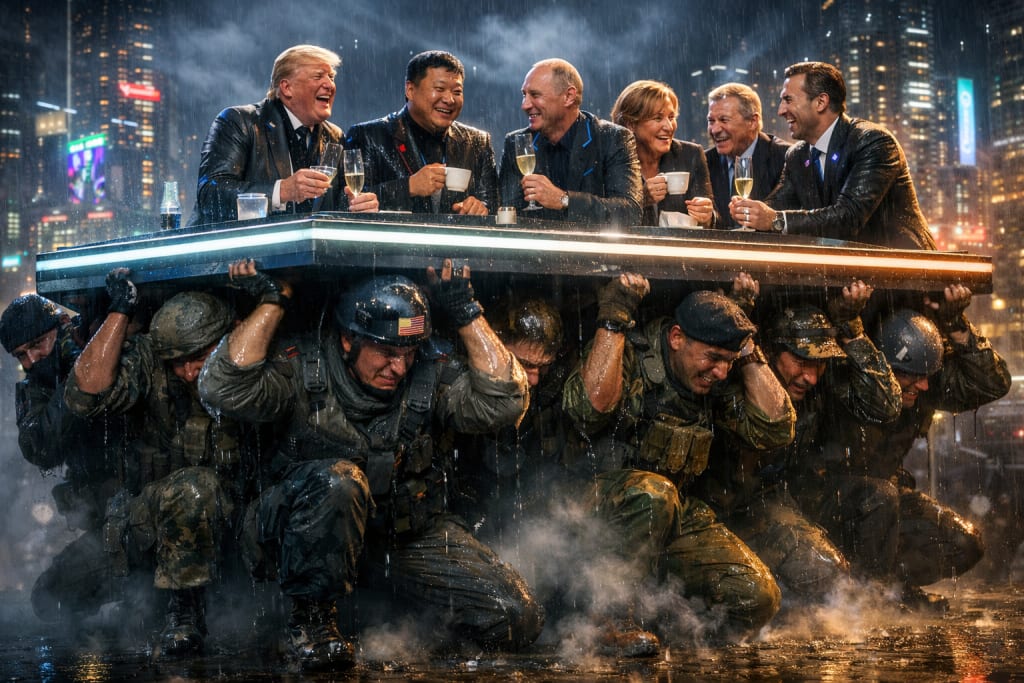
From 2010 to 2025, that tension between military dominance and national interest did not fade. It became the soundtrack. Every headline felt like a reminder that power still matters, but power now travels in new forms: data, supply chains, energy routes, sanctions, alliances, debt, and the quiet leverage of who controls the platforms where money and information move.
Back in 2010, many people still spoke with the optimism of the post Cold War era. Globalization looked unstoppable. The internet felt like a force that would naturally open societies. Finance flowed across borders like water finding the lowest point. Then the decade began to argue with itself.
The early 2010s brought political earthquakes that did not stay local. The Arab Spring showed how quickly a street can become a stage for history. At the same time, it exposed a hard truth about the global system: foreign policy is often a romance novel written in public, while the real plot is negotiated behind closed doors. Governments spoke of freedom. They also spoke, more quietly, of stability, energy security, and influence.
By the middle of the decade, the contest over borders and spheres of influence came roaring back. Russia’s seizure of Crimea in 2014 signaled that the era of “rules alone will protect you” was over. The language of deterrence returned, and so did the logic that military power can rewrite maps faster than diplomacy can protest.
Meanwhile, economics was becoming geopolitical. The Paris Agreement in 2015 reflected a moment when cooperation still felt possible, even necessary. But the same years also revealed how fragile that cooperation could be when domestic politics turned inward. The Brexit vote in 2016 and the surge of populism across multiple countries carried a similar message: global integration would no longer be treated as an unquestioned good. People wanted borders, control, and a story that put them back at the center.
Then came the late 2010s, when the US China relationship shifted from complicated partnership to open rivalry. Trade disputes and tariffs were not only about pricing. They were about technology leadership, industrial capacity, and who gets to set the standards of the future. It was the world order admitting, out loud, that economic advantage is a form of power and that power is rarely shared politely.
And then 2020 arrived like a door kicked in.
COVID 19 did something wars rarely do. It hit nearly everyone at once, and it turned the global economy into a stress test. The World Bank described 2020 as a severe global contraction, forecasting a steep drop in global GDP. The pandemic made supply chains visible to ordinary people. Suddenly, a mask, a chip, or a shipping container was not a boring logistical detail. It was destiny. Countries learned that dependency can feel like vulnerability, and resilience can look like nationalism wearing a lab coat.
The post pandemic recovery did not return us to the old rhythm. It produced a new kind of anxiety: inflation, interest rate shocks, and the realization that “efficient” systems often break when the world gets rough. The IMF has projected inflation easing over time, but the memory of the surge changed politics and policy debates everywhere. People began to talk about cost of living the way earlier generations talked about war.
In 2022, the world order’s central question sharpened again with Russia’s full scale invasion of Ukraine. Security became the headline. Energy became a weapon. Sanctions became a strategy. Europe raced to adapt, and defense planning moved from the back pages to the front. The lesson was blunt: military force is not an antique tool. It is still on the table, and it still moves markets.
If you want a number that captures the mood, look at defense spending. SIPRI reported world military expenditure rising to about 2718 billion dollars in 2024, the highest level it had recorded, alongside a rising global military burden. That is not a detail. It is a confession. Governments do not spend like that when they believe peace is guaranteed.
At the same time, the world did not become only a battlefield. It became a negotiation between fear and opportunity.
Technology accelerated. Artificial intelligence surged from research labs into everyday products, boardrooms, and policy arguments. Even the IMF warned that global growth could become too dependent on a narrow set of drivers tied to tech and markets. This is another kind of dominance, quieter than tanks but just as influential. The power to shape what people see, what they believe, and what businesses can do at scale is strategic power.
Across 2010 to 2025, public opinion also changed in a way leaders could not ignore. Trust became fragile. People grew skeptical of institutions, experts, media, and sometimes the idea of a shared reality. Politics turned into performance in many places, and policy became harder because consensus became rarer. The world order started to feel less like a system and more like a crowd, restless and ready to turn.
So what is the global order, really, in this fifteen year stretch?
It is not purely military hegemony, because even the strongest militaries cannot command supply chains, markets, or legitimacy forever. It is not purely mutual interest, because interests collide, and the collision is often violent or coercive. It is a hybrid machine: part security architecture, part economic network, part narrative contest.
And here is the romantic part, the part that still matters even when the news gets cold.
Countries, like people, want to feel safe. They want to feel respected. They want to believe their sacrifices mean something. When those needs are met, cooperation becomes possible. When they are not, even small disputes turn into symbol wars. From 2010 to 2025, we watched nations chase security through strength, chase prosperity through competition, and chase dignity through story.
The question is not whether dominance or interests will win. The question is whether the system can evolve toward a balance where security does not require humiliation, where trade does not require dependency, and where power does not need constant proof through crisis.
Because if the last fifteen years taught us anything, it is this: the world order is not a monument. It is a relationship. And relationships, as every human knows, can be either brutal or beautiful depending on how we choose to hold power.
About the Creator
Sayed Zewayed
writer with a background in engineering. I specialize in creating insightful, practical content on tools. With over 15 years of hands-on experience in construction and a growing passion for online, I blend technical accuracy with a smooth.
Keep reading
More stories from Sayed Zewayed and writers in Journal and other communities.
The Missing Language Every Engineer Should Speak.
Materials Engineering: The Missing Language Every Engineer Should Speak.. When most people think about engineering, they picture drawings, site coordination, schedules, and meetings. But quietly sitting under all of that is something far more fundamental: the materials themselves.
By Sayed Zewayed3 months ago in Journal
Author’s Advice
If you would’ve asked me 20 years ago did I know I’d become a writer and an author, I would’ve said “nope, ain’t happening”. As fate would have it I did become an author and I can honestly say I’m loving it so far. It really does feel good to be a writer. I’ve learned a lot on this journey and I feel like with even me being as new to this world as I am, there’s some wisdom I need to share with every other aspiring author.
By Joe Patterson3 days ago in Journal
How to Plan the Perfect Candlelight Dinner Experience in the Maldives
A candlelight dinner in the Maldives feels personal and intentional. The soft light and the open sky paired with the gentle sound of the sea, but to make sure this type of evening goes smoothly, it needs planning. Small choices shape the outcome, timing matters and the location matters. Details matter, and with the right approach, the experience feels calm rather than staged. This guide shows how to plan each step with care.
By Jeewanthi Armstrong4 days ago in Journal
The Forsyth House Fire
Since 1851, Forsyth House has stood on the corner of Union Street and Gordon Street in the heart of Glasgow. Its iconic, or was... because on Sunday 8th of March, 2026, a fire broke out in a small, seemingly un-named shop in the building and tore all that history down. As I write, the rubble is still unsettled and the street is still blocked off. Central Station is quiet on the upper level, and around 30 small businesses have quite literally gone up in smoke.
By S. A. Crawforda day ago in The Swamp




Comments
There are no comments for this story
Be the first to respond and start the conversation.