
The Three Horizon Model
Business planning strategy tool

Horizon — the limit of a person’s mental perception, experience, or interest
Every business needs a plan. When starting out, the business plan shows the customer base, marketing strategy, basic operating needs, costs, and the number of units sold at a certain price to be profitable. This plan helps the business hit the ground running. But once the business is up and running, the planning doesn’t stop just yet. Actually, the planning never stops. There will be strategy meetings, budget meetings, and brainstorming sessions, all of which are necessary to keep the business rolling. Without goals though, all of that planning is for nothing. This is where the Three Horizon Model comes in. In its most basic definition, the Three Horizon Model is a set of consecutive business goals or horizons. Each goal or horizon, at least in the beginning, should build upon the last goal. Each goal should be as far as you think you can take the business from where it is currently. The Three Horizon Model is a growth strategy developed by McKinsey & Company. The model is a growth strategy meant to help manage coordinated growth.
I’ve heard it said of the Three Horizon Model that it is flawed because it only has three horizons. The physical horizon is as far as the eye can see. If you keep moving, once you get to where the previous horizon was, you can see to a new horizon, giving your business an opportunity for new goals and new growth.
So back to all of those I mentioned. The Three Horizon plan can be set up to cover this week, three months in the future, and then six months in the future. There will always need to be new goals at the next horizon. That’s where the strategy and planning meetings come in. Maybe the business moves into a new market after it is up and running at the home base.
The Three Horizon Model is meant to always keep your business moving forward. Without goals, continuous growth is difficult. But, without growth, it’s hard to keep a business alive. For some businesses, it may make more sense to modify the plan and us five or more horizons, using goals that are smaller and more obtainable.
The model defines each horizon as the following:
Horizon 1: Current Period — Consolidate your current business model
Horizon 2: Future in the Medium Term — Expand your activity
Horizon 3: Future in the Long Term — Consolidate your new business model
Amazon is a great example of implementing the Three Horizon Model
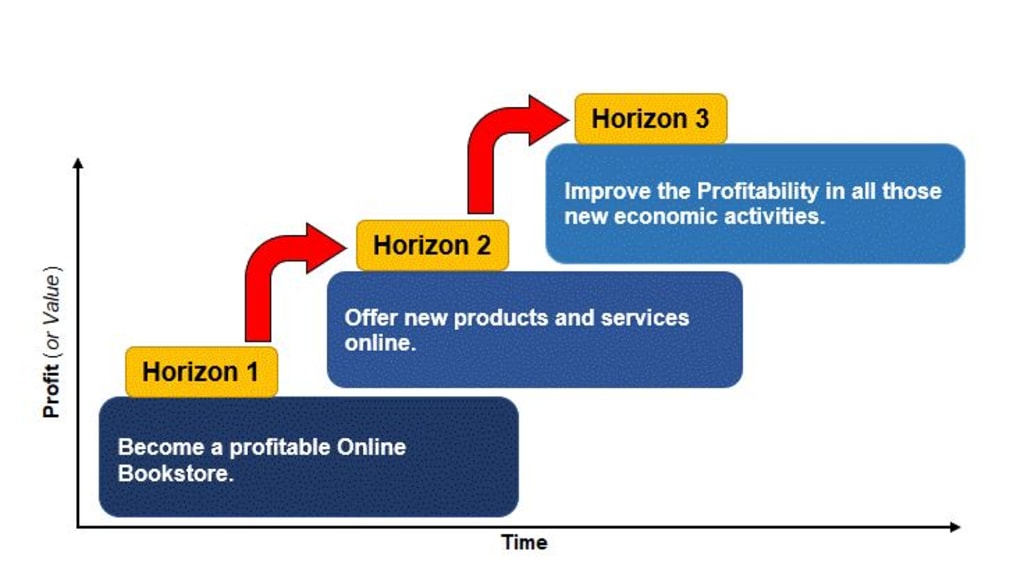
1. Horizon 1 — Become a profitable online bookstore
2. Horizon 2 — Diversify the online marketplace, offering all types of products
3. Horizon 3 — Improve the profitability of all the new economic activities
From there, Amazon went on to have a 1 Trillion dollar market capitalization.
The model can be applied to a sales team, or individual salesman, as well
1. Horizon 1 — The Salesman receives a book of business
2. Horizon 2 — Salesman adds 5 new accounts
3. Horizon 3 — Salesman and manager audit book of business, identifying growth accounts, accounts with potential, and accounts that need to be unassigned
Implementing a review process stage as one of the horizons helps to identify areas of growth and areas of stagnation. Sometimes it is hard to identify areas that aren’t bringing value without having an outsider perspective.
Standing still without a plan won’t get your business very far. The Three Horizon Model, while it won’t guarantee success, should be a good place to start. It was created by a powerhouse marketing and analytics firm and then used to create and build the largest online retailer. It can help you get yours off the ground too.
About the Creator
Keep reading
More stories from Nathan J Bonassin and writers in Journal and other communities.
Sales Tactics
There's a lot of chatter out there about what makes a good salesman. Every company needs at least one salesman, preferably a good one. Without someone to meet with your clients to present the product and educate the potential buyer, it's very difficult for a transaction to close. In an already crowded space, I'm sharing some of my thoughts on what makes a good salesman, what makes a bad salesman, and what I do on a daily basis in my sales job.
By Nathan J Bonassin11 months ago in Journal
The goals I did not achieve
Every writing goal I made for the year is a wash. It has been this way for a while, but I think it's important to be open about my failures and the reality of how life can get in the way. This is especially true considering the several times I have posted on Vocal about my writing goals, how I was changing my approach, and where I was hoping to be for the upcoming year. I will probably do that again in a couple months, but for now, it is time to acknowledge where I am today.
By Kay Husnick21 days ago in Journal
The Early Church Fathers and Why Their Writings Matter Today
The Early Church Fathers are some of the most important figures in the history of Christianity. Their writings, letters, sermons, and theological reflections helped define the beliefs, practices, and structure of the Church in the centuries following Christ. Understanding who the Church Fathers were and why their works matter today is essential for anyone seeking to understand Catholic teaching, tradition, and the roots of Christian faith.
By Sound and Spirit3 days ago in Journal


Comments
There are no comments for this story
Be the first to respond and start the conversation.