
The Silicon Anchor
Navigating the Tides of the Digital Infinite and the Reclamation of the Present

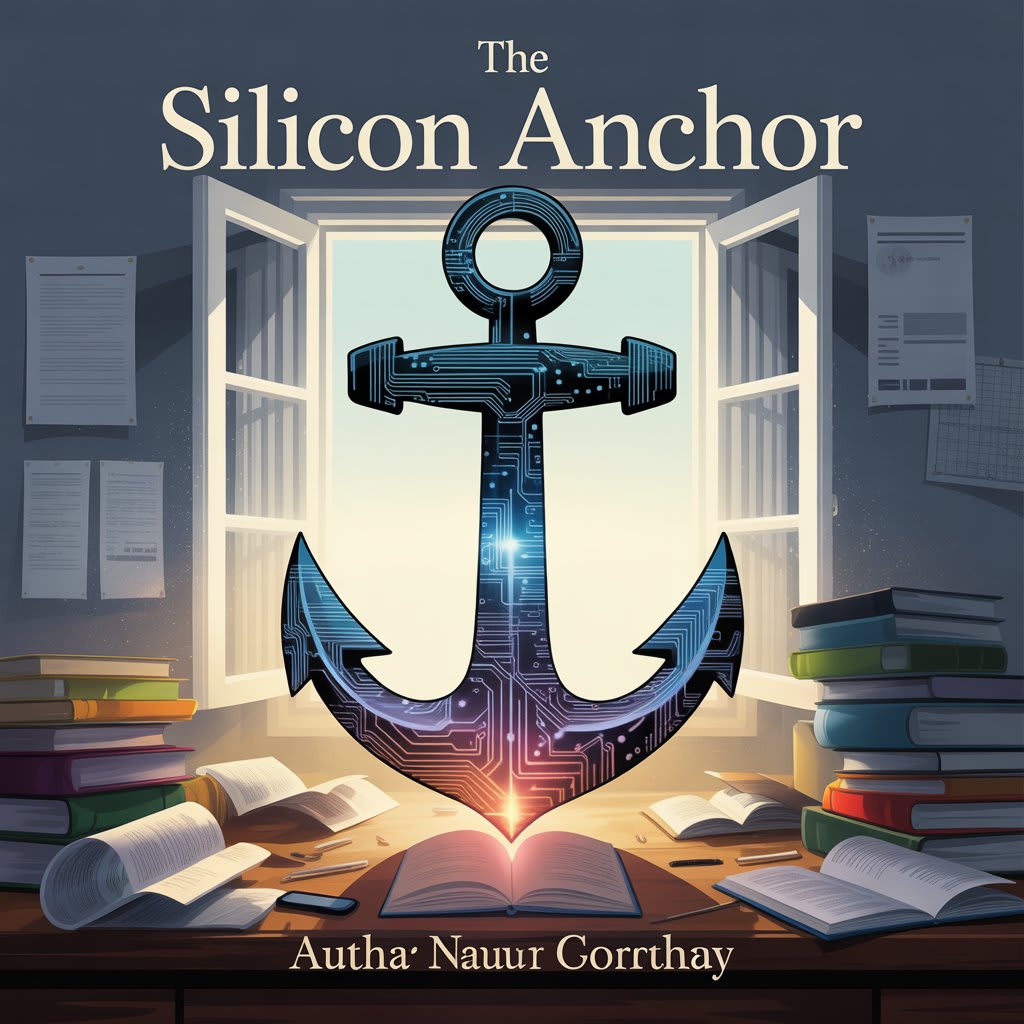
The fluorescent lights of the library hummed with a clinical persistence, a sharp contrast to the soft, rhythmic pulsing of the device in Leo’s palm. To any observer, Leo was the model of modern academic diligence. He sat in a secluded carrel, surrounded by a fortress of heavy textbooks: The Principles of Macroeconomics, Advanced Calculus, and a thick anthology of Romantic poetry. But Leo’s eyes weren't on the printed word. They were locked in a desperate, wide-eyed stare at a five-inch pane of illuminated glass.
Leo was a third-year university student, and like many of his peers in 2025, he lived in a state of "continuous partial attention." His phone was not just a tool; it was a digital phantom limb, a silicon anchor that both grounded him to his social reality and dragged him into the depths of a bottomless ocean of information.
The Dopamine Loop
The afternoon had started with a clear goal: finish the 2,000-word essay on the socio-economic impacts of the Industrial Revolution. He had opened his laptop, the cursor blinking like a taunt on the blank white page. But then, his phone vibrated—a sharp, haptic "thump" against the wooden desk.
It was a notification from a news app. “Tragedy in Los Angeles: Rob Reiner and Wife Found Dead.”
Leo didn’t just read the headline; he vanished into it. For the next forty minutes, he was a detective in a digital labyrinth. He swiped through threads on X, watched short-form videos of mourning fans on TikTok, and read a poignant reflection by a writer named Cheryl E. Preston about the fragility of life. By the time he looked back at his laptop, the cursor was still blinking, but the sun had shifted across the library floor, and his mental energy had been harvested by an algorithm designed to keep him scrolling.
This was the paradox of Leo’s life. He was a student—a seeker of knowledge—yet he was drowning in data. The mobile phone offered him the world, but in exchange, it took his ability to focus on the small corner of the world he actually inhabited.
The Ghost in the Classroom
The following morning, in a lecture hall filled with three hundred students, the scene was a tableau of the modern age. The professor, a graying man named Dr. Aris, spoke passionately about the "Reframing" of history. He walked back and forth, gesturing at slides of ancient ruins.
"To understand the past," Dr. Aris said, his voice echoing, "you must be present in the now."
Leo sat in the middle of the hall, his phone hidden beneath the ledge of his desk. He was currently in a heated group chat about a classmate’s recent "Life Update" post. His thumbs moved with a speed that exceeded his typing skills on a keyboard. Around him, dozens of blue-lit faces stared downward. It was a room full of bodies, but the minds were elsewhere—scattered across social media platforms, gaming servers, and shopping apps.
Suddenly, Dr. Aris stopped talking. The silence stretched until it became uncomfortable. Leo, sensing the change in the room’s frequency, looked up.
"I see a lot of bowed heads today," Dr. Aris said, not with anger, but with a profound sadness. "It looks like a room of people in prayer. But I fear you aren't praying to a god; you are sacrificing your time to a machine that will never give it back."
Leo felt a sharp pang of guilt. He looked at his phone. A notification had just popped up: “John Cena’s Retirement: A 20-year Legacy Ends.” Normally, Leo would have clicked. He would have spent twenty minutes watching highlight reels. But he looked at Dr. Aris, then back at the phone. For the first time, the device didn't look like a window. It looked like a cage.
The Experiment of Silence
That evening, Leo did something radical. He returned to his dorm room, sat at his desk, and placed his phone in his top drawer. He turned the handle and felt the click of the lock.
The silence was immediate and terrifying.
For the first twenty minutes, Leo experienced what he could only describe as "phantom vibration syndrome." He felt a twitch in his thigh where his phone usually rested. His brain kept sending signals to check the time, check his mail, check the weather, check anything. Without the constant stream of external stimuli, he was forced to sit with his own thoughts—and he realized he didn't really know them anymore.
He opened his textbook. At first, the sentences were difficult to process. His brain, conditioned for 15-second bursts of content, rebelled against the long, complex paragraphs of economic theory. He had to read the same page four times. He felt an itch to unlock the drawer, just for a "five-minute break."
But he persisted. He remembered an article he’d skimmed about "The Poetry Dimension"—how literature requires a different kind of "motor control" and mental stamina. He began to take notes by hand. The physical act of pen hitting paper felt slow, almost primitive, but it was grounding.
As the hours passed, something miraculous happened. The "brain fog" that had characterized his last two years of study began to lift. He entered a state of "Flow." The Industrial Revolution wasn't just a list of dates anymore; it became a narrative of human struggle and innovation. He found himself drawing connections between the steam engine and the very digital revolution he was currently battling.
The Reclamation
When Leo finally unlocked the drawer three hours later, he had 47 missed notifications. There were three "urgent" memes in the group chat, two emails from retailers, and a dozen likes on a photo he’d posted two days ago.
He looked at the notifications and realized: None of this mattered.
The world hadn't ended because he wasn't looking at it through a screen. His friends were still his friends. The news was still the news. But he had gained something precious—three hours of his own life.
The next day, Leo sat in the library again. He kept his phone in his bag, turned off. He looked out the window and noticed, for the first time, the way the winter light caught the red leaves of the maple tree outside. He saw a fellow student, Sabrina, actually reading a book titled An Ordinary Day, and they exchanged a brief, genuine smile—a real-world "like" that felt infinitely warmer than a heart icon on a screen.
Leo realized that his mobile phone was a bridge to the world, but a bridge is a terrible place to build a home. To be a student, he had to be a student of life, not just a consumer of content. He picked up his pen, looked at the blank page, and began to write. This time, the words came easily. He wasn't just a ghost in the classroom anymore; he was a person, awake and alive, finally tuned into the frequency of the real world.
About the Creator
How to Use a Tortellinatrice to Make Perfect Tortellini
Making tortellini by hand can be slow and difficult. Many cooks struggle with folding, filling, and sealing each piece perfectly. The result is often uneven shapes, broken pasta, or filling that leaks during cooking. The good news is that a tortellinatrice solves these problems by automating the process of shaping and sealing tortellini while keeping the traditional taste intact. With the right preparation and proper machine settings, anyone can use a tortellinatrice to produce perfectly shaped tortellini quickly and consistently.
By Zain Princeabout 17 hours ago in Journal
Bomb Scare
It was 2027, and the world never thought it would happen. A missle hit the United States, but it wasn't where they had anticipated. A little town in the northeast was hit by a missile strike, they didn't know why, and they didn't know exactly where it hit, but they did know it was a coastal community, somewhere between Maine and Delaware.
By Gregory Payton5 days ago in Fiction



Comments
There are no comments for this story
Be the first to respond and start the conversation.