
“The Science of Small Things”
A journey from childhood wonder to scientific discovery—how curiosity, memory, and loss shaped a lifelong pursuit of answers.

“The Science of Small Things”
When I was seven, I thought science was magic. Not metaphorically. I believed scientists were a special breed of sorcerers who had just learned how to speak the language of the earth better than anyone else.
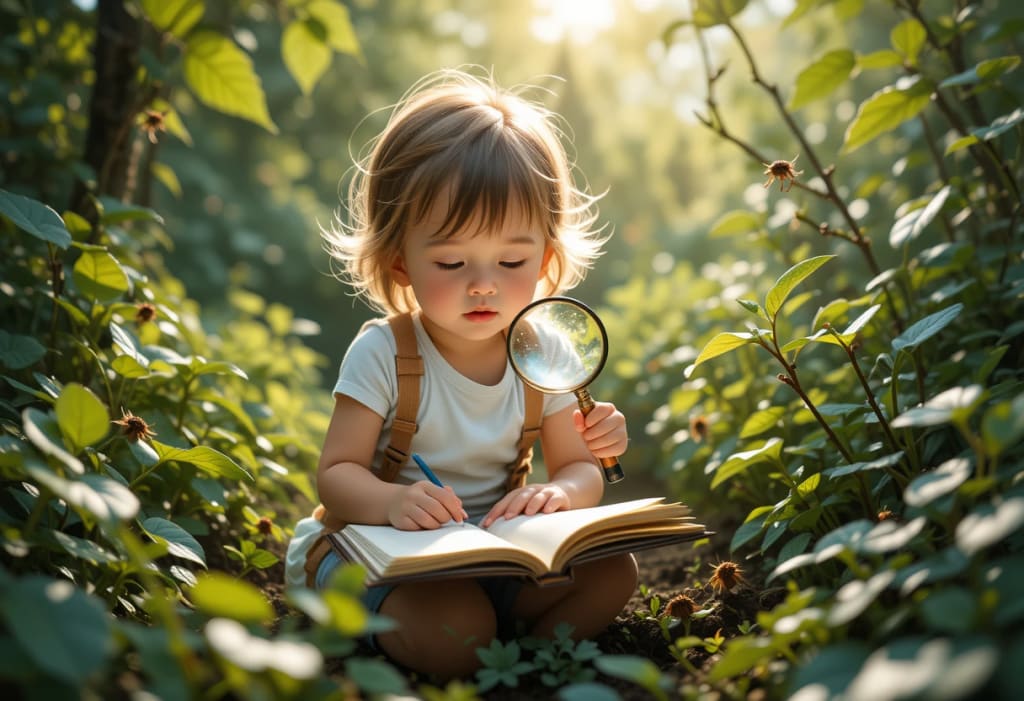
I used to sit in the garden behind our house with a battered notebook and a plastic magnifying glass. My grandmother thought it was adorable; my father thought I was wasting time. But to me, those slow afternoons of watching ants carry crumbs or testing how many drops of water a leaf could hold before spilling were acts of discovery. They were real science, even if I didn’t yet know what the word “method” meant.
The first time I heard the word photosynthesis, I thought it was a spell. I ran into the kitchen and shouted it like an incantation. “Photosynthesis!” I said, pointing at a spider plant like I expected it to bloom into fireworks. My mother chuckled, handed me a cup of juice, and asked if I wanted to help with the cooking instead.
I wanted science. Not soup.
By the time I was ten, I had built a “volcano” in the backyard using baking soda, vinegar, and food coloring. The grass around it died for a week. I proudly called it collateral damage.
No one in my family was a scientist. My father worked in construction. My mother was a part-time nurse and full-time everything else. My siblings were older and already consumed by phones and flirting and future plans that didn’t include backyard volcanoes. But I kept on, filling notebooks with observations, taping down leaves, bugs, petals, even feathers — each labeled with shaky handwriting and questionable spelling.
When my parents couldn’t afford to take us on vacation, I would turn our hallway closet into a space station. I’d climb in with a flashlight and a pair of goggles, pretending I was aboard the ISS, orbiting the Earth while conducting imaginary experiments with zero gravity and snack bars.
It was beautiful. It was mine.
High school changed things.
Science stopped being magic. It became formulas. Diagrams. Standardized tests and teachers too overworked to care if your lab report included a doodle of an electron dressed like a superhero. The fun drained out of it, one dry lecture at a time.
I started to think maybe I had gotten it wrong. Maybe science wasn’t magic. Maybe it was just...math in disguise.
But in 11th grade, something cracked open again.
It happened during a biology class, dissecting a frog. I didn’t flinch like the others. Instead, I stared — fascinated by the complexity inside something so small. The organs, the structure, the symmetry. My lab partner gagged; I memorized every detail.
That evening, I read an article online about regenerative biology and how frogs were being studied to help human limb regeneration. Suddenly, the frog wasn’t just a specimen. It was a clue — a piece of a puzzle stretching across centuries and species.
Science, I realized, wasn’t supposed to be neat. It wasn’t about the formulas. It was about the questions.
And I had so many.
By the time I reached college, I had declared a major in neuroscience. People often ask me why. I usually say something like, “I’ve always been curious about how the brain works.” But the real answer is this:
Because I watched my grandfather forget my name when I was twelve.
Because I saw the light in his eyes dim when he couldn’t remember where he lived.
Because I heard my father cry in the hallway when he realized his own father didn’t recognize him anymore.
I chose neuroscience not because I loved brains, but because I hated what happens when they fail.
I wanted answers. Science offered possibilities.
Now, I work in a lab studying memory consolidation. Most of what I do is tedious. I pipette chemicals into tubes. I run code that fails five times before it gives me data. I spend hours writing grant applications that go unanswered. It’s not glamorous.
But every now and then, I get to see a neuron fire on a screen. I get to watch data come together into a pattern that no one else has seen before. I get to feel that flicker of magic again.
And sometimes, on a quiet weekend, I still sit in the garden.
I don’t chase ants anymore. I don’t pretend leaves are test subjects. But I watch, and I wonder — just like I did when I was seven.
Because science, at its core, is about paying attention.
Noticing the things others ignore. Asking “Why?” when the world has moved on. Believing that the smallest patterns might lead to the biggest truths.
Science is slow. It’s stubborn. It doesn’t always give you answers. But it does give you better questions.
And that, to me, is still magic.
About the Creator
Keep reading
More stories from waseem khan and writers in Journal and other communities.
The Girl Who Dated Ghosts
The Girl Who Dated Ghosts Genre: Surreal / Romance / Humor I didn’t mean to fall in love with a ghost. At first, I thought Sam was just a guy who liked vintage coats and brooded well in low lighting. We met at a secondhand bookstore, both reaching for the same Sylvia Plath collection. Our fingers touched. He smiled—a little crooked, a little sad. He smelled like rain and old pages.
By waseem khan6 months ago in Journal
Center Stage with Paul Stewart
*** I'm keen to republish the interviews I did for my series with Vocal creators. It's been a few years and I thought it might be nice to revisit these wonderful conversations. I'll be releasing them one at a time for a few weeks/months.
By Heather Hubler4 days ago in Interview



Comments
There are no comments for this story
Be the first to respond and start the conversation.