
The Role of Point Cloud to Revit in Preserving Historical Buildings
Point Cloud to BIM Modeling
The architecture and construction landscape has adopted a paradigm shift that has offered advanced outcomes. From traditional, time-consuming and ineffective processes to well-organized, accurate and streamlined methodologies, the AEC industry witnessed drastic change. The early days of construction were extremely challenging, complex, time-consuming, and of course labour-intensive. All this impacted the process construction and over budgeted the project as well, due to significant rework. However, the transformative change in the AEC landscape changed the scenario into the most accurate, effective, and efficient one.
Mainly, this drastic change is fueled by building information modeling technology that has allowed AEC experts to enhance the complex construction and designing process. BIM services in the AEC industry have revolutionized the working approach by streamlining the process, enhancing communications, and facilitating efficient design, among other benefits. With BIM technology in the architecture and construction realm, architects, designers, engineers, and other professionals have improved the working structure with accurate results. As a matter of fact, BIM is not only implied for new construction projects but is also helpful in renovation, refurbishment, and preserving historical monuments.
Preserving the art and history in architecture is a complex task, as the building lacks essential construction documents, such as blueprints, that are useful. However, technology plays a major role in the construction sector, which has offered laser scanning approaches and integrated them into Revit. In today's technological world, heritage restoration with Revit brings advantageous solutions, from efficient preservation to managing facilities for future outlooks.
The idea of laser scanning in the BIM workflow is often used for renovation, remodel, and refurbishment projects. Typically known as scan to BIM services in the architecture and construction realm, AEC professionals leverage the power of technology to preserve heritage monuments, offering a variety of advantages. Furthermore, the significant power of point cloud to Revit has given a modern curve in the AEC landscape, enabling architects, designers, and engineers to efficiently restore the building without losing the essence.
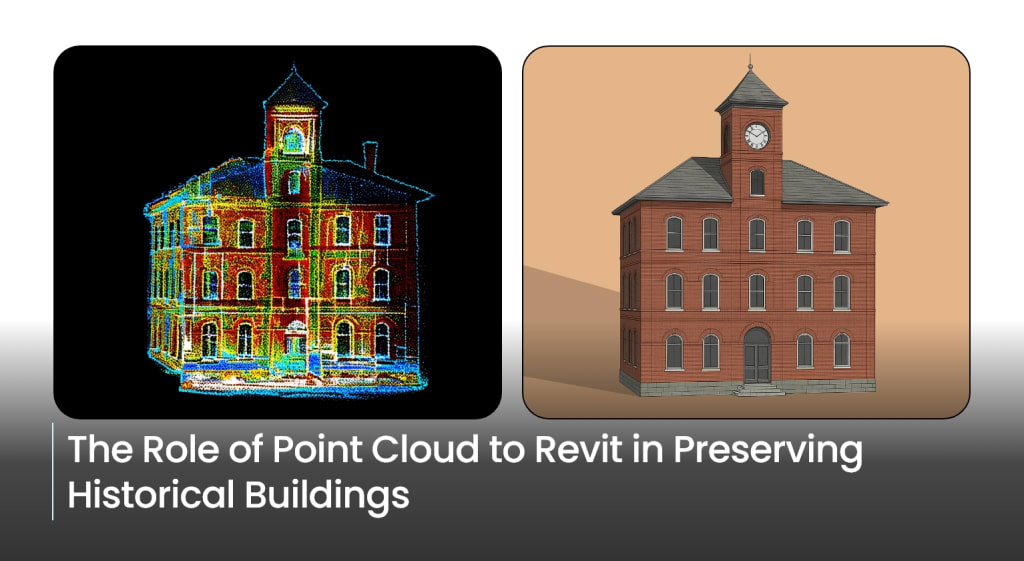
This advanced technology involves scanning buildings, collecting point clouds, and converting them into a 3D model that showcases the area for renovation. Let's understand in detail what point cloud modeling architecture is and its significant benefits.
Point Cloud to Revit for Historic Preservation
Preservation of historic monuments is significant due to the cultural and traditional values of the nation and the ability for future generations to witness the historical art. Historical buildings have complex designs, and it is challenging to preserve them. Scan to BIM technology plays a crucial role in modern architecture and construction. As mentioned, preserving historical monuments is crucial for future generations, and over time, buildings, facilities, and monuments degrade due to various reasons.
It is evident that preserving and scan to BIM services is a significant technology that allows AEC professionals to renovate the building in the affected arena. This process begins with laser scanning of the existing building (designated space or entire building) that digitally captures the physical space.
Furthermore, the collected data or scanned file is converted into a 3D Revit model that enables architects, designers, engineers, and other professionals to renovate the historical building as required. As a matter of fact, point cloud to Revit modeling helps to create precise, efficient, and data-rich 3D models for analysis of the historical building. This digital approach allows AEC professionals to accurately plan, design, and execute the remodeling project. In the modern architecture and construction industry, point cloud data serves as a building block for Revit modeling, enabling precise refurbishment of existing structures without delays or errors.
As a matter of fact, playing a crucial role, it offers information about the current state of the building that enables AEC professionals to make informed decisions for design and required renovation. This helps the project team or experts to reduce errors, save time, and ensure that the design aligns with the actual building. BIM being the major approach, converting data points into a 3D model serves as the building block of the project in accordance with the improved renovation process and historic preservation. Explore in detail the benefits of Revit for cultural heritage projects.
Key Advantages of Scan to BIM for Historic Buildings
As previously discussed, point cloud modeling architecture for historic preservation also brings various advantages. The landscape of AEC has undergone a significant transformation, driven by technological advancements and innovative approaches that enable architects, designers, engineers, and other professionals to streamline and enhance project quality. With BIM being the heroic approach in the architecture and construction landscape, point cloud to Revit, or popularly known as scan to BIM services, has been a holistic technology. It allows professionals to renovate or remodel the existing building with precision and efficiency. Not only this, but it offers a variety of benefits, as follows;
- Enhanced accuracy and efficiency: By converting the point cloud into a Revit model, AEC professionals can proceed with the remodeling process, utilizing efficient design planning and enhanced resource allocation. This ensures the digital model is accurate and meets the project's requirements, aligning with the project's design.
- Solving As-built inconsistencies: Preserving a historic building is a complex process considering the lack of information and the complex design of the infrastructure. Renovation of the existing infrastructure comes with a variety of inconsistencies, especially in the built model. With accurate implementation of point cloud to Revit, AEC professionals can manage as well as bring a holistic solution for streamlining the remodeling process.
- Precision in groundwork: Once the model is built, it is evident that maintaining accuracy in the on-site construction process is also crucial. Unlike traditional approaches that heavily relied on manual measurement, the scan to BIM process helps in maintaining accuracy, efficiency, safety, and reliability during the on-site construction work.
- Cost and time saving: One of the major advantages of utilizing point cloud in Revit is saving time and cost in various aspects. As the digital 3D model reduces errors, it accelerates project delivery, enhances project planning and time management, improves resource management, and reduces wastage.
- Better communication and coordination: Another significant perk of scan to BIM for historic buildings is easy communication and coordination. As there are plenty of AEC professionals working on the same project, effective communication and coordination are key aspects of a project's success. With precise Scan to BIM implementation, AEC experts can easily communicate and coordinate with each other, which reduces the scope of errors and rework.
These are some of the key benefits, and partnering with the right Scan to BIM company is significant. Partnering with scan-to-BIM experts ensures significant results through the proper use of technology and adherence to industry standards for seamless paperwork.
Final Words
Scan to BIM has become a comprehensive way that provides seamless renovation execution, historic preservation, and an accurate outcome of the project. It has become an indispensable approach in today's AEC landscape.
About the Creator
UniquesCADD
UniquesCadd is an architectural & engineering company providing exceptional building design solutions, namely BIM services, architectural services, structural services, scan to bim, 3D rendering, CAD drafting & MEPF solutions
Keep reading
More stories from UniquesCADD and writers in Journal and other communities.
Scan to BIM Services for Sustainable Building Design
The rising concern of saving the environment and looking for novel solutions has become a prime goal to achieve. As every sector is contributing its part in saving the environment, the AEC sector has come up with a bunch of sustainable and environmentally friendly solutions. Thanks to the introduction of BIM technology, which became a valuable tool for architects, engineers, and other professionals, the rise of building information modeling has altered the industry’s working approach and given a new curve of creativity with enhanced precision and efficiency.
By UniquesCADD8 months ago in Journal
Office Solutions, Local Sponsorship & Nominee Services: Supporting Business Growth
Starting and running a business in the United Arab Emirates involves more than securing a trade license. Entrepreneurs must also address practical and legal requirements such as office space, ownership structures, and compliance with local regulations. For many investors—especially those new to the UAE—office solutions, local sponsorship, and nominee services play a key role in ensuring smooth business operations.
By Adnan Sheikh4 days ago in Journal


Comments
There are no comments for this story
Be the first to respond and start the conversation.