
The Role of CRM in KYC, AML, and Regulatory Compliance for Banks
Strengthening KYC, AML, and compliance with CRM in banking
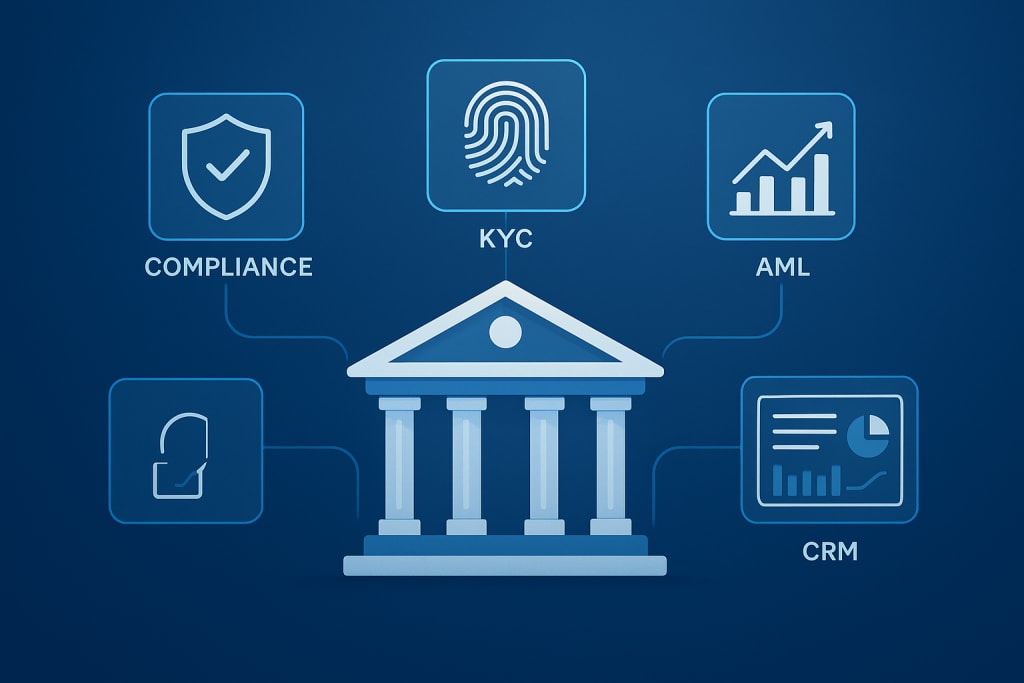
In an era of tightening financial regulations and rising expectations for seamless customer experiences, banks must adopt systems that not only manage relationships but also enforce compliance. CRM in banking is no longer just about marketing and sales—it’s a strategic tool to support Know Your Customer (KYC), Anti-Money Laundering (AML), and broader regulatory compliance. When paired with robust banking software development services, the right CRM can become a compliance backbone rather than an afterthought.
Why Compliance Matters in Banking
Before we dive into how CRM supports compliance, it helps to understand the stakes:
- KYC (Know Your Customer): Regulations require banks to verify the identity of their customers, assess risk, and maintain records.
- AML (Anti-Money Laundering): Frameworks require banks to monitor, flag, and report suspicious transactions, ensuring illicit funds cannot flow undetected.
- Regulatory Oversight: Compliance demands auditability, traceability, data protection, and regular reporting. Non-compliance can lead to heavy fines, reputational damage, or even loss of license.
Given these pressures, banks can no longer treat compliance as a siloed function. They must embed compliance into customer lifecycle operations.
How a CRM System Supports KYC & AML
A well-designed CRM system in banking does more than just store contact details. It becomes a dynamic compliance engine when configured properly. Here are key ways crm in banking platforms aid KYC/AML and regulatory functions:
1. Unified Customer 360° Profiles with Verified KYC Data
A CRM tailored for banking can house all relevant customer information—identity documents, risk scores, transaction patterns, and third-party checks—in one unified view. This ensures that relationship managers, compliance teams, and back offices always operate from the same, up-to-date data.
2. Embedded KYC Workflow Automation
Instead of handling KYC checks in a separate system, the CRM can host workflows that guide users through verification processes. Integration with identity verification APIs, e-signature tools, or external databases reduces manual errors and ensures compliance checks are completed efficiently.
3. Transaction Monitoring & Risk Scoring
The CRM can ingest transactional data to track customer behavior over time. It can flag anomalies, sudden spikes, cross-border transfers, or suspicious patterns. Advanced systems may use analytics or machine learning to reduce false positives in AML alerts, improving both accuracy and efficiency.
4. Audit Trails, Logs & Traceability
One critical compliance requirement is the ability to trace who did what, when, and with which data. A CRM must generate detailed audit logs for all interactions, changes in customer status, document updates, and approvals. These logs support internal reviews and regulator audits.
5. Regulatory Reporting & Dashboarding
A compliance-aware CRM can generate reports required by regulators, such as suspicious transaction reports, KYC completeness metrics, and turnaround times. Dashboards provide visibility into compliance indicators, helping banks identify and address issues proactively.
6. Role-based Access, Data Segmentation & Encryption
Because banking data is highly sensitive, the CRM must enforce strict security: encryption, role-based access control, data masking, and segmentation. This ensures only authorized users can access specific records, supporting compliance with privacy regulations.
7. Ongoing Monitoring & Periodic Review
Compliance is not static. KYC needs periodic refresh, risk profiles evolve, and new regulations may impose additional checks. A CRM can schedule periodic reviews, send reminders, escalate overdue cases, and integrate with updated watchlists such as sanctions or PEP databases.
Why Generic CRMs Often Fail in Banks
Many banks initially adopt off-the-shelf CRMs designed for sales and marketing. However, these systems often fall short when regulatory demands are considered:
- They lack built-in compliance workflows, audit logs, and granular access control.
- Integration with core banking, identity verification, or transaction systems is limited.
- They struggle with scaling to high transaction volumes and complex risk assessments.
- Regulatory reporting requires extensive custom development, increasing cost and effort.
This is why many institutions turn to specialized banking software development services to design or customize CRMs that natively handle KYC, AML, and regulatory workflows.
Role of Banking Software Development Services
To make crm in banking compliance-ready, banks often collaborate with experienced banking software development services providers. These partners bring deep expertise in financial regulations, security, and system design. Here’s how they add value:
- Architecture & Integration – Designing robust architectures that integrate CRM with core banking, transaction engines, identity verification APIs, and compliance databases.
- Compliance-by-Design Development – Embedding compliance logic such as alerts, thresholds, and reporting directly into the CRM system.
- Scalable Analytics & AI Modules – Implementing analytics and machine learning to enhance AML detection and risk scoring.
- User Experience & Workflow Customization – Creating intuitive interfaces that improve adoption among relationship managers and compliance officers.
- Security, Audit, and Governance – Enforcing strong encryption, access control, and logging to align with global regulations.
- Maintenance & Regulatory Updates – Ensuring the system evolves as regulations change, minimizing compliance risks.
With such expertise, CRM becomes more than a tool—it becomes a compliance enabler and a strategic advantage.
Competitive Advantage for Banks
When banks successfully embed compliance into CRM, the benefits go beyond risk management:
- Faster and smoother customer onboarding
- Reduced cost of compliance operations
- Better fraud detection and prevention
- Stronger trust with regulators and customers
- Increased customer loyalty due to a seamless yet secure experience
This dual advantage—improved compliance and better customer service—is why compliance-driven CRM systems are quickly becoming a standard in modern banking.
Key Takeaways
- CRM in banking now plays a central role in ensuring compliance with KYC, AML, and regulatory requirements.
- Features such as unified customer profiles, workflow automation, transaction monitoring, and audit trails make CRM indispensable for compliance.
- Off-the-shelf CRMs often fail to meet compliance demands, making tailored solutions essential.
- Partnering with banking software development services ensures that CRM systems are compliance-ready, secure, and scalable.
- Implementation success depends on phased rollout, clean data, cross-departmental collaboration, and continuous monitoring.
- A compliance-ready CRM not only reduces risk but also improves customer trust and loyalty.
About the Creator
Keep reading
More stories from Isabella Rossi and writers in Journal and other communities.
Top 10 Software Development Companies in Canada
As the digital economy in Canada accelerates, businesses are increasingly turning to high-performance software partners to drive innovation, scalability, and digital transformation. Whether it's enterprise systems, cloud-native applications, AI-powered platforms, or fintech ecosystems, choosing the right software development company in Canada can make all the difference.
By Isabella Rossi4 months ago in Journal




Comments
There are no comments for this story
Be the first to respond and start the conversation.