
The Role of Agility In The Age Of Enterprise Solutions
As a technology and a business leader, you’re challenged with creating the right mix of people, processes, and technologies to accelerate innovation through agility.

“Don’t Just Transform, Evolve Too”
The term "Agile Transformation" has gone from a fashionable buzzword to a must-have corporate strategy, and it shows no signs of dying down. The concept of an agile transformation is not new in an agile software company. It's not simple to become a digital champion - to stand out and win clients, you need to be able to exhibit something rapidly, whether it's real hardware or an application.
Of course, to reap the benefits of Agile concepts, Development teams must go beyond theory and put them into practice.
The articles illustrate how BJIT assisted customers in making the switch to Agile.
Why Is Agile Development Popular For Digital Transformation Projects?
The strategic agile manifesto has expanded beyond IT to affect whole organizations, with the ultimate objective of updating how businesses operate, compete, and adapt. An enterprise-wide agile transformation that welcomes iterative, cross-functional cooperation to fully realize the promise of digital technologies.
Every facet of business operations in a genuinely agile organization is involved in a continuous cyclical process of finding and assessing, prioritizing, creating, operating, analyzing...…and repeat.
Experimentation, cooperation, iteration, and a customer-centric approach are all significant characteristics in agile software development services.
Why Should You Switch To Become Agile Too?
It's a fiercely competitive and ever-changing corporate world. IT companies are under increasing pressure to innovate quicker, better, and more frequent in providing better customer service, increase operational efficiency, and increase return on investment (ROI).
Simultaneously, businesses must be cautious about continuous regulatory compliance—which can be a changing target—while lowering operational risks, staying ahead of the competition, and integrating top talent of an agile company.
Finally, in today's rapidly growing digital world, it's critical for businesses to closely link their operations with their IT. All of this means that organizations today have an overall strategic requirement for agility to respond and adapt swiftly to their changing business environment and create more value in all areas.
Clients, nowadays, need and expect organizations to be able to shift quickly to fulfil their expectations.
The ideal method to execute any corporate solution through IT is to put the customer at the heart of the system's purpose while making economic compromises to guarantee that the system offers the most value for the least amount of money. Choosing the appropriate implementation technique may put firms on a better route to business agility, whether they choose a technology "off the shelf" or entirely tailor-made.
The "Scaled Agile Framework for Enterprise Solutions" developed by BJIT - agile software development company, has several advantages over standard vendor-driven methodologies like SAP's Activate and Oracle's Unified Method or derivatives:
1. Pivot possibilities that promote company agility
2. Implements lean approaches in the delivery of corporate solutions
3. Continuous business involvement and alignment
4. With "continuity" deployment, implement continuous integration and validation cycles
5. With digital decoupling, encourages flexible and robust architecture.
6. With an economic perspective, focuses on continuously upgrading the system
While Scaled Agile Framework for Enterprise Solutions can make any corporate solution easier to build, it still isn't enough.
Have a further glimpse of the features of an Agile Software Development.
What Are The Main Features Of Agile Software Development?
The collaborative approach of an agile team is specified, and some of the primary frameworks connected with the technique include, but are not limited to:
Lean - Teams who are empowered to remove waste fast. Toyota pioneered lean manufacturing procedures, and the 'just-in-time' production cycles of the twentieth century gave birth to lean.
Kanban - A lean technique for project management that visualizes elements like features, user stories, and deliverables aboard.
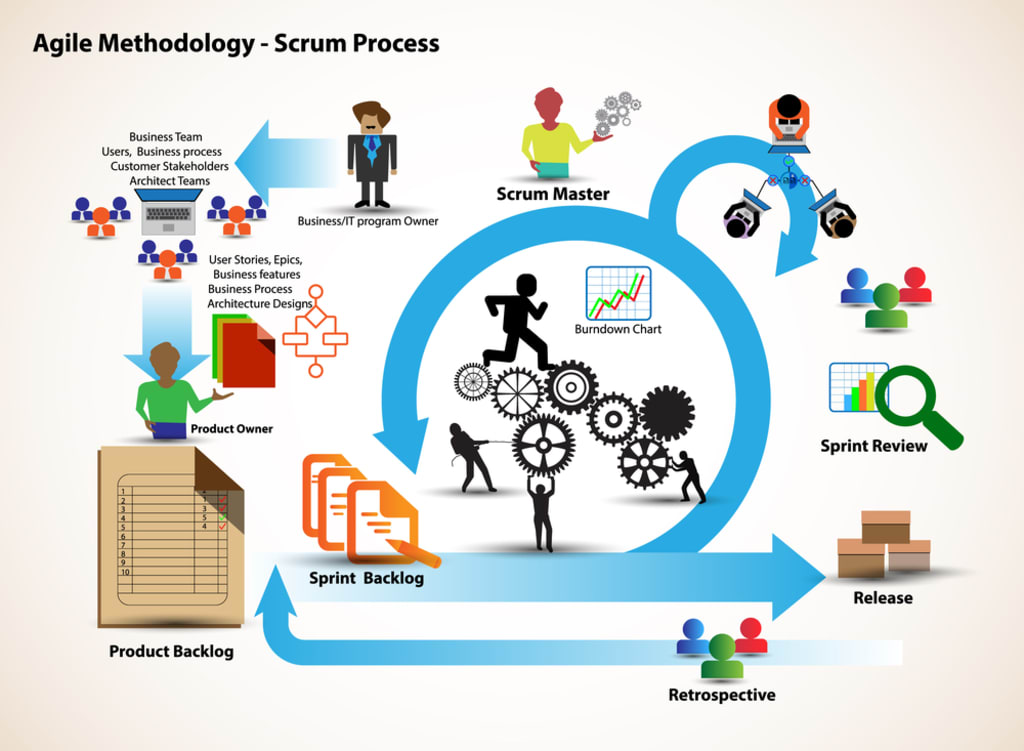
Scrum is an agile methodology for small teams of ten or fewer people that divide work into time-constrained chunks called sprints and discuss progress in scrum sessions.
Establishing the proper foundation for an agile scrum methodology transition may help businesses avoid frequent stumbling blocks and achieve the intended outcomes.
There are three main requirements for attaining enterprise-wide end-to-end agility.
- Agile Implementation Of Enterprise Strategy
The first is a successful agile enterprise strategy, which is built on a decentralized description of the company's strategic themes. The strategic planning process is driven by customer insights, market demands, regulatory requirements, and technology prospects.
• Using an evolutionary approach to define what needs to be constructed as a "success" component in building agile PLM software.
• Using a cross-functional and collaborative approach to strategic planning
• Using a planning cycle that is iterative and recurring
- Mastering Agility At Enterprise Scale
The ScrumMaster positions are given on a program-by-program basis. To develop releases, timelines and architectures are aligned. Agile teams from both onshore and offshore are used to assist these objectives. In several iterations, a specialized release management function simplifies continuing administration, verification, and communication regarding the scope of releases.
- Automation & Collaboration In DevOps
Increased implementation speed leads to a shorter time-to-market and a more reliable manufacturing process when using an agile strategy. DevOps (Development and Operations) is essential for achieving this goal. DevOps brings together software development and operations in a collaborative setting with automated procedures, resulting in frequent yet modest incremental releases of new features. Full product owner responsibility, faster team choices about new features to add to future releases, and higher overall efficiency are all part of the DevOps collaborative operating model, which includes toolchains that handle incident management, testing, deployment, and monitoring.
- DevOps vs Agile Software Development
Software development and IT operations are combined in DevOps. DevOps strives to provide higher-quality software by utilizing continuous delivery and iterations. Agile software development services may be linked back to many of the fundamental DevOps techniques.
While Agile emphasizes sprints that might span weeks or months, DevOps emphasizes ultra-fast releases that can last days or even hours. DevOps and Agile may be used together since they are complementary.
The agile manifesto is, by definition, a continual improvement process. Developing an agile mentality and agile processes are prerequisites for a successful transformation, but the beauty of an agile software development company is that it is a never-ending process with endless chances for improvement.
This is something that leaders and participants should bear in mind when they implement agility across the organization.
About the Creator
Joe Harkins
Hey, I'm a freelance writer and like to create some stories and blog as well.
Keep reading
More stories from Joe Harkins and writers in Journal and other communities.
Why is Salesforce implementation service good for your business?
We must confront the realities of today's fast-paced, competitive market. Clients are more likely to transfer between your rivals than ever before if they are dissatisfied with customer service. As a result, meeting the demands of new and modern clients is becoming increasingly difficult as technology improves how businesses engage with their consumers.
By Joe Harkins4 years ago in Journal
How Much Does It Cost to Start an Outpatient Rehab Treatment Facility
Introduction to Outpatient Rehab Facility Costs Establishing an outpatient rehabilitation treatment facility requires a nuanced understanding of both healthcare delivery and business economics. Unlike residential centers, outpatient programs typically involve lower capital intensity, yet they still demand substantial upfront investment. Costs vary widely based on geography, service scope, and regulatory rigor. A modest facility may require a few hundred thousand dollars to launch, while a comprehensive center offering multiple therapies can exceed seven figures. Prudent financial forecasting at the outset reduces fiscal turbulence later and creates a foundation for sustainable operations.
By Fida Hassain3 days ago in Journal
Wild Card Weekend Recap: What Happens Now?
I think I figured out why I love Wild Card Weekend so much. It's because it's the first playoff anything of the calendar year. The NFL season starts in the fall, and once upon a time, the champion was crowned either on or slightly before New Year's. The evolution of the NFL schedule has resulted in the playoffs starting just into the New Year, and currently, the final week of the season falls on the first weekend of the New Year, with Wild Card Weekend coming a week after that. So yes, chronologically, the NFL's Wild Card Weekend serves as the first playoff anything of the calendar year.
By Clyde E. Dawkins6 days ago in Unbalanced



Comments
There are no comments for this story
Be the first to respond and start the conversation.