
The Rise Of Elon Musk’s Tech Empire
Explore his journey from failure to world domination

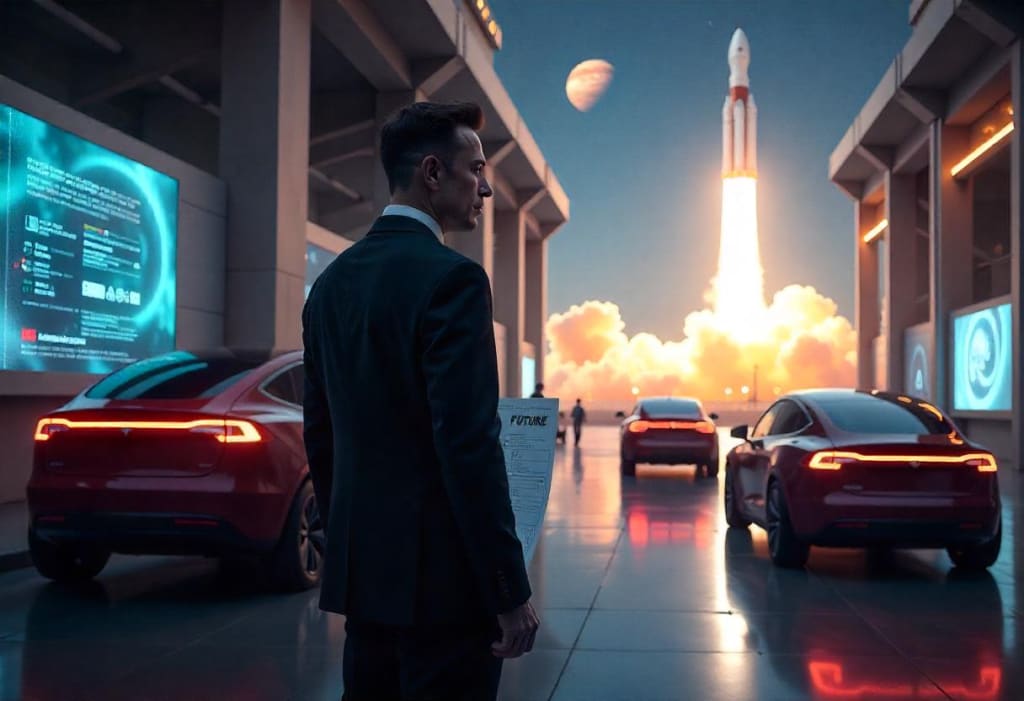
Elon Musk, the name that now echoes through boardrooms and innovation labs, was once just a boy with big dreams and little means. Born in Pretoria, South Africa, in 1971, Elon was often seen as quiet and bookish. His childhood was shaped by science fiction novels, encyclopedias, and endless curiosity. At just 12 years old, he taught himself programming and sold his first software, a space-themed game called Blastar, for $500. But his path to global fame wasn’t easy—it was marked by struggle, setbacks, and relentless ambition.
After finishing school, Elon moved to Canada and later to the United States. He attended the University of Pennsylvania, earning degrees in physics and economics. Not long after, he was accepted into a PhD program at Stanford University in California. However, he dropped out just two days in. He had a bigger dream—to create something that could change the world.
Elon’s first success came with Zip2, a company he co-founded with his brother, Kimbal Musk. It provided online city guides for newspapers. Despite his initial vision, Elon was eventually removed as CEO by the board. However, when Compaq bought the company in 1999, Elon walked away with $22 million. For most, that would have been enough. But for Elon, it was just the beginning.
He invested his earnings into a new venture—X.com, one of the first online banks. The company soon merged with Confinity and became PayPal. Again, Elon was ousted as CEO, but when eBay bought PayPal for $1.5 billion in 2002, he received $180 million. Instead of relaxing or investing safely, he did the unthinkable—he poured nearly all of it into three bold ideas: Tesla, SpaceX, and SolarCity.
Each of these companies seemed doomed to fail. Tesla faced constant criticism, financial instability, and manufacturing delays. Many believed no one would ever choose electric cars over traditional vehicles. SpaceX suffered three failed rocket launches, burning through funds and testing everyone’s faith. SolarCity, led by his cousins with Musk backing the vision, aimed to change the way homes used energy, but it was slow to catch on. Still, Elon pressed forward, risking everything.
In 2008, SpaceX finally launched a rocket successfully on its fourth attempt. That same year, NASA signed a $1.6 billion contract with the company. Tesla, after many near-death moments, secured vital funding and released its first electric sports car—the Roadster. Musk had pulled off what seemed impossible: building a car company and a space company from scratch, both of which began to reshape entire industries.
By 2020, Tesla became the most valuable automaker in the world, leading a global shift toward electric transportation. SpaceX launched astronauts into space—the first private company to achieve this milestone. Along the way, Musk also founded Neuralink to explore brain–machine interfaces, Starlink to provide satellite internet worldwide, and The Boring Company to tackle traffic problems with underground transportation.
What makes Elon Musk different isn’t just his intelligence or wealth—it’s his belief in humanity’s future. He dreams of colonizing Mars, preventing AI from surpassing human control, and creating a world powered entirely by sustainable energy. These aren’t just ideas to him—they are missions he’s actively pursuing.
Despite his achievements, Musk remains a controversial figure. His social media posts often stir debate, his leadership style is intense, and his work hours are extreme. But these traits, however polarizing, are tightly woven into his success. He doesn’t play by the rules—he rewrites them.
Elon’s story is a powerful reminder that innovation doesn’t come from comfort. It comes from risk, from refusing to give up, and from pushing forward even when the world says no. His journey shows that failure is not the end, but the foundation for greatness when paired with vision, grit, and belief.
From a curious kid in South Africa to the founder of the world’s most futuristic companies, Elon Musk has built an empire that touches the sky—literally. Whether sending rockets to space or reshaping how we drive, communicate, and think, his impact is undeniable.
And yet, he’s still reaching. Still dreaming. Still building the future.
About the Creator
majid ali
I am very hard working give me support
Author’s Advice
If you would’ve asked me 20 years ago did I know I’d become a writer and an author, I would’ve said “nope, ain’t happening”. As fate would have it I did become an author and I can honestly say I’m loving it so far. It really does feel good to be a writer. I’ve learned a lot on this journey and I feel like with even me being as new to this world as I am, there’s some wisdom I need to share with every other aspiring author.
By Joe Patterson3 days ago in Journal
Pandora’s Burden
“My brother warned me to not accept gifts from the one who commissioned you,” said Epimetheus to the woman clad in silvery raiments standing at the entrance to the temple. Her silver tiara and the silver rings on her fingers and toes glinted in the firelight cast by torches set on either side of the doorway. Lingering in the shadows, beyond the reach of the flames as she was, he could not tell what she held in her hands. At first what appeared to be a box was perhaps a funerary urn, or maybe merely an apple.
By J. Otis Haasa day ago in Fiction




Comments
There are no comments for this story
Be the first to respond and start the conversation.