
The Resilience and Evolution of Skyscrapers: Learning from the World Trade Center Tragedy
How 9/11 changed designs
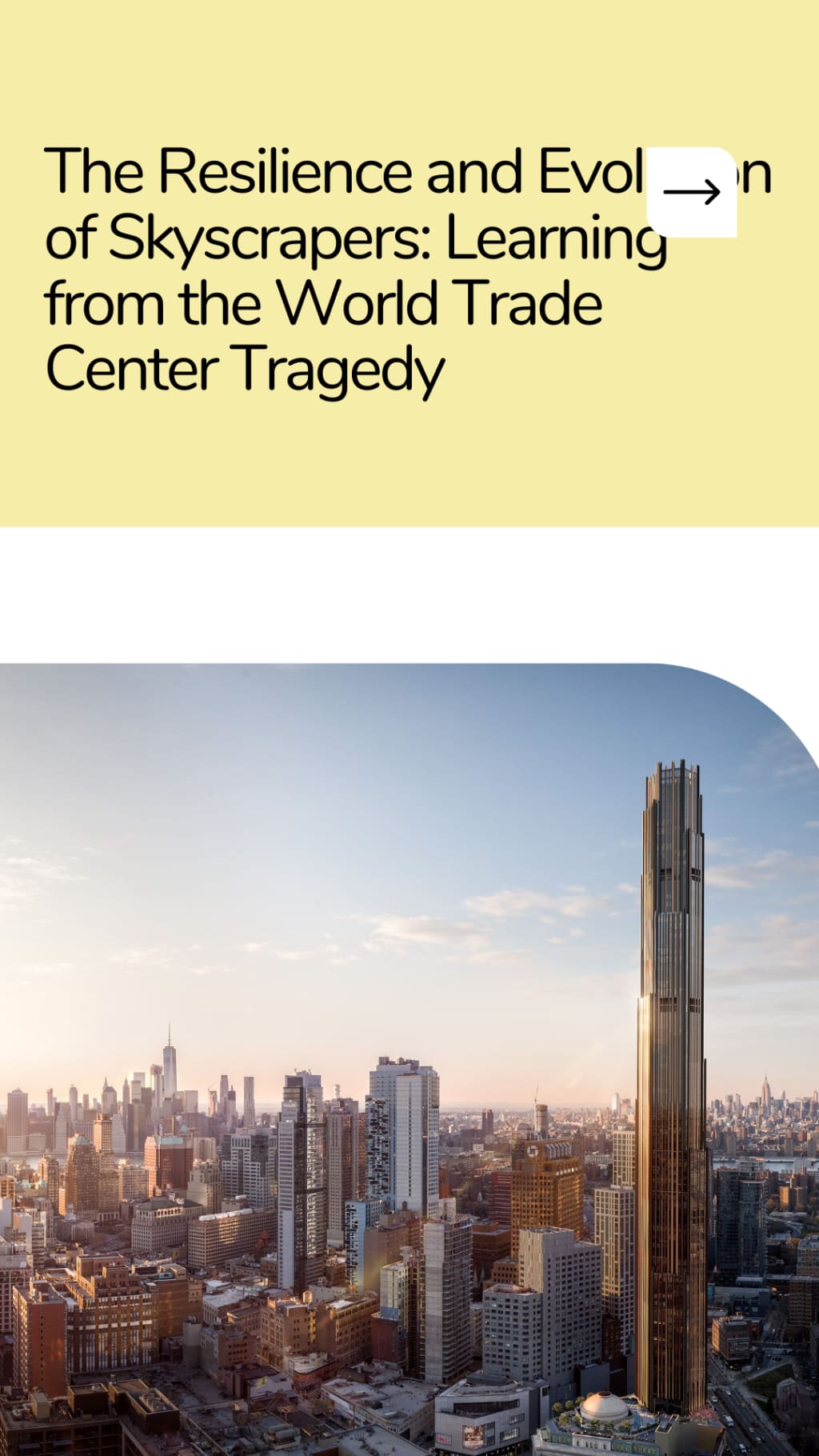
The September 11, 2001 terrorist attacks had a far-reaching impact on the United States. Political differences seemed to disappear for a brief period of time, new security measures were put into place at airports all around the world, and thousands of families mourned the loss of loved ones. But one change that you probably didn't notice took place inside high-rise buildings - the elimination of spire tops on many of them. Prior to September 11th, spire tops were a common feature on many high-rise buildings throughout Manhattan. However, as a result of 9/11, this practice was discontinued in order to improve safety. But understanding what changed requires first understanding how the towers were originally designed.
In 1946, the concept of a World Trade Center was born, envisioning a single 70-story building - a far cry from the iconic Twin Towers we know today. Fast forward to 1962, when Japanese-American architect Minoru Yamasaki's firm won the commission to design the Twin Towers, marking a pivotal moment in his career that even landed him on the cover of TIME Magazine. On April 4, 1973, the Twin Towers stood tall as the world's tallest buildings, boasting not only impressive height but also a unique architectural and structural design.
Distinguished by their "steel tube" design, the Twin Towers' exterior featured steel columns lining the perimeter, connected to the building's core via the floors. These floors were made of concrete, which added strength, while the core housed elevators, stairwells, and utility shafts, allowing for uninterrupted, open floor space - a groundbreaking concept that offered approximately 95% of the buildings' space for occupancy.
Despite concerns about the potential impact of aircraft on buildings, especially after a B-52 accident with the Empire State Building in 1945, the Twin Towers were designed to withstand the planes of their time, like the Boeing 707. However, the actual events on September 11, 2001, presented an unprecedented scenario, with the hijacked planes crashing into the towers at speeds exceeding 400 miles per hour.
The Twin Towers' inherent strength through redundancy allowed them to initially withstand the impacts, shifting the weight away from affected areas. However, the intense fires that followed compromised the fire-resistant coating on the steel, weakening it substantially. While the fires did not melt the steel, they heated it to a critical point where it lost its strength and stiffness. Eventually, the floors above the impact zones became too heavy for the weakened steel to support, leading to the catastrophic collapse of both buildings.
In the aftermath of the tragedy, it might be expected that radical changes would be made to building codes and structural designs. While some improvements have been made, the overall building codes have not changed dramatically. The belief was that the cost of implementing extensive measures to protect against such rare attacks would outweigh their practicality. As a result, the focus shifted more towards enhancing means of egress (exits) in buildings, ensuring that people have sufficient opportunities to escape in emergencies.
Modern skyscrapers now embrace different designs and materials to increase their resilience. Many structures rely on a combination of concrete walls in the core and steel framing around the perimeter, providing greater strength and fire resistance. The use of ultra-high-performance concrete, with strengths ranging from 15,000 to 30,000 psi, further contributes to the robustness of contemporary skyscrapers.
Although protection against terrorist attacks is not explicitly mandated, some new high-rise buildings have voluntarily incorporated features to enhance their resistance to such events. Measures like wider stairways, self-luminous exit pathways, and additional stairways in tall buildings have become standard to ensure the safety of occupants during emergencies.
In conclusion, the World Trade Center tragedy sparked significant changes in skyscraper design and safety protocols. The focus has shifted towards prioritizing the safety and well-being of occupants by providing ample means of egress and utilizing stronger, more resilient materials. While we honor the memory of the Twin Towers, their legacy lives on as a powerful catalyst for progress in building safer and more sustainable structures.
About the Creator
Austin Cayden
Let us explore the unexplored.
"We make a living by what we get , we make a life by what we give." - Winston Chruchhill
Keep reading
More stories from writers in Journal and other communities.
The Path to Salvation
The late autumn evening air filled the monk's lungs, but it wasn't the season that chilled his bones. The heavy-handed presence of evil he had sensed upon entering the woods surrounding this mountain village had not bothered to conceal itself from him.
By Made in DNA2 days ago in Fiction




Comments
There are no comments for this story
Be the first to respond and start the conversation.