
The Quantum Curtain: How China Built the First Unhackable Network—and Pulled the World Into a New Digital Cold War
A silent countdown is already underway. As Q-Day approaches, China’s quantum network may reshape global power before the world fully understands what’s happening.

Right now, as you read this, a clock is ticking somewhere in the background of our digital lives.
You can’t see it.
You can’t hear it.
But it's counting down to a moment scientists call Q-Day—the day when quantum computers become powerful enough to crack almost every security system that currently protects our banks, our messages, our governments, and even our identities.
For years, Q-Day felt like a sci-fi story—interesting, but far away.
A problem for the future.
Something for scientists in white coats to worry about.
But what if the future arrived early?
What if one country quietly launched something so advanced, so transformative, that it forces the rest of the world to rethink what “secure communication” even means?
Because that just happened.
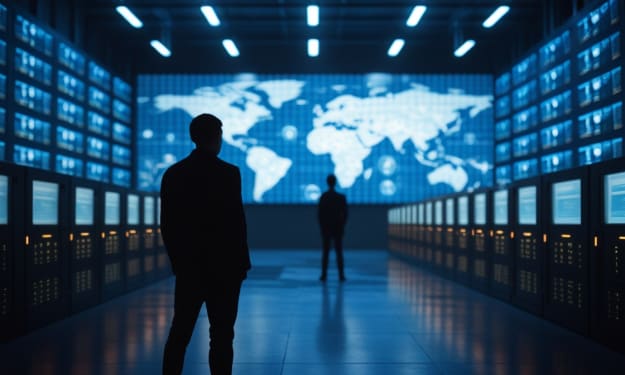
China has activated the world’s first large-scale quantum communication network—an enormous web of fiber-optic lines and satellites engineered to be, by the laws of physics, almost impossible to hack. This is not fantasy. This is not a theory. It is already switched on.
And whether we like it or not, it has triggered one of the biggest technology races in modern history.
A Network That Cannot Be Hacked? That Starts With Physics
To understand why this is such a seismic shift, you need to understand one simple but frightening truth:
The entire internet depends on cryptography.
Every password, every credit card transaction, every classified government message—it’s all protected by math problems that are “too hard” for ordinary computers to solve.
Quantum computers laugh at those math problems.
So instead of making the math harder, China changed the game entirely by rewriting the physics of communication.
Their tool: Quantum Key Distribution, or QKD.
Imagine sending a secret key, not as numbers, but as tiny particles of light—photons—each placed in a delicate quantum state. Vertical, horizontal, diagonal, or anti-diagonal. Those states form the key.
Now here’s the magic—and the reason this is unhackable:
In quantum mechanics, observing something changes it.
If a hacker tries to intercept the photons, the act of measuring them alters their quantum states. The sender and receiver immediately notice something is wrong. They throw away the compromised key and create a new one.
Security doesn’t come from complexity.
It comes from the laws of the universe.
It’s like having a message that self-destructs the moment someone tries to peek inside.
But there’s a catch: quantum signals inside fiber-optic cables weaken quickly, and you can’t amplify them without destroying the information.
So China turned to the sky.
Satellites: China’s Quantum Leap
In 2016, China launched Micius, the world’s first quantum communication satellite. It wasn’t a science experiment. It was a blueprint.
Today, new satellites—like Jinan-1—can transmit quantum keys over thousands of kilometers. In one stunning demonstration, scientists connected Beijing to Vienna using a quantum-secured video link spanning 12,700 km.
China then went further.
It built an integrated hybrid system—over 700 fiber-optic links combined with space-to-ground quantum channels—connecting major hubs such as Beijing and Shanghai and used by more than 150 banks, power grids, and government agencies.
This is not a pilot project.
It is an infrastructure.
And it may be the most strategically important communication network ever created.
]A Digital Power Imbalance
Here’s where things get uncomfortable.
If China’s own network becomes quantum-secure while other nations still depend on crackable encryption, the balance of power shifts dramatically.
China can protect its secrets.
It can shield its communications.
Meanwhile, everyone else remains exposed.
In a tense geopolitical moment, such an imbalance increases the risk of miscalculation. If two nations don’t fully understand each other’s capabilities—or intentions—history shows how quickly things can spiral.
That’s why the U.S., the EU, Japan, and others are now racing to catch up.
The U.N. has even declared 2025 the International Year of Quantum Science and Technology, a global acknowledgement that this race is as important as nuclear, AI, or space technology.
Europe is building EuroQCI, its own space-and-ground quantum network, with its first satellite launching soon.
The U.S. has launched the National Quantum Initiative, pouring billions into research.
But despite these efforts, many experts quietly believe China is years ahead in practical, real-world quantum communication.
And the stakes could not be higher.
Whoever leads in quantum technology will write the rules of communication for the next century—and control a market projected to reach $15 billion by 2035.
China isn’t just participating in this future.
It wants to run it.
A Quantum Future—But Not an Even One
So what does this mean for the rest of us?
Are we heading toward a world divided into two internet systems?
One quantum-secure.
One dangerously vulnerable.
Possibly.
China’s network is groundbreaking, but it isn’t yet a true quantum internet—the kind that could transmit quantum information directly across continents. Current networks still rely on “trusted nodes” every 50–100 km, which remain classical hardware and therefore theoretically hackable.
The holy grail is quantum repeaters, devices that can strengthen quantum signals without destroying them. They exist in labs, but widescale deployment is likely a decade away.
In the meantime, the world is hedging its bets.
Alongside QKD, scientists are developing post-quantum cryptography (PQC)—new math-based encryption so complex that even future quantum computers can’t crack it. NIST in the U.S. is already standardizing these algorithms.
That means the quantum future may be split:
Governments, banks, militaries, and power grids will use quantum networks.
Ordinary citizens will rely on quantum-resistant algorithms built into our apps, browsers, and devices.
A hybrid world.
A divided world.
But a protected one.
A New Era Has Quietly Begun
China’s quantum communication network represents more than a technological triumph.
It marks the beginning of a new era—one where digital security is no longer based on math, but on the fundamental laws of physics themselves.
The global quantum race is no longer theoretical.
It is happening right now, in labs, in satellites, in underground fiber lines—and in the quiet decisions of governments who understand what’s coming.
The dream of a single, open, trusted global internet is slipping away.
In its place, we are watching the rise of ultra-secure quantum networks, national and regional fortresses of information.
Some will be unbreakable.
Some will be vulnerable.
And all of them will shape how power moves in the 21st century.
The clock toward Q-Day is still ticking.
But the race to prepare for it has already begun.
About the Creator
Keep reading
More stories from Shahjahan Kabir Khan and writers in Journal and other communities.
The Quiet War of the Machines: How AI Became the World’s New Superpower Weapon
The War We Don’t See Fights were loud most of our time on Earth. These were battles carried out on terrain altered by bloodshed, explosions, and loss of life. Conversely, the most fighting currently going on goes mostly unnoticed. There is no movement of soldiers, missiles, or army vehicles. Rather, it takes place in computer centers, scientific research institutions, and intelligence groups.
By Shahjahan Kabir Khan2 months ago in Journal
The goals I did not achieve
Every writing goal I made for the year is a wash. It has been this way for a while, but I think it's important to be open about my failures and the reality of how life can get in the way. This is especially true considering the several times I have posted on Vocal about my writing goals, how I was changing my approach, and where I was hoping to be for the upcoming year. I will probably do that again in a couple months, but for now, it is time to acknowledge where I am today.
By Kay Husnick20 days ago in Journal
What the Catholic Church Means by “Sacrament” and Why They Matter
The Catholic Church teaches that God is not distant or invisible in our daily lives but comes to us in real, tangible ways. One of the primary ways He does this is through the sacraments. While some people may think of sacraments as symbolic rituals or merely traditional ceremonies, the Catholic understanding goes much deeper. Sacraments are outward signs instituted by Christ that confer grace, and they are central to Catholic faith, worship, and spiritual life.
By Sound and Spirit2 days ago in Journal


Comments
There are no comments for this story
Be the first to respond and start the conversation.