
The Predictive Edge: AI in Diagnostics Takes Center Stage
Artificial intelligence (AI) has quickly become the leading force in delivering faster and more precise diagnostic solutions in a world where time is of the essence.

AI technology is expanding the limits of early disease detection capabilities while enhancing risk prediction and decision-making processes through imaging and genomic applications. AI has moved from being a supplementary tool to becoming the primary force in diagnostic processes within global healthcare systems that demand increased efficiency and personalized care.
AI: The New Diagnostic Powerhouse
Traditional diagnostic methods have depended on human professional judgment alongside lengthy testing processes and sequential analytical procedures. But AI is changing the game. AI models learn to detect hidden patterns and deliver faster results when algorithms are trained on massive datasets that include imaging archives and pathology slides along with patient records and genomic data.
AI technology helps doctors diagnose diseases earlier and manage them more effectively leading to better overall patient results.
Key Applications Taking the Lead
🧠 Medical Imaging
Radiology remains the field where AI adoption has reached full maturity and enjoys widespread implementation. Through extensive training on millions of scans, algorithms can identify varied anomalies present in X-rays, MRIs, and CT scans including tumors, fractures, stroke indicators, and COVID-19 complications. The use of artificial intelligence tools enhances diagnostic imaging speed and precision while maintaining consistent results especially in areas with limited resources.
🧬 Pathology & Genomics
Pathology slides and genetic information analysis through AI-powered platforms enables tumor classification and personalized treatment recommendations alongside drug response predictions. These diagnostic tools prove most beneficial in cancer treatment because precise classification at an early stage determines patient survival outcomes.
❤️ Predictive Analytics
AI technology combines interpretation of existing data with predictions of potential future outcomes. Predictive diagnostic models utilize electronic health records (EHRs), lab results and wearable data to assess patients' risk levels for conditions like heart disease diabetes and mental illness. Proactive healthcare strategies enable both timely medical actions and decreased future healthcare expenses.
🤖 Point-of-Care AI
Built-in AI capabilities in portable devices are reshaping how frontline diagnostics operate. Medical diagnostic technology now includes handheld ultrasound devices and mobile eye scanning tools alongside smartphone applications for skin disease detection which operate through artificial intelligence. Rural and remote regions are experiencing expanded healthcare access thanks to these technological advancements.
Market Momentum
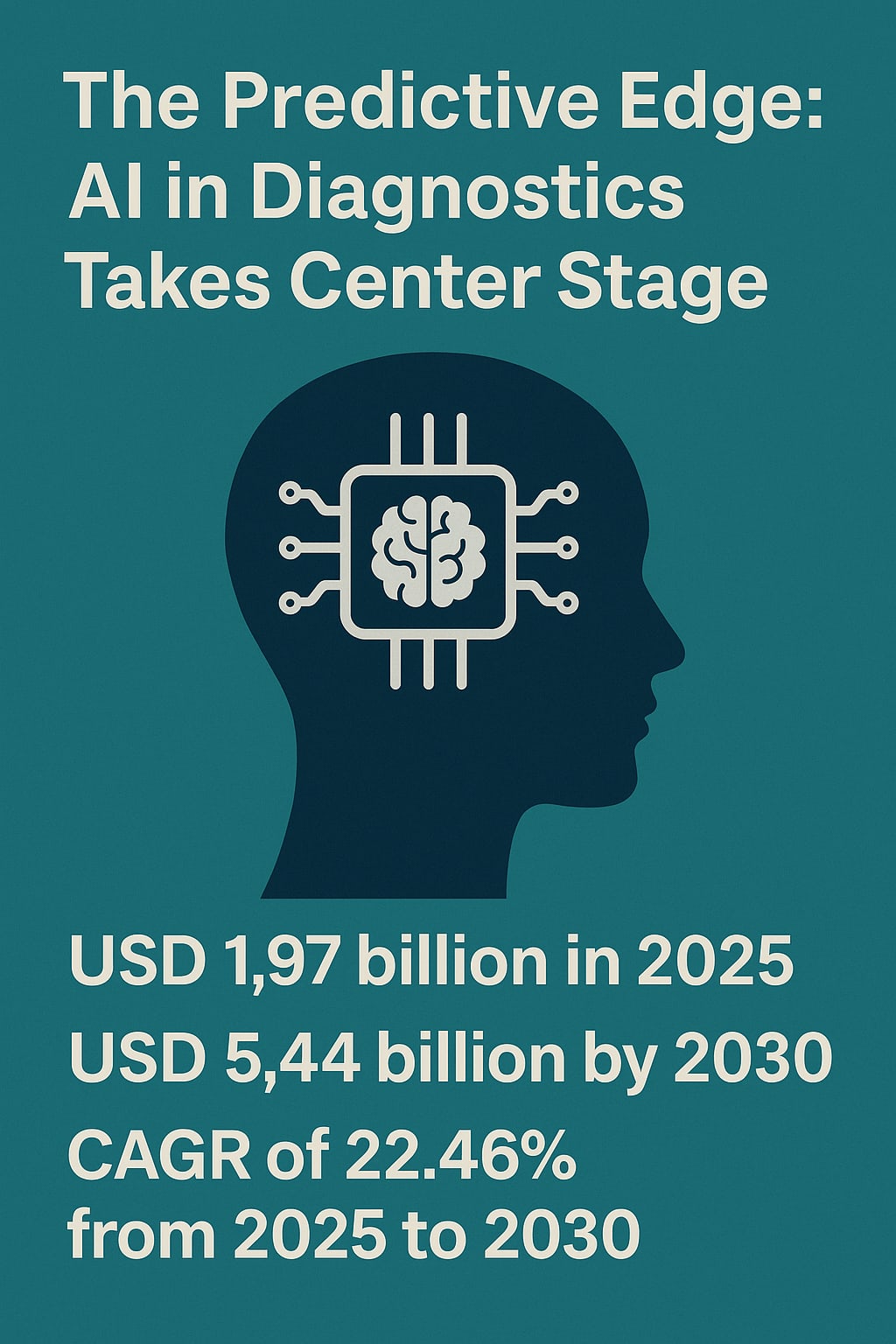
The market for global artificial intelligence in diagnostics market is experiencing rapid growth. The global AI in diagnostics market reached nearly USD 1.97 billion in 2025 and the increasing adoption of digital health solutions along with rising healthcare data needs and demand for non-invasive early diagnosis will push it past USD 5.44 billion by the 2030.
IBM Watson Health, GE Healthcare, Siemens Healthineers, PathAI, and Tempus are focusing their resources on creating advanced diagnostic platforms. Regulatory agencies are expediting the approval process for AI diagnostic tools which demonstrates increasing confidence in their dependability and usefulness.
Challenges Ahead
AI-based diagnostic methods struggle with substantial barriers despite their potential benefits.
The healthcare sector faces challenges due to changing regulatory standards and unclear requirements for clinical validation.
Patient records and genomic data present substantial data privacy challenges that must be addressed.
Researchers must address AI model biases and their ability to generalize across different populations.
AI systems must seamlessly integrate with current healthcare workflows and electronic health record systems.
AI success depends on its ability to provide clear explanations while earning trust and integrating smoothly into clinical decision-making workflows.
The Diagnostic Revolution Has Arrived
AI supports clinicians by enhancing their capabilities and providing them with unprecedented predictive insights. AI enables doctors to achieve better visualization, quicker understanding, and speedier response times in their practice.
AI's increasing integration into diagnostic processes will enhance the accuracy and accessibility of disease detection while making it possible to identify illnesses sooner than ever.
Latest Press Release: www.prnewswire.com/news-releases/artificial-intelligence-in-diagnostics-market-size-worth-us-5-44-billion-by-2030---exclusive-report-by-the-research-insights-302461670.html
About the Creator
Paxton Templeton
I’m a storyteller at heart with a passion for turning data into compelling narratives. With a focus on industry trends, market insights, and growth statistics, I bring clarity to complexity
Keep reading
More stories from Paxton Templeton and writers in Journal and other communities.
Diagnosing the Future: Trends in the AI Healthcare Market
AI drives precision medicine forward through its application in imaging analysis as well as robotic surgery alongside virtual assistants and predictive analytics. The future AI healthcare market stands ready to revolutionize every stage of patient interaction throughout their healthcare experience.
By Paxton Templeton8 months ago in Journal
How AI Agent Development Companies Design Autonomous Workflows
Autonomous workflows aren’t about replacing humans they’re about removing friction from decision-heavy processes. AI agent development companies focus on designing systems that can observe, decide, act, and improve with minimal human intervention.
By Lilly Scott7 days ago in Journal



Comments
There are no comments for this story
Be the first to respond and start the conversation.