
The Phone You Can See Through
How Xiaomi’s rumored transparent smartphone could redefine innovation—and put Apple in an unfamiliar position

For years, smartphone innovation has followed a predictable script. Better cameras. Faster chips. Slightly thinner designs wrapped in familiar glass and metal. The changes mattered, but they rarely surprised anyone. Now, a strange and almost unbelievable discussion is spreading through the global tech community—one that sounds more like science fiction than a product roadmap.
According to multiple industry insiders and analysts connected to Nikkei Asia, the South China Morning Post, Reuters, and Digitimes, Xiaomi may be preparing to introduce the most unconventional device in mobile history: a fully transparent smartphone. Not a concept. Not an exhibition prototype. A real, functional phone—one you can literally see through.
If these reports hold true, the implications could be enormous. Not just for Xiaomi, but for the entire balance of power in the tech industry.
From copycat to category creator
For much of its global rise, Xiaomi has carried an uncomfortable label in Western media: “the Chinese Apple copy.” Its designs were often compared to iPhones, its product launches framed as reactive rather than revolutionary. That narrative, fair or not, has followed the company for over a decade.
This rumored transparent phone threatens to flip that story completely.
Instead of following Apple’s lead, Xiaomi may be positioning itself to redefine what a smartphone even looks like. Analysts at Bloomberg Intelligence and Counterpoint Research have already discussed the symbolic weight of such a launch. If a transparent phone reaches consumers first under a Xiaomi logo, it wouldn’t just be a product win—it would be a perception shock.
For the first time in years, Apple could find itself chasing a vision it didn’t originate.
Why transparency was considered impossible
The idea of a transparent smartphone isn’t new. It has appeared in movies, concept videos, and futuristic design sketches for years. The problem has always been practicality.
Transparent displays exist today, but they are fragile, expensive, and usually require all computing components to live somewhere else. Xiaomi itself proved this with the Mi TV Lux Transparent Edition—a stunning OLED panel just 5.5 mm thick, but dependent on a large external base to house its electronics.
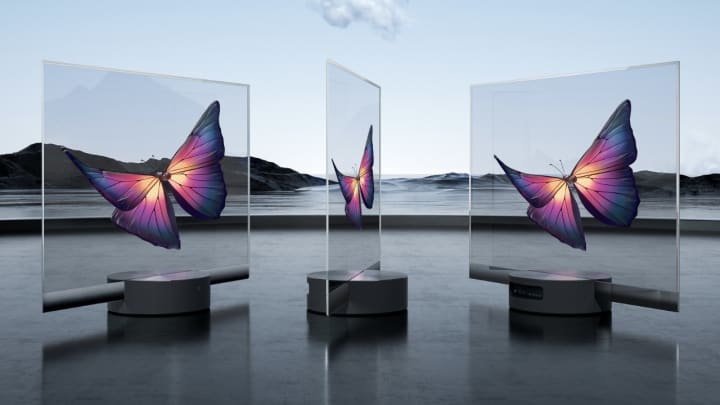
A smartphone doesn’t have that luxury.
Inside a phone, everything must coexist in a tiny space: battery, processor, modem, antennas, cameras, sensors, speakers, and structural support. According to insiders, this was the wall Xiaomi kept hitting early in development.
The solution, reportedly, was a complete rethink of internal architecture.
Reinventing the inside of a phone
Sources familiar with Xiaomi’s engineering process say the company moved toward a modular, edge-focused design. Some components were pushed into ultra-thin perimeter modules, nearly invisible to the naked eye. Others were embedded within the glass itself using transparent conductive layers that only reveal themselves under specific lighting conditions.
Battery technology posed an even bigger challenge. Insiders claim Xiaomi is experimenting with hybrid mini-batteries that partially allow light to pass through—something that would have sounded unrealistic just a few years ago.
Camera systems, meanwhile, appear to rely on Xiaomi’s existing under-display camera experience from its Mi Mix lineup. Early patents filed between 2020 and 2022 show concepts for wrap-around displays, transparent bodies, and optical structures that once looked experimental but now feel suspiciously relevant.
More recent leaks suggest testing is underway on a reinforced transparent composite layer designed to act as both glass and structural frame—eliminating the need for a traditional metal body altogether.
The result, according to insiders, looks almost unreal: a single slab of glass. No visible camera. No back panel. No frame. When powered off, it looks like nothing at all. When powered on, the interface seems to glow from within.
The readability problem no one talks about
Transparency introduces a problem that sounds minor but isn’t: visual noise.
If you can see your hands, the table, the background, and moving objects through the screen, readability quickly becomes unbearable. This, insiders say, became one of the toughest engineering hurdles of the entire project.
Xiaomi’s reported solution is a multi-layer OLED system capable of switching between transparent, semi-transparent, and fully opaque modes. Much like art glass that can darken on command, the display can block background visuals when clarity matters most.
An adaptive dimming system reportedly adjusts automatically based on ambient light, allowing the phone to behave like a normal smartphone when needed—and something entirely new when it doesn’t.
If true, this would be a breakthrough not just in design, but in user experience.
Why Apple should be paying attention
Even if transparent smartphones remain a niche category, the strategic impact could be profound.
Barclays analysts note that the existence of such a device alone could reposition Xiaomi as a technology leader. Media narratives would shift. Developer interest could follow. Consumer expectations would change.
For Apple, the challenge would arrive on three fronts at once:
- Image shock – the story of innovation leadership moving away from Cupertino.
- Technology race – hardware that takes years and massive investment to replicate.
- Psychological impact – a visible symbol that the future might now be arriving from Beijing.
That combination is rare—and uncomfortable.
What happens next
The final product name remains unconfirmed. Internally, it’s rumored as “Mi Mix Transparent” or “Xiaomi Transparent Edition.” Specifications are still under wraps. But analysts at TechRadar and GSMArena point out something unusual: the leaks are consistent, detailed, and coming from multiple independent sources.
Xiaomi already owns many of the required building blocks—transparent OLED panels, under-display cameras, composite glass materials, and experience with cutout-free designs. What remains is execution.
If Xiaomi successfully combines durability, battery life, color accuracy, and readability into a single transparent device, the smartphone industry could face its biggest design reset since the original iPhone.
IDC analysts suggest official confirmation could arrive sooner than expected—possibly with early teasers by mid-2026.
If that moment comes, one thing will be clear: the next era of smartphones may not begin in California.
It may begin in China.
#Feature #Technology #Smartphones #Xiaomi #Apple #Innovation
About the Creator
Keep reading
More stories from Shahjahan Kabir Khan and writers in Journal and other communities.
The Economist’s 2026 Cover: Prediction, Pattern, or Power Play?
Every year, as the world edges closer to January 1, one magazine quietly captures global attention long before fireworks light the sky. It doesn’t rely on sensational headlines or viral outrage. Instead, it offers symbols—dense, unsettling, and strangely precise.
By Shahjahan Kabir Khan2 months ago in Journal
~ Fired ~
— Ai Intrusion ~ Are you Next ~ Is Ai Evolution after your job? — Few workplaces haven't been affected. Ai is in supermarkets, at doctors' offices, and even monitoring farms. I just can't think of anything this machine is not getting into, can you? For instance: Education ~ Law and Tech jobs will one day have a major influence or be taken over by these inanimate machines, with accuracy and vigor. From mechanics' diagnoses to a wide variety of everyday jobs, including fast food workers, with this input having the ability to cut their unnecessary work hours. I'm certain all of us have been touched by this with our short stories and colorful headings, have you? Even comments are very questionable 'Non-Robot' insertions.
By Jay Kantor28 days ago in Journal
When the Shelter Closes
Across the street from my house, a man slept under a tree, his dog by his side. My first, naive thought: he must be traveling through. But he kept coming back, often sleeping there during the day. Then it hit me—that person might not have a home.
By Bride of Sound3 days ago in Humans



Comments
There are no comments for this story
Be the first to respond and start the conversation.