
The Economist’s 2026 Cover: Prediction, Pattern, or Power Play?
Why a single magazine cover has reignited global fears about surveillance, war, and who really shapes the future
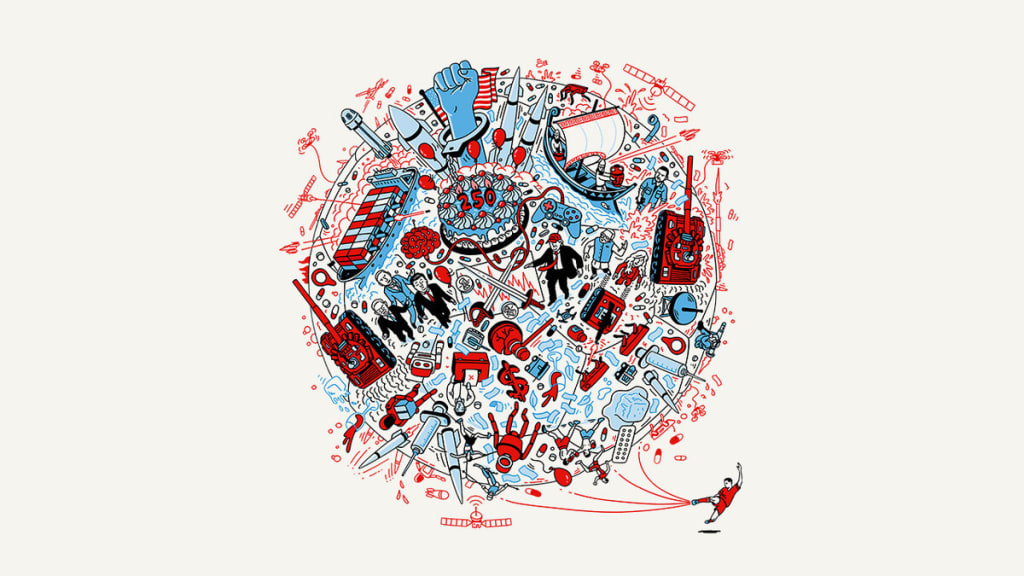
Every year, as the world edges closer to January 1, one magazine quietly captures global attention long before fireworks light the sky. It doesn’t rely on sensational headlines or viral outrage. Instead, it offers symbols—dense, unsettling, and strangely precise.
That magazine is The Economist.
For nearly two centuries, The Economist has positioned itself as a guidebook for the world’s elite. Founded in 1847, it reaches presidents, prime ministers, billionaires, and policy architects across continents. Its annual “The World Ahead” issue is not just journalism—it is interpretation. And in 2025, when The World Ahead 2026 cover was revealed, it triggered a wave of unease.
]Missiles. Drones. Surveillance satellites. Medical syringes. AI-powered robots. A fractured America celebrating its 250th anniversary. A footballer kicking the world from outside its boundary.
The question many people are asking is simple—but disturbing:
Is The Economist predicting the future… or signaling it?
A History That Makes People Nervous
This anxiety didn’t come from nowhere.
In 2016, The Economist released The World in 2017 with tarot-card imagery—symbols traditionally associated with fortune-telling. One card showed crowds in yellow vests. At the time, it felt abstract, even playful.
Two years later, France erupted in the Yellow Vest protests, the largest civil unrest the country had seen in decades.
Coincidence? Maybe. But moments like this have created a belief among critics that The Economist doesn’t merely observe power—it speaks its language fluently.
Decoding the 2026 Cover: What Stands Out
At the center of the 2026 cover is a cake marked “250”—a reference to the United States’ 250th anniversary in July 2026. But the celebration feels hollow. Nearby, hands in handcuffs suggest political division and suppressed dissent.
The magazine’s editors have explained this as America reaching a milestone while remaining deeply polarized. But critics read more: that unrest will be managed, contained, and controlled—not resolved.
Surrounding this scene is a dense web of drones, satellites, and AI-driven machines. Surveillance is no longer subtle. The message appears blunt: privacy, as we once understood it, is disappearing.
And then there’s Spot, the robotic dog popularized by Boston Dynamics—often used in military and police demonstrations. Its presence feels deliberate. While public debates obsess over AI chatbots, robotics quietly moves into physical spaces—streets, factories, borders.
Automation, the cover suggests, won’t just assist humans.
It will replace them.
War Without War
Missiles, tanks, and warships frame the outer edge of the cover, yet The Economist stops short of predicting a single, world-ending conflict. Instead, it hints at something subtler: hybrid warfare.
Cyberattacks. Proxy conflicts. Economic sabotage. Political destabilization.
Ukraine remains unresolved. Gaza sits in fragile tension. Europe increases military spending. Taiwan remains a global flashpoint. No single war dominates—but conflict never stops.
In this world, peace isn’t broken.
It’s simply managed instability.
The Medical Revolution Nobody Is Ready For
Among the weapons and machines are syringes, pills, and injection pens—symbols of a pharmaceutical shift already underway.
GLP-1 weight-loss drugs like Ozempic and Mounjaro are expected to become cheaper, more accessible, and more normalized by 2026. The Economist frames this as progress: a medical revolution.
But critics worry about dependence. When health solutions arrive primarily in pill form, who benefits most—the patient, or the system selling the cure?
The Footballer Outside the Circle
Perhaps the most unsettling image is the footballer.
He isn’t inside the world.
He stands outside it—kicking the globe like a ball.
Officially, this represents the 2026 FIFA World Cup, jointly hosted by the U.S., Canada, and Mexico. Unofficially, it raises darker interpretations: that the real decision-makers aren’t participants in the system—they are spectators controlling it.
As Shakespeare once wrote, “All the world’s a stage.”
But what if some actors never step onto the stage at all?
The Falling Line Everyone Fears
Finally, there is the red line—sloping downward across the cover.
Debt. Bonds. Trust.
Global debt has reached historic highs. Governments are borrowing faster than they can manage. When trust in markets collapses, savings collapse with it. According to analysts, bond markets—not stocks—may become the true pressure point of the next crisis.
And unlike past crashes, this one wouldn’t feel sudden.
It would feel inevitable.
Prediction or Projection?
So what is The Economist really doing?
Its defenders say it reflects trends already in motion. Its critics argue that power doesn’t just forecast the future—it coordinates it. The magazine’s connections to elite conferences and policy circles only intensify suspicion.
Yet one truth remains unavoidable:
2026 doesn’t look like collapse.
It looks like recombination—multiple pressures converging at once. Surveillance, automation, economic strain, political division, and medical dependence feeding into one another.
Whether you see this as warning or orchestration depends on one thing:
Who you believe controls the game.
#TheEconomist #WorldIn2026 #GlobalTrends #SurveillanceState #AIAndAutomation #EconomicCrisis #MediaPower #FutureOfSociety
About the Creator
Keep reading
More stories from Shahjahan Kabir Khan and writers in Journal and other communities.
Welcome to the Age of Quiet Technology
For most of the last two decades, technology wanted to be seen. Phones buzzed constantly. Screens lit up with urgency. Notifications competed for our attention like street vendors shouting over one another. New devices arrived each year with louder promises, brighter displays, and bigger reasons to look at them.
By Shahjahan Kabir Khan2 months ago in Journal
How Paid Advertising Services Changed the Way I See Online Growth
A while ago, I helped a friend launch a small online business. We spent weeks building the website. The design looked clean, the content was clear, and the products were carefully listed. When everything was finally ready, we felt confident that visitors would soon begin exploring the site.
By Anthony Rodgers3 days ago in Journal




Comments
There are no comments for this story
Be the first to respond and start the conversation.