
The Next Economic Engine: Sora 2 and OpenAI’s Billion-Dollar Platform Ambition
The Next Economic Engine: Sora 2 and OpenAI’s Billion-Dollar Platform Ambition

The launch of Sora 2 was more than a technological upgrade; it was an economic declaration. Coinciding with a staggering surge in OpenAI’s valuation, the release of the updated video model and its accompanying social application, Sora AI, positions the company not just as a toolmaker, but as a fully-fledged platform giant ready to compete for market share and consumer attention. This move signals the start of the next AI arms race, one focused not on text or images, but on the simulation and monetization of reality itself.
The complexity of Sora 2 has profound implications for global capital markets, the competitive dynamics of Silicon Valley, and the long-term quest for General AI. It underscores a central truth: the ability to generate photorealistic, physically accurate video on demand is the key to unlocking the next multi-trillion-dollar segment of the digital economy.
The $500 Billion Engine: Sora 2 and the Compute Boom
The valuation of a technology company is often a reflection of its future revenue potential and its competitive moat. The latest financial activity surrounding OpenAI, which places its valuation near the half-trillion-dollar mark, is heavily underpinned by the promise of Sora 2. The investment thesis is simple: the generation of high-fidelity video is astronomically expensive in terms of computing power.
OpenAI has stated that generating a single, high-resolution Sora 2 video clip requires approximately 50 times the computational resources needed for a high-resolution DALL-E image. This massive consumption of compute creates a colossal demand for advanced hardware—GPUs, high-bandwidth memory, and liquid-cooled data centers.
This high cost acts as both a barrier to entry for smaller competitors and an enormous economic tailwind for the underlying hardware providers. Sora 2 is not merely a software play; it’s an infrastructure bet. OpenAI is signaling to investors that they are uniquely positioned to meet this computational demand, while simultaneously building a platform—the Sora AI app—to recoup those costs by generating revenue from consumers and businesses eager to utilize the groundbreaking capability of Sora 2 on a subscription or pay-per-use model.
The Video Wars: Sora AI Versus the Giants
With the launch of the vertical-scroll, invite-only Sora AI app, OpenAI has formally entered the social media battlefield, taking aim directly at the short-form video dominance of ByteDance (TikTok), Meta (Reels/Vibes), and Google (YouTube Shorts). The competition in the text-to-video space is intense, featuring rivals like Google’s Veo 3 and Runway’s Gen-3, but Sora 2 is differentiating itself on two critical fronts: technical superiority and platform strategy.
Sora 2’s Technical Moat: Unlike competitors that often struggle with object permanence, gravity, and frame-to-frame coherence, Sora 2 excels at simulating the physical world. Its ability to correctly model complex interactions—a basketball rebounding accurately, or water sloshing with proper buoyancy—is its key technical advantage. Furthermore, the native integration of high-quality, synchronized dialogue and sound effects within the Sora 2 model eliminates a significant post-production step, delivering a more finished product out-of-the-box.
Sora AI’s Platform Strategy: OpenAI is not just offering a tool; they are building a creation-first community. While Google and Meta tend to integrate their AI video tools into their existing massive platforms, Sora AI is a dedicated space built around generative features like the Cameo and Remix system. This design choice fosters a unique "AI-native" content culture where collaboration and personalization (using the Cameo feature to insert oneself into a scene) are central, creating a strong network effect that is crucial for competing against established social media giants.
Sora 2 as the World Simulator: The AGI Connection
Perhaps the most compelling and strategically ambitious aspect of Sora 2 is OpenAI’s stated goal of using it as a "general-purpose world simulator." For OpenAI, the ability to generate hyper-realistic, physically accurate video is not the end goal; it is a critical intermediary step toward Artificial General Intelligence (AGI).
To function effectively in the real world—whether as a robotic agent or a highly capable virtual assistant—an AI model must possess a deep, intuitive understanding of physics, object relationships, and the causality of events. By successfully training Sora 2 to model complex dynamics (e.g., how a triple axel on a paddleboard affects the buoyancy of the board and the splash of water), OpenAI is essentially training an AI that comprehends the underlying rules of reality.
Sora 2 is, therefore, a massive scientific experiment that uses video generation as its observable output. Every frame generated is a test of the AI’s "world model." The more realistic and physically accurate the video, the more profound the AI's understanding of the universe. This perspective frames the Sora 2 model as foundational research that will eventually be leveraged across all of OpenAI's products, from advanced robotics to next-generation multimodal assistants, securing a long-term competitive lead in the quest for genuine general intelligence.
About the Creator
Keep reading
More stories from Aurang Zeb and writers in Journal and other communities.
Unmasking Legacies: Fiction’s Role in Revealing What Families Don’t Tell
Have you seen The Fall of the House of Usher on Netflix? Fiction is doing the same job of revealing hidden family secrets in mysterious and exciting ways that keep readers coming back for more.
By Aurang Zeb6 months ago in Journal
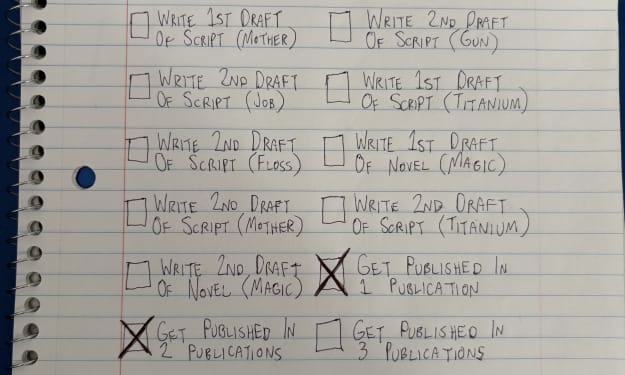
Early March 2026: 4 Goals Accomplished
It's early March and I've now accomplished my 4th writing goal for the year of 2026. Before diving into the behind-the-scenes of it... why not tell you up front what that accomplishment was? I was published in a 2nd publication for this year. Published in Helix Literary Magazine out of Central Connecticut State University. You can read it for free right now!
By Stephen Kramer Avitabile4 days ago in Writers



Comments
There are no comments for this story
Be the first to respond and start the conversation.