
The Mathematical Impossibility of Perfect Democracy: A Deep Dive into Voting Systems
Why Your Vote Might Not Count as Much as You Think


In a groundbreaking exploration of democratic systems, a recent YouTube video titled "Why Democracy Is Mathematically Impossible" has shed light on the inherent flaws in our voting methods. This comprehensive analysis delves into the mathematical intricacies that challenge the very foundations of how we elect our leaders, revealing startling truths about the systems we've long trusted to represent the will of the people.
The video begins by dissecting the widely used "first past the post" voting system, a method employed in 44 countries worldwide, including many former British colonies. This system, while seemingly straightforward, harbors significant drawbacks. For instance, in the United Kingdom, over the past century, a political party has held a majority in Parliament 21 times, yet in only two of these instances did that party actually receive a majority of votes. This stark reality illustrates how a minority party can wield complete governmental control, fundamentally undermining the principle of majority rule.
Moreover, the "first past the post" system is notorious for the "spoiler effect," a phenomenon vividly demonstrated in the 2000 US presidential election. In Florida, Ralph Nader, a third-party candidate, garnered nearly 100,000 votes, potentially tipping the scales in favor of George W. Bush over Al Gore. This case exemplifies how similar parties can inadvertently "steal" votes from each other, leading to outcomes that may not reflect the true preferences of the electorate.
In response to these shortcomings, alternative voting methods have been proposed. One such method is the "instant runoff" or ranked-choice voting system. This approach allows voters to rank candidates in order of preference, potentially offering a more nuanced representation of voter sentiment. However, even this system is not without its flaws. The video presents a hypothetical scenario where a candidate performing worse in initial rounds could paradoxically end up winning the election, highlighting the counterintuitive results that can emerge from such systems.
The quest for a perfect voting system has captivated mathematicians for centuries. Notable figures like the Marquis de Condorcet in the 18th century and even Lewis Carroll (of "Alice in Wonderland" fame) in the 19th century grappled with this challenge. Condorcet proposed a method where the winner must triumph in head-to-head comparisons against every other candidate. While this approach seems intuitively fair, it can lead to circular preferences known as Condorcet paradoxes, where no clear winner emerges.
The pinnacle of this mathematical exploration came in 1951 with Kenneth Arrow's groundbreaking work. Arrow outlined five reasonable conditions that a fair voting system should meet, including unanimity (if everyone prefers one option, the group should prefer it) and non-dictatorship (no single person's vote should override all others). Astonishingly, Arrow proved that it is impossible to satisfy all these conditions simultaneously in a ranked voting system with three or more candidates. This revelation, known as Arrow's Impossibility Theorem, earned him the Nobel Prize in Economics and fundamentally changed our understanding of voting systems.
However, the video doesn't leave us in despair. It presents potential solutions and alternative perspectives. For instance, Duncan Black's theorem suggests that in scenarios where voters and candidates naturally spread along a single dimension (e.g., liberal to conservative), the preference of the median voter often aligns with the majority decision, potentially circumventing some of the paradoxes highlighted by Arrow.
Furthermore, the video introduces the concept of rated voting systems, particularly approval voting. In this system, voters simply indicate which candidates they approve of, rather than ranking them. Research suggests that approval voting can increase voter turnout, decrease negative campaigning, and prevent the spoiler effect. Interestingly, this method isn't new – it was used to elect the Pope between 1294 and 1621 and is currently used to elect the UN Secretary-General.
The video concludes with a nuanced perspective on democracy. While mathematically perfect democracy might be impossible using ranked-choice methods, this doesn't negate the value of democratic systems. As Winston Churchill famously quipped, "Democracy is the worst form of government except for all the others that have been tried."
In essence, this exploration reveals that while our current democratic systems may be flawed, they remain our best option. The video encourages viewers to stay politically engaged and continually strive for improvement in our voting methods. It reminds us that understanding these mathematical complexities is crucial for informed citizenship and the ongoing refinement of our democratic processes.
As we move forward, the challenge lies in balancing mathematical ideals with practical realities. While a perfect voting system may be mathematically impossible, the pursuit of fairer, more representative methods continues. This ongoing quest underscores the dynamic nature of democracy – a system that, despite its imperfections, remains our most valuable tool for collective decision-making and governance.
About the Creator
Keep reading
More stories from Next Koding and writers in Journal and other communities.
AI's Hidden Hand: How Algorithms Are Silently Shaping Driver Wages and Consumer Prices
In the ever-evolving technology landscape, artificial intelligence (AI) has penetrated various aspects of our daily lives. A YouTube investigative video titled "We Put 7 Uber Drivers in One Room. What We Found Will Shock You" recently has shed light on a disturbing trend in the ride-sharing industry, revealing how companies like Uber and Lyft are using AI algorithms to manipulate driver wages and passenger fares.
By Next Kodingabout a year ago in Journal
How Receipt Printers Improve Checkout Speed in Retail Stores
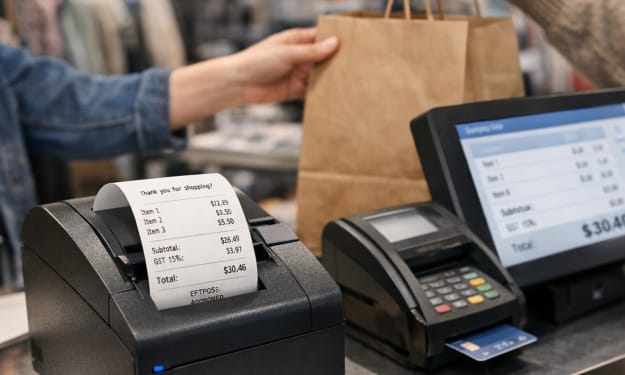
Introduction Retail stores in New Zealand often face long queues during busy hours. Customers expect quick service, especially in supermarkets, convenience stores, and small retail outlets. When checkout lines move slowly, shoppers may feel frustrated and leave the store with a negative experience.
By POS Central NZabout an hour ago in Journal



Comments (1)
Very interesting article. I hope technology will be used for the good of democracy and not for manipulating the world or even for stealing elections.