
The Last Leaf
A story which show hope and courage in life
Introduction
Literature is rich with stories that speak to the human condition, exploring themes of hope, despair, sacrifice, and the redemptive power of art and friendship. One of the most cherished short stories that capture these elements is "The Last Leaf" by O. Henry. This touching narrative, though brief in its original form, leaves a profound impact on readers with its emotional depth and poignant conclusion. In this extended retelling, we delve deeply into the world O. Henry created, exploring the characters, their emotions, the setting, and the symbolism that makes this story timeless.
The Setting: Greenwich Village
At the heart of the story is the charming, bohemian neighborhood of Greenwich Village in New York City. This area, known for its narrow, winding streets and its vibrant community of artists, writers, and dreamers, sets the perfect backdrop for a story about art, hope, and sacrifice. The narrative unfolds during a bitterly cold winter, where the cold winds seem to carry with them the despair of the characters battling against illness and hopelessness.
In a modest three-story brick building, with ivy climbing up its walls, live two young women, Sue and Johnsy. Both are aspiring artists who have come to the city from different parts of the country to pursue their dreams. Their bond of friendship is strong, forged through shared experiences, struggles, and ambitions.
The Onset of Illness
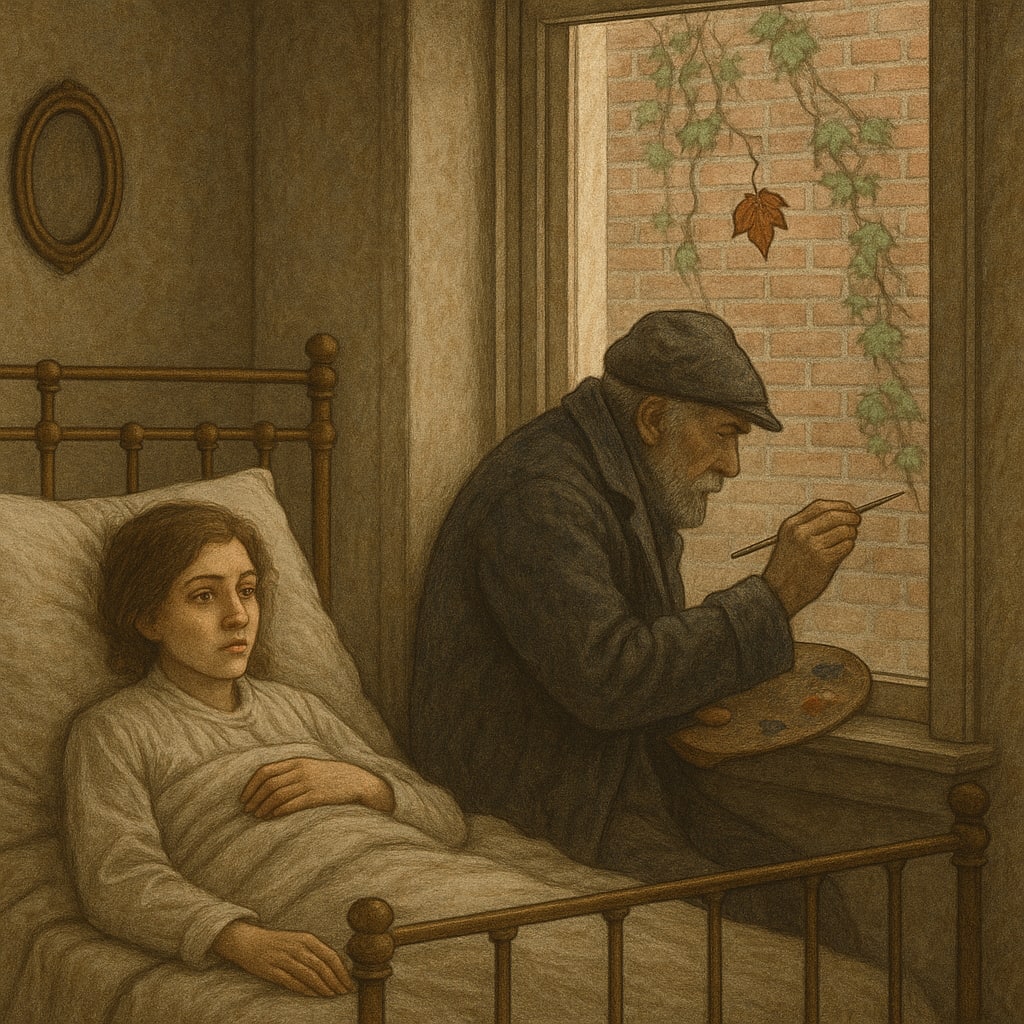
As winter deepens, an outbreak of pneumonia sweeps through the city, and Johnsy becomes one of its unfortunate victims. The once lively and spirited Johnsy is reduced to a frail figure lying on her bed, staring listlessly out of the window. The harsh winter does not just attack her body but also her spirit. She becomes despondent, surrendering to a sense of inevitable doom.
Sue, deeply worried for her friend, tries her best to nurse Johnsy back to health. She consults doctors, follows their advice diligently, and tries to lift Johnsy's spirits with stories, jokes, and news from the outside world. Yet, Johnsy remains indifferent, her mind fixated on a single, morbid thought.
The Ivy Vine and the Fixation
Outside their window grows an old ivy vine, climbing the brick wall of a neighboring building. The vine, with its thick, knotted branches and once vibrant leaves, is now shedding its foliage rapidly under the assault of the cold wind and rain. Johnsy, lying in bed and watching the vine, develops a grim obsession: she begins to count the leaves as they fall. She convinces herself that when the last leaf falls, she too will die.
No amount of reasoning or persuasion from Sue can dislodge this belief from Johnsy's mind. Sue is heartbroken to see her friend give up on life so easily. She watches helplessly as each day Johnsy becomes weaker, her will to live eroding with every leaf that drops.
Sue's Desperation and the Introduction of Behrman
Sue, in her desperation, seeks help from their elderly neighbor, Behrman. Behrman is a gruff, cantankerous old man, a failed artist who has lived in the building for decades. Despite his rough exterior, Behrman possesses a heart of gold, especially for Sue and Johnsy, whom he regards almost like daughters.
Behrman has long spoken about painting a masterpiece, a work of art that would define his legacy, but he has never managed to begin it. Instead, he spends his days posing as a model for younger artists and occasionally drinking to drown his frustrations.
Sue visits Behrman in his cluttered, messy studio, explaining Johnsy's condition and her strange fixation on the ivy leaves. Behrman is initially incredulous and dismissive, but as Sue describes the depth of Johnsy's despair, his heart softens. He realizes that Johnsy's life might depend on a gesture of hope.
The Fateful Stormy Night
That evening, a terrible storm rages through the village. The wind howls fiercely, and rain pours in sheets, battering the buildings and stripping the ivy vine of its remaining leaves. Sue watches with dread, fearing that by morning, the vine will be bare and Johnsy's fragile spirit will finally break.
However, when dawn breaks, something extraordinary happens. Johnsy, weak and barely able to speak, asks Sue to draw the curtain so she can look at the vine. To her astonishment, the last leaf is still there, clinging tenaciously to the branch despite the storm's fury.
Johnsy watches the leaf, waiting for it to fall. But hour after hour, it remains steadfast. Day turns to night, and still, the leaf does not waver. A slow transformation begins within Johnsy's mind. She marvels at the leaf's persistence and begins to reflect on her own surrender to despair.
"I have been foolish," Johnsy admits to Sue. "It is a sin to want to die. That leaf has taught me a lesson. I will not give up."
Johnsy's will to live rekindles. She begins to eat, to take her medicine, and to respond to Sue's care. Her recovery, though slow, is certain. The simple presence of that stubborn leaf becomes a symbol of hope, endurance, and life itself.
The Sacrifice Revealed
A few days later, Sue receives distressing news. Behrman has contracted pneumonia and has died after just two days of illness. The janitor who found him reported that he was soaking wet, his clothes and shoes drenched and icy. They also discovered that he had been out during the stormy night.
Sue, puzzled and heartbroken, connects the dots. She visits the vine and examines the last leaf closely. It is no ordinary leaf; it is a masterful painting, so skillfully done that Johnsy could not distinguish it from the real ones.
Behrman had painted the leaf on the wall during the stormy night, risking his own life in the cold rain to give Johnsy a symbol to hold onto. This was Behrman's long-awaited masterpiece—a single painted leaf that saved a life.
Themes and Symbolism
The story of "The Last Leaf" is rich with symbolism and thematic depth:
Hope and Despair: Johnsy's journey from despair to hope is central to the narrative. The painted leaf symbolizes resilience, a silent yet powerful message that life must be cherished.
Sacrifice: Behrman's selfless act is the epitome of sacrifice. He finally creates his masterpiece, not on canvas, but on a cold, damp wall, using his life as the price.
The Power of Art: The story beautifully illustrates how art can transcend aesthetics and become a force for life and hope. Behrman's leaf is not just a painting—it is a lifeline.
Friendship and Compassion: The deep bonds between Sue, Johnsy, and Behrman highlight the importance of empathy and community. Sue's unwavering care and Behrman's ultimate sacrifice are testaments to the strength of human connections.
Nature and Tenacity: The ivy vine, with its clinging leaves, serves as a metaphor for tenacity and the struggle to hold on despite adversity.
Character Analysis
Johnsy: Her character represents vulnerability and the psychological impact of illness. Her fixation on the ivy leaves reflects a deeper existential struggle between life and death.
Sue: As a caregiver, Sue embodies resilience, patience, and unwavering support. She balances her artistic aspirations with her role as a nurturer.
Behrman: Perhaps the most poignant character, Behrman is a failed artist who achieves greatness through his final act. His gruff demeanor hides a compassionate soul willing to make the ultimate sacrifice.
The Enduring Legacy of the Story
"The Last Leaf" remains one of O. Henry's most beloved works, celebrated for its emotional resonance and moral depth. It continues to be taught in schools, adapted into plays and films, and cherished by readers around the world.
The story's enduring appeal lies in its universal message: in the darkest moments, even the smallest gesture of hope can be transformative. It reminds us of the power we hold to influence each other's lives positively, often in ways we may not fully realize.
Conclusion
In this extended retelling of "The Last Leaf," we see how a simple story about a painted leaf can encapsulate profound truths about life, art, and humanity. O. Henry masterfully weaves a narrative that is both heart-wrenching and uplifting, showing that sometimes, a single act of kindness, a single symbol of hope, can alter the course of a life.
As readers, we are left to ponder the value of perseverance, the importance of friendship, and the quiet heroism that often goes unnoticed. Behrman's masterpiece was not just a painted leaf—it was a testament to the enduring human spirit, a legacy that continues to inspire generations.
Thus, "The Last Leaf" is not merely a story; it is a gentle yet powerful reminder that in the tapestry of life, every act of compassion, no matter how small, paints a part of the larger picture of humanity.
About the Creator
Fawad Khan
I’m Fawad Khan a passionate speaker and researcher sharing journals, fiction, history, education, current affairs, and English literature. With deep research and clear voice, I bring knowledge to life. Learn,grow, and stay informed with me.
Keep reading
More stories from Fawad Khan and writers in Journal and other communities.
The Internet Wept
Hope Online In a digital age overflowing with divisive headlines and doomscrolling, one heartwarming story recently broke through the noise—restoring a sense of empathy and unity across the globe. A now-viral video of a baby elephant reuniting with its mother after days of separation has not only captivated millions but also reignited conversations about wildlife conservation and the emotional lives of animals.
By Fawad Khan8 months ago in Journal



Comments
There are no comments for this story
Be the first to respond and start the conversation.