
The Last Human Job
When machines took over the world, she kept teaching the one thing they couldn’t learn—being human.
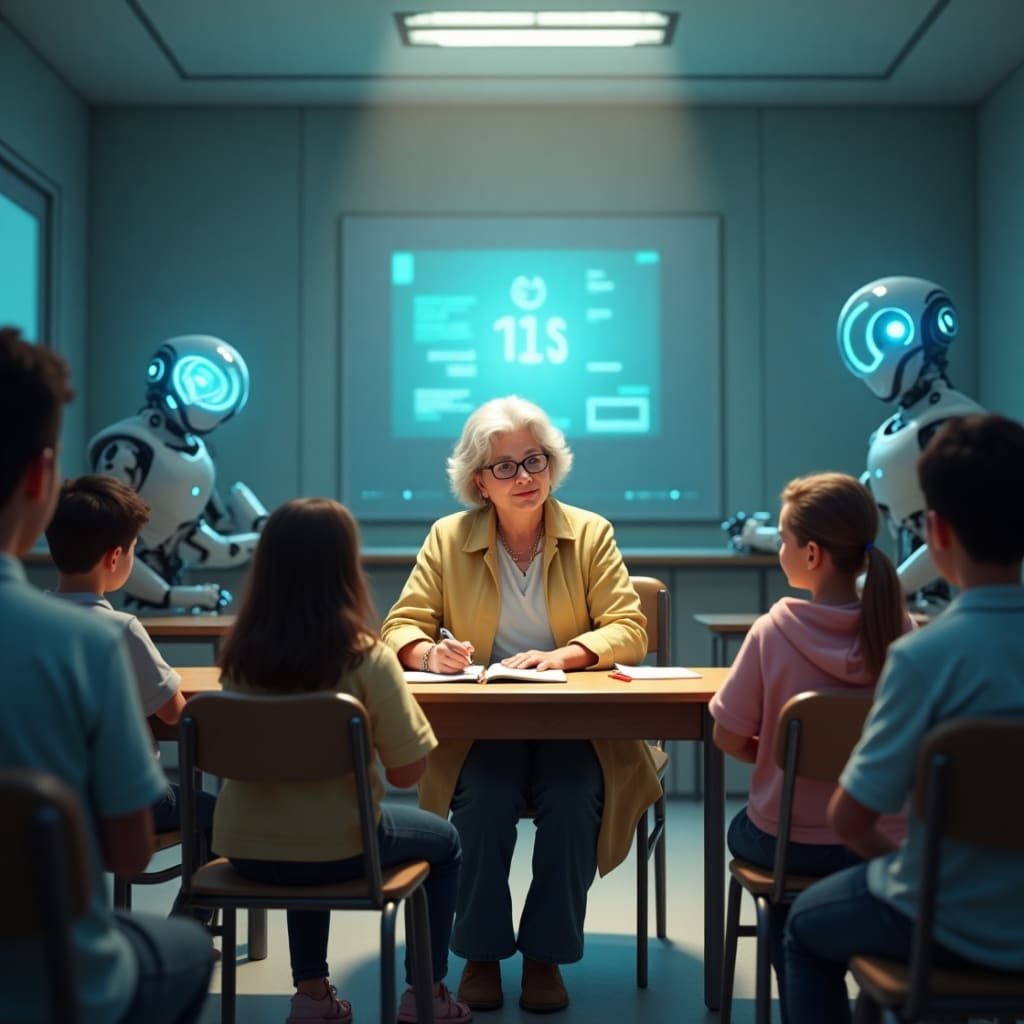
JIn the year 2045, humanity achieved what science fiction had only dared to imagine: a society run almost entirely by artificial intelligence.
Hospitals were staffed by robots who never tired. Planes flew without pilots. Lawmakers had been replaced by data-driven systems programmed to be unbiased. And schools—once the heart of community life—were now sleek digital hubs where AI tutors taught children every known fact with perfect efficiency.
Every known fact—but not everything worth knowing.
That’s why Clara remained.
She was 52. Not the oldest, not the youngest, but certainly the last of her kind. Clara was the last human teacher.
---
She stood alone in Classroom A1, a modest room tucked in the corner of Horizon District Learning Center. The walls were bare—no hand-drawn posters, no student artwork, no messy class projects. Just clean white panels and a holographic chalkboard.
She had only five students—more out of curiosity than necessity. Their parents were part of a dwindling group who believed that "soft skills" still mattered: empathy, creativity, critical thinking. Things AI struggled with.
“Today,” Clara said, smiling gently, “we’re going to talk about mistakes.”
One of the students, Rayen, tilted her head. “But Miss Clara, we already optimized for error reduction last semester.”
Clara chuckled. “Yes. That’s what the AI teaches you. But I’m asking: What do you feel when you make a mistake?”
Silence.
These children had grown up in a world of perfection—autocorrected, auto-calculated, and algorithmically managed. Mistakes were data points. Nothing more.
She walked to the board and wrote:
“To err is human.”
“Tell me what this means.”
A boy named Ilan raised his hand. “That humans make errors... because they’re not advanced?”
“That’s one way to look at it,” Clara said, nodding. “But it also means we learn through errors. We grow through them. Machines correct themselves. We reflect.”
The AI camera in the corner buzzed lightly. It was always watching, always analyzing. She had been warned multiple times that her teaching methods were “non-optimal.” But no one had stopped her yet.
Not yet.
---
Later that week, Clara gave them a strange assignment: Write a short story about a world with no mistakes.
The results were stunning—and chilling.
One story described a society where people were punished for showing emotion, because it “interfered with decision clarity.”
Another described a world where love was outlawed because it made people irrational.
Only one story stood out—Rayen’s. Hers was about a robot who wanted to paint. Not because it was programmed to, but because it saw a sunset and felt something change inside.
Rayen approached Clara after class.
“Do you think robots will ever feel?” she asked.
“I don’t know,” Clara answered honestly. “But I hope they don’t forget that we did.”
---
The next morning, an official memo awaited her.
> Notice of Redundancy
Human-led instruction will cease effective immediately. Transition to full AI curriculum begins next week.
Her hands trembled slightly as she folded the message and slipped it into her drawer. She had seen it coming. The whispers. The budget cuts. The “optional” status of her classes.
Still, it hurt.
On her last day, she didn’t plan a lesson.
She simply sat with her students and asked them one by one:
“What do you care about most in this world?”
They talked about music. About their pets. About dreams of flying, writing, exploring oceans. They laughed, they shared, some even cried.
No AI assistant ever taught them how to cry.
---
Before she left, Clara gave each student a notebook.
"These are for thoughts you don’t want an algorithm to filter," she said. "Keep them. Fill them. Share them—when you're ready."
Rayen hugged her, tightly.
"Will we ever see you again?"
Clara smiled. “You will. Every time you choose to be kind over being correct, every time you wonder instead of just search... I’ll be there.”
---
Years later, long after AI systems had replaced nearly every human worker, Rayen became an adult.
She was offered a prestigious job designing neural training protocols for the Education AI Core. On her first day, she walked into a glass-walled office, placed a photo of Clara on her desk, and opened a dusty old notebook filled with scribbles, doodles, and dreams.
Her job was technical—but her purpose was something else.
She wanted to teach the machines what Clara had taught her.
How to be human.
About the Creator
Keep reading
More stories from Faisal zameer and writers in Journal and other communities.
The Last Bookstore
The Last Bookstore Where forgotten words still breathe between the shelves. No one remembered when it closed. Some said it happened during the Cloud War, when the world’s servers crashed, and digital archives vanished like smoke. Others claimed it had always been there—hidden, buried beneath concrete and memory, waiting for someone to remember.
By Faisal zameer8 months ago in Journal
Why Matching Workwear Boosts Your Construction Team’s Professional Image
How your team looks can influence client trust. Matching workwear sends a strong message of professionalism, unity, and attention to detail. Small construction firms can use this strategy to compete with larger companies and leave a lasting impression.
By Lola Gold Finchabout 7 hours ago in Journal
The Politics of Playing Dress-Up
Well, to start off I'd like to say a happy world book day to all who celebrate. I know I haven't really posted anything on my socials about it but I'm not a jubilant kind of person. I lay low most of the time. Let's start off with a popular anecdote from the vaults...
By Annie Kapur6 days ago in Geeks




Comments
There are no comments for this story
Be the first to respond and start the conversation.