
The Kennedy Memorial @ Runnymede
V2 for Coddiwompling
The events of 22nd November 1963 in Dallas have been forensically analysed. Acres of paper and gallons of ink have been consumed in the quest for the truth. Yet, fifty-seven years later there is no substantial evidence available. Evidence that could be brought into the courtroom of history to once and for all answer those perennial one word drivers of journalism: who, what, why and how.
I was with my Grandparents having hot sweet tea from bone China cups with matching saucers eating hot buttered toast by an open fire watching children’s TV. The sitting room wa fugged with heat from the open fire and the smoke from one of Grandad’s Monte Cristo cigars. My parents arrived on their way home from their Friday shopping trip to pick me up and take me home. I still have the shopping list from that day in the family memory box. They came into the sitting room with a vortex of cold air pushing them. Children’s hour on the BBC was interrupted with the log for the evening news being put on the screen followed by the sombre announcement:
‘The President has been shot’.
Everyone, including me at the tender age of nine knew that the President was John F Kennedy. The man who had appeared almost nightly on our TV screens when we were living in Canada in October 1962 telling us what was happening with Cuba and Russia’s missiles. My two elder brothers worshipped Kennedy and even tried to copy his hairstyle by moving their partings from left to right.
Back at our home we didn’t yet have a television. We had only just arrived from Canada about a month ago and Mum and Dad’s financial priorities did not include a television. We sat around the radio. That is Mum, Dad my two elder brothers and me listening to the updates until it was confirmed that the President had died.
In 1964 Britain gifted an acre of land by the River Thames at Runnymede in perpetuity where a memorial to the late President could be built. In 1965 Her Majesty Queen Elizabeth II officially opened the completed memorial in the presence of the President’s widow, their two children and political dignitaries.
Soon after it was completed my parents took my two elder brothers and me to see it. My memories of that day were of sunshine, warmth, light and green trees. The freshly carved pristine looking piece of stone dappled by the alternating sunlight and shade as a breeze rustled the leaves.
How different things were when I returned for the first time for fifty-five years on a December afternoon.
It was cold, damp, cloudy, gloomy and the trees were bare. The walk from the car park, just like fifty years ago was across a field but today it was wet and muddy. What would be described in horse racing terms as ‘good to soft and heavy in places’. Some parakeets screeched from treetops as I entered their territory. Each footstep became a slurp and a squelch. I thought about returning to the car to change into more appropriate footwear. There was time pressure accumulating as the gates to the car park were scheduled to close at half past four. It was not quite three and I didn’t want to be phoning my wife at thirty-one minutes past four to explain why she would have to make her own way to the hotel in Staines that night.
Through a narrow gateway, without my passport or a visa and without any other immigration formalities I was now walking on American land.
Ahead of me was a set of fifty steps sloping and curving away into the woods. This whole step way is made from granite blocks about the size of an average house brick. They are not set in the ground horizontally but ends up. The fifty steps represent the mainland states of America. There are 60,000 blocks made from hand cut Portuguese granite setts that represent individual pilgrims progressing through ‘life to enlightenment’. Over fifty years the setts have been pushed into small undulations as the earth they have been resting on has settled causing shallow dips and the roots from the oak trees lining the step way have grown and pushed the setts upwards into small hummocks. These forces over time have given each step its own unique shape and pattern just like the fifty mainland states they represent with their own unique shapes and qualities.
At last, I reached the memorial stone.
It was carved from a single piece of Portland stone hewn from one of the quarries near Weymouth in Dorset. As the President loved the ocean I would like to hope that this piece of stone had overlooked the sea before it came to rest here at Runnymede and held echoes of the waves crashing into the cliffs around the Isle of Portland. The stone measures ten feet by five feet by five feet and weighs seven tonnes.
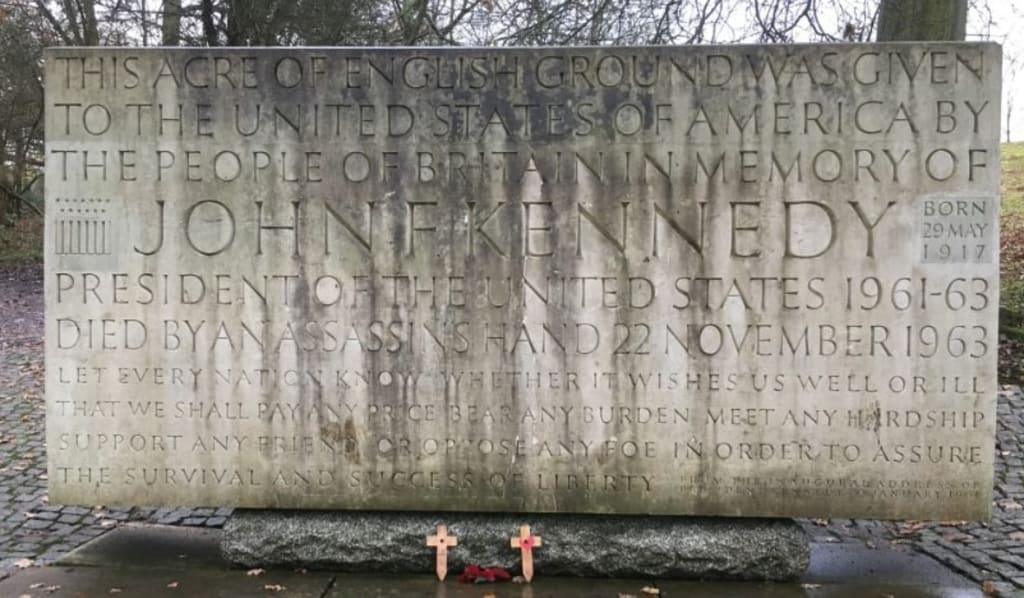
The inscription carved into the front face has been partially redacted by the ravages of time and weather rather than any deliberate attempt to conceal and hide what was originally engraved into the Portland stone.
THIS ACRE OF ENGLISH GROUND WAS GIVEN TO THE UNITED STATES OF AMERICA BY THE PEOPLE OF BRITAIN IN MEMORY OF JOHN F KENNEDY, BORN 29TH MAY 1917: PRESIDENT OF THE UNITED STATES 1961-63: DIED BY AN ASSASSINS HAND 22ND NOVEMBER 1963
‘Let every nation know whether it wishes us well or ill that we shall pay any price bear any burden meet any hardship support any friend or oppose any foe to assure the survival and success of liberty’
The stone’s surface was cold and damp when I touched it. The indented inscription felt as sharp as the day as it was carved. Time had not eroded them, in much the same way as ‘Let every nation…’ sounds in the replays of the President’s inaugural speech he made on 20th January 1961 with his clipped Massachusetts accent. He had a way of putting words together that even on voiceless paper conveyed an accent and cadences that identified them clearly as his.
The stone, on my first visit just after it had been put in place marked one of those watershed moments in life when I realised that the outside world, the real world, a world of death and violence was never far from an open fire, cigar smoke, warmth, tea, toast and children’s television.
I retraced my route down the fifty individual steps. Going down a set of steps anywhere else becomes second nature as my legs and brain work out the patterns quickly. Not here on these fifty steps as each one is different like a set of fingerprints. Each one patterned with their own sets of loops, whorls and arches. And each step was different in length as well. They all slowed me down forcing me to take time to think not only about my leg and eye coordination but also about life, memories, family and how much more time I had before the gates to the car park are closed.
From the gate I took one last look back up the steps and into the woods towards the memorial. I tried to ameliorate any melancholy the weather was having on me. I recognised how I felt at that moment and how upset I was at the condition of the stone. I then tried to imagine the stone as it was today in sunnier weather under a canopy of green leaves. My imagination would not free me from my gloomy feelings. The stone was still stained and tired.
The great political and constitutional writer, Walter Bagehot (1826-1877) wrote:
‘The best history is but like the art of Rembrandt, it casts a vivid light on certain selected causes, and those which were best and greatest: it leaves the rest in shadow and unseen.’
From where I was standing the memorial stone was unseen and in shadow but the light cast by the man it was memorialising is still vivid.
Dec 20
About the Creator
Alan Russell
When you read my words they may not be perfect but I hope they:
1. Engage you
2. Entertain you
3. At least make you smile (Omar's Diaries) or
4. Think about this crazy world we live in and
5. Never accept anything at face value
Keep reading
More stories from Alan Russell and writers in Journal and other communities.
Bus Seat Market: Comfort and Performance on the Move
You board a bus at rush hour. The ride ahead will be long, but the moment you sit, you notice the seat feels supportive. The cushion adjusts with your posture. A built-in USB port lets your device charge. Comfort is no longer an afterthought. It is part of the journey.
By james robert4 days ago in Journal




Comments
There are no comments for this story
Be the first to respond and start the conversation.