
The Invisible War: How a Battle Inside Microchips Is Redrawing the Map of Global Power.
The world’s next great power struggle isn’t fought with missiles or tanks — it’s fought with microchips smaller than a fingernail, and its outcome will decide who rules the 21st century: code or crown.
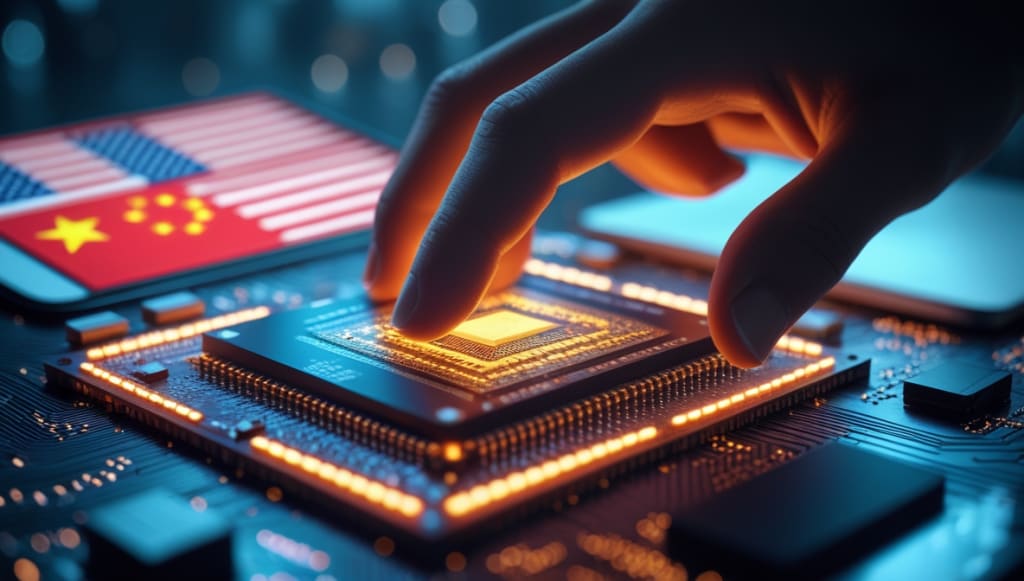
It’s a war unlike any other — no trenches, no soldiers, no sky filled with fire. Yet it’s raging right now, deep within the tiny silicon chips that power your phone, your laptop, even your car. Hidden in cleanrooms and boardrooms, in Washington and Beijing, this “Chip War” will determine who leads the future — the United States or China.
The battleground is invisible, but the consequences are immense. Semiconductors — those microscopic slices of silicon — are the beating heart of the modern world. They run everything from smartphones to satellites, from artificial intelligence (AI) systems to advanced medical devices. If the Industrial Revolution was powered by steam and electricity, the new world runs on code — and that code needs chips.
The Brains of Modern Civilization
Think of semiconductors as the neurons of our civilization — unseen, but essential. They process every digital command, making them the true engines of our global economy and national security. For over half a century, the United States has ruled this world of silicon supremacy. From the invention of the integrated circuit in California’s Silicon Valley to the creation of today’s most advanced processors, America has always held the crown.
In the 1970s, industry pioneers called semiconductors “the new oil.” Half a century later, the phrase has never been truer. Designing the world’s most powerful chips meant controlling not just markets, but military might and political power. But while the U.S. mastered design, it outsourced manufacturing to Asia, creating a fragile yet brilliant global supply chain. A chip might be designed in California, built with Dutch machines in Taiwan, assembled in Malaysia, and finally installed in a phone made in China.
This worked — until the world realized how dependent it had become. A single disruption could freeze global progress overnight. Then came China’s master plan.
The Rise of a Challenger
Under its “Made in China 2025” initiative, Beijing announced its ambition to become a high-tech powerhouse — self-reliant and unstoppable. Its goal: break free from dependence on foreign chips and build a domestic semiconductor empire. Billions of dollars flowed into research, factories, and education. But it wasn’t just about economics; it was about sovereignty. In the age of AI, whoever controls the chips controls intelligence itself.
For Washington, this wasn’t just competition — it was a direct threat. Thus began the Chip War, the largest technological conflict in modern history.
The Three Power Chokepoints
To understand this war, you have to see how the semiconductor world is structured. It isn’t ruled by one nation or company but divided across a complex web of specialization. The U.S., Europe, Taiwan, South Korea, Japan, and China together control 92% of global semiconductor output. Yet the balance of power isn’t even — the U.S. still holds the upper hand.
There are three key “chokepoints” in this system — pressure points that can halt entire nations.
1. Chip Design and Intellectual Property
The most advanced processors that drive AI and supercomputers are still designed mainly by American companies like NVIDIA, AMD, and Qualcomm. Their intellectual property represents decades of innovation and billions in investment. China, however, is catching up. Huawei’s semiconductor arm, HiSilicon, has already begun designing its own competitive chips.
2. Manufacturing Equipment
Building advanced chips requires machines of unimaginable precision. And here lies America’s biggest advantage — or rather, Europe’s. A single Dutch company, ASML, produces the only machines capable of making the world’s most cutting-edge chips using extreme ultraviolet (EUV) lithography. Each machine costs over $350 million. Without them, no country can reach the frontier of chip technology.
3. Fabrication
Finally, there’s the process of actually making chips. The crown jewel here is TSMC — Taiwan Semiconductor Manufacturing Company. It produces more than half the world’s advanced chips and supplies tech giants like Apple and NVIDIA. But its location — just 100 miles from China — makes it one of the world’s most geopolitically sensitive assets.
The Day the War Went Public
On October 7, 2022, Washington launched what many call the first major strike in the Chip War. The U.S. government imposed sweeping export controls, blocking China from buying advanced AI chips like NVIDIA’s A100 and H100 and restricting its access to chip-making tools. America didn’t stop there — it pressured allies like the Netherlands and Japan to follow suit. Overnight, China’s AI industry found itself paralyzed. Factories stalled, startups froze, and the country’s technological dreams dimmed — at least temporarily.
The message was clear: America would not let its silicon supremacy slip away.
But China wasn’t backing down. While the West raced ahead with next-generation AI chips, China turned its focus to legacy chips — the slightly older semiconductors still used in cars, appliances, and industrial equipment. These chips might not make headlines, but they keep the world running. Beijing poured billions into building factories for them, ensuring that even if it couldn’t win the future yet, it would dominate the present.
The Counterattack
By 2023, Chinese engineers had found creative ways to work around restrictions. Semiconductor Manufacturing International Corporation (SMIC) developed 7-nanometer chips using older machines that weren’t even supposed to handle that precision. It was a powerful statement: innovation finds a way.
China also began flooding global markets with cheap, state-subsidized chips — a strategy designed to undercut foreign manufacturers and gain leverage. If the West wanted to choke off China’s tech supply, Beijing could choke back — halting exports of essential materials or legacy chips that global industries depend on.
The Human Frontline
Behind every chip is a human mind. That’s why this isn’t just a technological war; it’s also a battle for brains. America’s semiconductor dominance has always rested on global talent. Over half the CEOs of top U.S. chip companies were born abroad, and nearly 50% of the industry’s workforce is foreign-born. Even many U.S. chip patents include Chinese researchers as co-authors.
Now, China is fighting back with its own talent strategy. It’s launching programs to attract international scientists, engineers, and AI specialists — recognizing that the ultimate weapon isn’t a factory, but the human brain.
Code or Crown?
The Chip War isn’t ending anytime soon. It’s reshaping economies, alliances, and the very architecture of power. A single semiconductor plant can shift geopolitical balance as much as an army ever could.
What’s at stake isn’t just who makes your next smartphone — it’s who defines the next century. The victor won’t hold a throne or a flag; they’ll hold the world’s most advanced code.
So next time you unlock your phone or start your car, remember: inside that little chip, an invisible war is being fought — one that will decide whether the 21st century belongs to code or crown.
About the Creator
Keep reading
More stories from Shahjahan Kabir Khan and writers in Journal and other communities.
The Quantum Cold War: How the Next Superpower Race Will Be Fought in Silence
The next worldwide conflict will not center on fossil fuels or regions. Additionally devoid of any customary warfare sounds. Instead, it will reverberate in secure networks and sterile labs, in settings lacking natural illumination. Rather than conventional military garb, the combatants in this battle will be outfitted with lab gear, headphones, and the invisible protection offered by algorithms.
By Shahjahan Kabir Khan3 months ago in Journal
The goals I did not achieve
Every writing goal I made for the year is a wash. It has been this way for a while, but I think it's important to be open about my failures and the reality of how life can get in the way. This is especially true considering the several times I have posted on Vocal about my writing goals, how I was changing my approach, and where I was hoping to be for the upcoming year. I will probably do that again in a couple months, but for now, it is time to acknowledge where I am today.
By Kay Husnick21 days ago in Journal


Comments
There are no comments for this story
Be the first to respond and start the conversation.