
The Great Digital Divide 2.0: When Technology Leaves Humanity Behind
We thought the internet would unite us. Instead, it’s drawing invisible borders we can’t see but always feel.
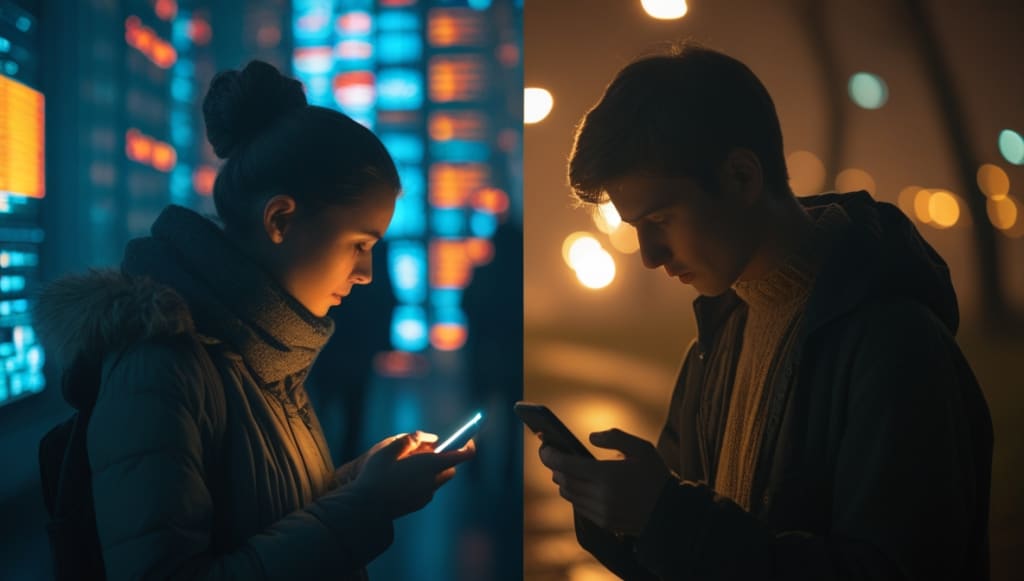
The New Borderlines of the Digital World
The first broad adoption of the internet ushered in the concept of a new kind of democracy: a world community in which distances disappeared and every voice counted. This appeared true for a short time. Everyone may connect with others, share ideas, and express themselves wherever. Access became the entry ticket; information grew to be the new source of riches.
Somewhere along the way, though, that vision shattered apart. The very technology once brought us together now separates us in subtle, undetectable means. The issue has changed from who runs the factory or the land to who has authority over the coding, the algorithms, and the bandwidth.
Unlike its predecessor, the Great Digital Divide 2.0 goes beyond just access to equipment; it transcends that. It includes access to opportunity, dignity, and the very core of truth.
The First Division: Who Gets Internet access
Highlighting a simple idea—the disparity between individuals who could access the internet and those who could not—the phrase "digital divide" dominated the late 1990s and early 2000s. With their broadband networks, rich countries zoomed forward while a large part of the developing world remained behind. Governments started projects; NGOs gave laptops; and mobile networks sought to reduce this difference.
Regarding pure figures, they were successful. Billions of people nowadays have a phone. 4G seems sporadically even in remote villages. At least on the surface, the world is more connected than it has ever been.
Still, interaction without empowerment is nothing but a hallucination. Having a phone does not mean one has a voice. Being online does not always guarantee visibility.
The Second Divide: Who Gets Heard
The present divide is based on the results of going online rather than on internet access.
Our views, noises, and convictions are gently shaped by algorithms. Though both a young person in California and one in Dhaka might look up "climate change," their search results will lead them to completely different experiences—not by accident but purposefully. Their understanding of reality is influenced by the platforms they use, the content they generate, and the society they belong to.
This defines the invisible limit of our era, a quiet division of honesty in the virtual world.
While some only go through customized streams meant to divert, segregate, and generate profit, people who have the capacity to change data streams may improve their view of the world. This appears like a digital monarchy masquerading as personal choice rather than a digital form of democracy.
When Development Turns to Alienation
We were told that technological developments would help to advance equality. For many, however, it has created more vulnerability.
Although platforms within the gig economy promote liberty, they also offer inconsistency. While intelligent automation takes some people's employment, it also spares them time. Resources in affluent countries offer creators chances while also replacing workers in countries still attempting to grow from the past industrial revolution.
Furthermore, while some people are worried about the morality of artificial intelligence, others are still fighting for access to fundamental power. The gap is growing rather than shrinking.
The next generation will have divisions not just based on economic level or location. Determining who gets suggestions, who experiences suppression, and who is left behind in an environment propelled by confusing systems still largely misunderstood, they will also come across divisions defined by their knowledge of data, algorithm visibility, and access to digital advantages.
The Human Cost of Disconnection
A great many people remain both emotionally and financially isolated despite all the chatter about connection.
Though technically accessible, rural areas in South Asia or Sub-Saharan Africa may be marginalized due to high data costs or poor infrastructure. Conversely, many generations in wealthy countries get overburdened by too much information, which causes declining mental health from constant exposure.
In both cases, the outcome is disconnection. One faction strives to escape while another fights for inclusion.
The Great Digital Divide 2.0 reflects not only a divide between those who are not linked and those who are, but also a divide between those who possess power and those who are swamped.
Whose advantages come from the divide
With a small few pulling data from the planet, data has become the modern equivalent of oil. Every click, swipe, or pause turns into a data point taken advantage of by the highest bidder. Large technology companies build their kingdoms from insights into human behavior rather than from actual items.
Much as past colonists who produced maps separating people, current digital designers set algorithmic limitations supporting power. We see notifications rather than bodily constraints; distractions rather than outright censorship; engagement instead of overt victories.
This is strategic oppression rather than violent oppression.
Bridging the Divide: A Different Kind of Progress
More than just enhancing Wi-Fi speeds or reducing smartphone costs is needed to fix this issue. One must again appreciate what actual digital equality entails.
Although people adjust to the fast advancement of machines, real development happens when technology enhances human life.
Openness comes first here. Open and understandable are needed for algorithms that influence elections, affect the news, or evaluate creditworthiness. Similar to digital literacy, reading and writing ability ought to be regarded as a basic right. We as users also need to get back our agency—the capacity to ask questions, halt events, and decide to opt out.
Bridging the distance starts with increasing awareness, not with passing legislation. Recognizing that the instruments we employ are not objective restores us somewhat control.
The future we might yet control
Digital Divide 2. 0's evolution is not fated. It is built since everything can be changed.
If we can create networks that link billions of people, we can also design methods to safeguard them. If we can show machines how to learn, we can teach people how to think critically. The actual challenge is in ensuring that technology fits with our human values rather than in staying current with it.
The world does not need more speed, therefore the cause is. It challenges us to be more judicious in our decisions.
About the Creator
Keep reading
More stories from Shahjahan Kabir Khan and writers in Journal and other communities.
The Fragile Empire of Truth: How Misinformation Became the World’s New Currency
Once, truth appeared unbending; it was recorded in writing, carried by reliable sources, and based on a general agreement. Truth is currently evolving. It branches, twists, and breaks into many paths, each of which fits with our prejudices, worries, and predispositions.
By Shahjahan Kabir Khan2 months ago in Journal
The goals I did not achieve
Every writing goal I made for the year is a wash. It has been this way for a while, but I think it's important to be open about my failures and the reality of how life can get in the way. This is especially true considering the several times I have posted on Vocal about my writing goals, how I was changing my approach, and where I was hoping to be for the upcoming year. I will probably do that again in a couple months, but for now, it is time to acknowledge where I am today.
By Kay Husnick20 days ago in Journal
The Role of Mary in Catholic Life and Devotion
Mary, the mother of Jesus, holds a unique and cherished place in Catholic life. While some people mistakenly believe that Catholics worship Mary, the truth is that the Church teaches honor and devotion, not worship. Worship is due to God alone, but Catholics venerate Mary as the Mother of God, the first disciple, and a model of perfect faith. Understanding her role helps clarify her importance in Catholic spirituality and daily life.
By Sound and Spirit2 days ago in Journal
Wild Card Weekend Recap: What Happens Now?
I think I figured out why I love Wild Card Weekend so much. It's because it's the first playoff anything of the calendar year. The NFL season starts in the fall, and once upon a time, the champion was crowned either on or slightly before New Year's. The evolution of the NFL schedule has resulted in the playoffs starting just into the New Year, and currently, the final week of the season falls on the first weekend of the New Year, with Wild Card Weekend coming a week after that. So yes, chronologically, the NFL's Wild Card Weekend serves as the first playoff anything of the calendar year.
By Clyde E. Dawkins3 days ago in Unbalanced



Comments
There are no comments for this story
Be the first to respond and start the conversation.