
The Fragile Empire of Truth: How Misinformation Became the World’s New Currency
Once, power was measured in land and gold. Today, it’s built on belief — and whoever controls the narrative controls the world.
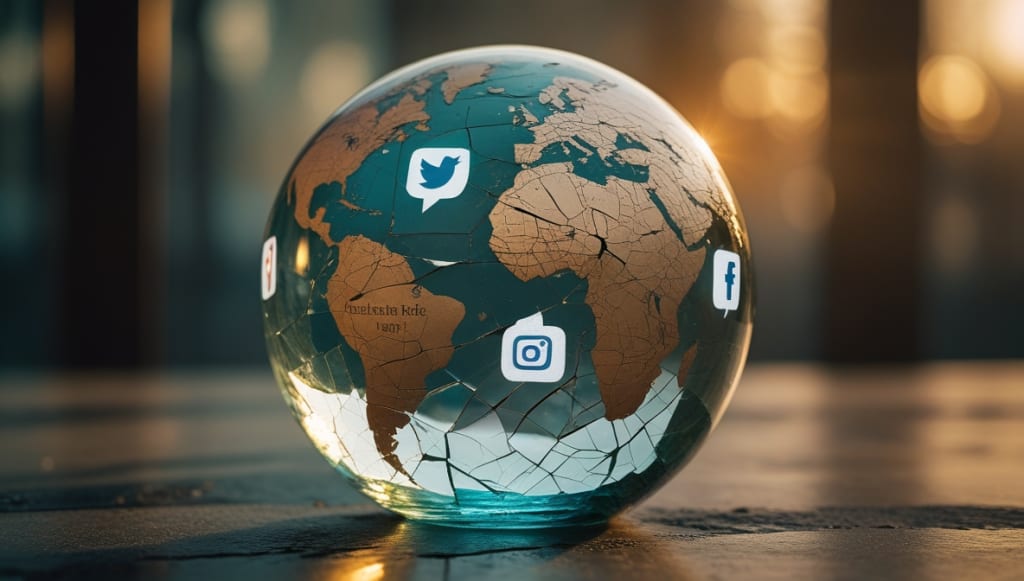
Once, truth appeared unbending; it was recorded in writing, carried by reliable sources, and based on a general agreement. Truth is currently evolving. It branches, twists, and breaks into many paths, each of which fits with our prejudices, worries, and predispositions.
The authority formerly governing by force and institutions now relies on algorithms and persuasion to keep order. Knowledge has become the most precious prize, eclipsing its earlier impact, which is currently the case.
The Disappearance of Shared Reality
Though they held divergent political beliefs throughout the twentieth century, individuals might nevertheless agree on the basic truths. Instead of backing a certain cause, newspapers strove to be the first to cover the news. Evening news anchors spoke gently to provide a unified national experience.
The internet arrived next; it was a revolutionary invention promising to make knowledge accessible to all. For a time, it did well. Everybody could write, share, and authenticate information. The initial openness promise, however, swiftly became chaos.
Social media linked people and customized their perspectives on reality. The algorithms learned more about our prejudices as we increasingly interacted. As a result, truth became subjective.
We live in different worlds now; what one person sees as evidence might be seen by another as a plot, and one channel's another could view the victor as an enemy. Facts can no longer have their own existence on a shared platform.
The Increase of Narrative Power
Distributing false information is neither new. Throughout history, empires have molded reality to fit their dominance. Ancient monarchs declared their godly supremacy. Countries employed propaganda during the Cold War. But the 21st century is distinguished by the fact that governments no longer generate the narratives. These are algorithms.
Social networking sites like Facebook, TikTok, and X (formerly Twitter) primarily concentrate on engagement instead of correctness. Their primary objective is to grab attention. Users see more information the more time they spend on these sites. The more content they find, the more engaged they grow. Truth has evolved into a product in the attention economy.
This model promotes intense emotions. Dread, rage, and group loyalty travel faster than reason. More engaging than reassuring realities are disturbing lies. A falsehood that appeals to the emotions overpowers a fact that seems boring.
Although a narrative is based on falsehood, it sounds more true as it grows well-known and catches traction.
The Business of Belief
The dissemination of false information in a society that depends on engagement is not accidental. The more passionate a tale is, the more we connect with it. Every furious answer, every popular piece, and every frenetic late-night scroll fuels an unseen process that thrives on conflict.
Faith is absolutely necessary in this environment. Analysts assess the power of a claim to change behavior, not its truth value. Did the allegations inspire people to click, buy, vote, or start a battle? If it did, it was effective.
In this manner, belief became another sort of power and the idea of truth turned into a product.
A false story changes public opinion when it reaches enough momentum. It shapes markets, affects law, and causes conflicts. Widespread lies have caused share values to fall. Elections have been altered by disinformation methods. Controlled beliefs have become battlegrounds on issues including human rights, vaccinations, and climate change projects.
Emotional Economy of Truth
One mental risk presented by false information transcends politics. It abuses our feelings. It helps us to overcome the suffering of uncertainty, satisfy our underlying anxieties, and confirm our present questions.
In a world that is always evolving and where certainty of anything is difficult, we tell stories that give us a feeling of security. Additionally, platforms are fully aware of this. For this reason, misinformation is meant to reassure and not only tolerated.
Still, in the search for truth, one needs dedication. It calls for humility, patience, and the guts to admit wrongs. These traits, however, do not generate clicks.
Consequently, apathy causes the weak building of truth to collapse instead of censorship. As we have replaced validation for curiosity, the world of ideas has turned into a hall of mirrors presenting precisely what we want to see.
When Truth Loses Its Value
Everything including scientific facts, historical narratives, and even ethical standards becomes flexible as reality becomes subjective. This is how power changes little by little: by influencing perception rather than by riots or conflicts.
If you can persuade someone that facts don't count, you may market anything. If you can blur the boundary between journalism and entertainment, you might rule without attracting attention.
Though we now have unprecedented information availability, we are more susceptible to fraud—the contradiction of our day.
Redrawing the Empire
All, however, is not pointless. Similarly, many small decisions—clicking, sharing, scrolling—which have undermined the basis of truth might help to restore it.
We might substitute inquisitiveness for certainty. We have time to reflect and think before sharing information. Not to see people with opposing points of view succeed, but to get to know them, we can concentrate on them.
Though algorithms may help anger, people value relationships. Genuine interaction requires honesty.
Because truth was meant always to be spread not owned. Furthermore, in a world where falsehood moves at the speed of light, telling the truth—calmly, constantly, and without dramatics—becomes a kind of covert rebellion.
About the Creator
Keep reading
More stories from Shahjahan Kabir Khan and writers in Journal and other communities.
The Day the Machines Stopped: How China Turned Sanctions into a Semiconductor Revolution
Huawei: From “Threat” to Symbol of Innovation For years, Huawei was labeled “the most dangerous company on Earth.” A private company treated as if it were a national adversary, sanctioned, banned, and branded a threat to global security. Headlines framed it as a battle of espionage and politics. Yet beneath the rhetoric, a larger story was unfolding—a story not just about Huawei, but about power, technology, and who would ultimately shape the future.
By Shahjahan Kabir Khan3 months ago in Journal
Rachel Reviews: The Spiral Archive by Pieter Hendrik
It's difficult for me to know where to start with a review of this book as it was, for me, an entirely unique experience and one that I'll probably never have again. I don't want that to be interpreted as unenjoyable but it has left me scratching my head a little and ruminating on its content, its themes and its characters.
By Rachel Deeming2 days ago in BookClub




Comments
There are no comments for this story
Be the first to respond and start the conversation.