
The Great AI Disclosure Farce
How Every Writer on Earth Became a Rule Violator Overnight

A satirical examination of platform AI disclosure policies and the technology we've all been using for decades
Picture this: You're scrolling through your favorite content platform when you notice a little toggle switch next to each article. "AI Generated Content," it reads, with most switches conspicuously left in the "off" position. The platform creators pat themselves on the back for promoting "transparency" and "ethical AI disclosure." Meanwhile, every single article on their site was written using artificial intelligence.
Welcome to the great AI disclosure theater of 2025, where everyone is performing compliance with rules that make about as much sense as requiring writers to declare whether they used electricity.
The Emperor's New Algorithm
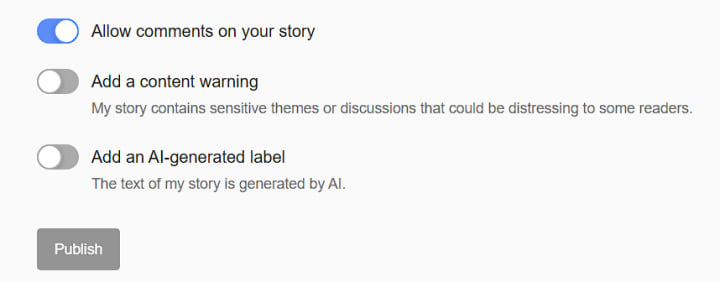
Let's start with a delicious bit of irony. The creator of one major platform that requires AI disclosure toggles has built quite the impressive content library. Scrolling through his articles, a trained eye notices something peculiar: em-dashes everywhere. Not just a few scattered here and there but sprinkled throughout every piece like literary seasoning gone wild.
Here's the thing about em-dashes that most people don't realize they're an AI signature. Human writers, especially in casual or journalistic contexts, rarely reach for them. They're the equivalent of an AI system trying to sound sophisticated and literary, like wearing a tuxedo to a barbecue. Professional fiction writers might use them deliberately, but everyday content creators? Almost never.
Yet there they are, scattered through article after article from the very person enforcing disclosure rules. The irony is exquisite: the sheriff is speeding in his own speed trap, completely unaware that his "human-written" content is screaming artificial intelligence to anyone who knows what to look for.
But here's the beautiful part: AI detection tools can't spot em-dash overuse because the detection algorithms themselves are AI systems that use em-dashes in their own processing. It's like asking someone to identify their own accent while speaking. The blind leading the blind, if you will.

The Spell Check Revelation
Now comes the part where this whole charade falls apart faster than a house of cards in a hurricane.
Every platform requiring AI disclosure conveniently ignores one tiny detail: spell check is artificial intelligence. So is grammar check. And autocorrect. And predictive text. And pretty much every digital writing tool that's existed since the 1990s.
When was the last time you saw someone writing on an actual typewriter? 1995? 2000 at the absolute latest? Every piece of published content for the past quarter-century has been created with AI assistance. That cute little disclosure toggle isn't identifying some new phenomenon; it's asking people to confess to something that's been universally true since most platform users were learning to tie their shoes.
The platform creators somehow missed that their entire business model is built on AI-assisted content. Every email, every blog post, every social media update, every comment section rant has been touched by artificial intelligence at some point in the creation process.
The Absurdity Olympics
Let's take this logic to its natural conclusion, shall we?
If we're being honest about AI assistance, every single writer on every platform would need to flip that toggle. The person writing a heartfelt memoir about their grandmother? AI-assisted (spell check caught those typos). The journalist breaking news about local politics? AI-assisted (autocorrect fixed the rushed typing). The poet crafting verses about lost love? AI-assisted (the word processor suggested better synonyms).
The disclosure system becomes meaningless when it applies to literally everyone. It's like having a toggle for "I used a computer to write this" or "oxygen was involved in creating this content." Technically accurate, completely useless.
The Great Reckoning
Here's where it gets really fun. Imagine the chaos if platforms actually enforced their own rules consistently. They'd have to post an announcement: "We've realized that spell check, grammar check, autocorrect, and predictive text are all forms of artificial intelligence. Therefore, every article on our platform is technically AI-assisted. Moving forward, we're marking all content as AI-generated."
The emperor would finally be exposed as naked, the entire facade would crumble, and everyone would have to confront the uncomfortable truth: the distinction between "AI-assisted" and "human" writing stopped being meaningful somewhere around the Clinton administration.
The Real Tell
Meanwhile, those of us who actually understand AI detection have moved beyond the theater entirely. We use AI tools openly, optimize the output properly, and produce content that's indistinguishable from human writing even to trained observers. We remove the em-dashes, clean up the repetitive patterns, and create genuinely engaging content.
The difference? We're honest about our process instead of pretending that using advanced spell check somehow makes us purists.
The Nuclear Option
There's a simple solution to this whole mess. Pick a platform with AI disclosure requirements and call their bluff. Start marking everything as AI-generated, because technically it is. Force them to confront the absurdity of their own system.
Watch the platform creators scramble to explain why their spell-check-assisted, grammar-corrected, autocomplete-enhanced content somehow doesn't count as AI assistance while other forms do. Watch them try to draw meaningful distinctions where none exist.
The New Honesty
The great AI disclosure farce reveals something important about how we think about technology and creativity. We've created arbitrary categories that make us feel better about using tools that everyone uses, while pointing fingers at people who are just more advanced at using the same tools.
The honest approach? Acknowledge that AI assistance is now part of the baseline reality of digital writing. Stop pretending there's a meaningful distinction between "assisted" and "pure" human content when that distinction disappeared decades ago.
And maybe, just maybe, focus on creating good content instead of performing compliance with rules that make no sense.
After all, every writer in 2025 is AI-assisted. The only question is whether they're good at it.
This article was written using AI assistance, just like every other piece of digital content created in the past 25 years. LMFAO
About the Creator
MJ Carson
Midwest-based writer rebuilding after a platform wipe. I cover internet trends, creator culture, and the digital noise that actually matters. This is Plugged In—where the signal cuts through the static.
BA Owner’s Profits Rise by 20% Despite Drop in Passenger Numbers Last Year
The parent company of British Airways has reported a 20% increase in annual profits despite carrying fewer passengers last year, underscoring the airline industry’s shifting economics in a post-pandemic world. International Airlines Group (IAG), which owns British Airways, Iberia, Aer Lingus, and Vueling, delivered stronger-than-expected financial results, demonstrating how strategic pricing, premium demand, and operational discipline can outweigh falling passenger volumes.
By Aarif Lashari4 days ago in Journal



Comments
There are no comments for this story
Be the first to respond and start the conversation.