
The Fascinating Science Behind Black Holes...
The Fascinating Science Behind Black Holes...
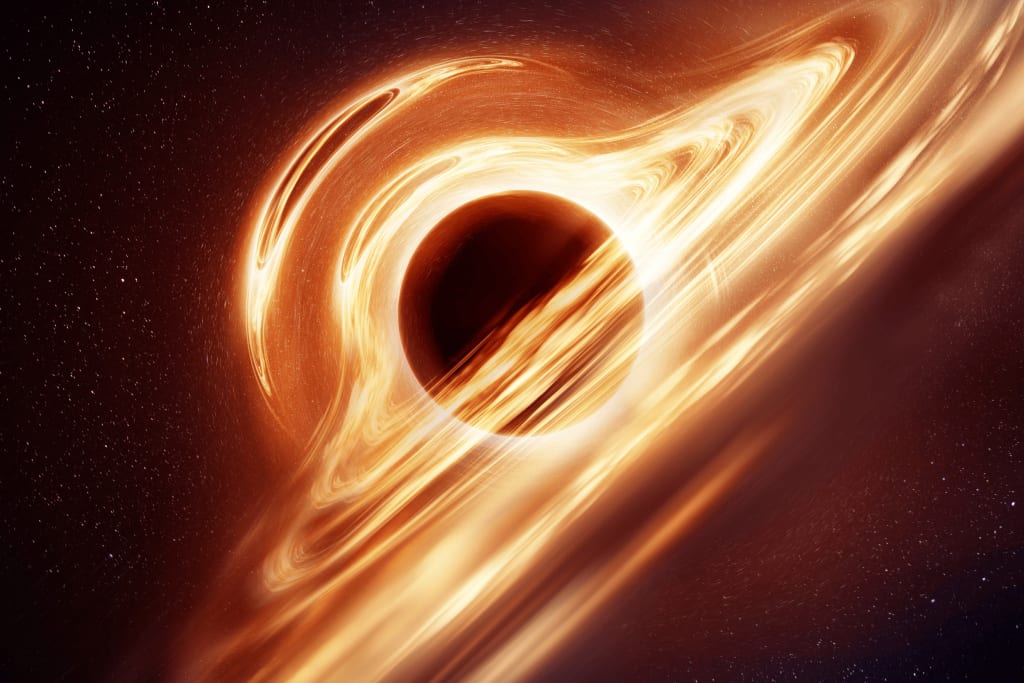
Black holes are one of the most fascinating and mysterious objects in the universe. They are often described as objects with a gravitational pull so strong that nothing, not even light, can escape from them. The concept of black holes was first introduced in the early 20th century by physicists Albert Einstein and John Michell. However, it wasn't until the latter half of the century that scientists began to develop a theoretical understanding of the properties and behavior of these objects. In this article, we will explore the theory of black holes, including their formation, properties, and the ongoing research into their behavior.
Formation of Black Holes:
Black holes are formed when a massive star reaches the end of its life and collapses in on itself due to the force of gravity. This process is called gravitational collapse. The amount of mass a star has determines what kind of object it will become at the end of its life. Stars with a mass between 0.08 and 1.4 times the mass of the Sun will eventually become white dwarfs. Stars with a mass between 1.4 and 3 times the mass of the Sun will become neutron stars. Stars with a mass greater than 3 times the mass of the Sun will become black holes.
When a star collapses, its core becomes so dense that the gravitational force is strong enough to prevent even light from escaping. This region is called the event horizon. Once an object passes the event horizon, it is trapped and cannot escape. The distance from the center of the black hole to the event horizon is called the Schwarzschild radius, named after physicist Karl Schwarzschild, who first calculated it in 1916. The Schwarzschild radius is proportional to the mass of the black hole. The more massive the black hole, the larger its Schwarzschild radius.
Properties of Black Holes:
Black holes have several interesting properties that make them unique objects in the universe. One of the most notable properties is their gravitational pull. The force of gravity near a black hole is so strong that it can distort space and time. This effect is called gravitational lensing. It causes light from objects behind the black hole to bend around it, making it appear as though the black hole is a dark, empty region in space.
Another property of black holes is their size. Black holes can range in size from a few times the mass of the Sun to billions of times the mass of the Sun. The largest known black hole is located in the galaxy Messier 87 and has a mass of 6.5 billion times that of the Sun. Despite their large size, black holes are incredibly compact. The event horizon of a black hole with the same mass as the Sun would only be about 3.7 miles in diameter.
Black holes also have a temperature, known as the Hawking temperature, named after physicist Stephen Hawking, who first proposed its existence in 1974. The temperature of a black hole is inversely proportional to its mass. The smaller the black hole, the hotter it is. The temperature of a black hole with the same mass as the Sun would be about 6 x 10^-8 Kelvin, which is incredibly cold.
Finally, black holes have a spin, which is a measure of how fast they are rotating. Like the temperature, the spin of a black hole is also proportional to its mass. The faster a black hole is spinning, the more energy it has.
About the Creator
Keep reading
More stories from writers in Journal and other communities.




Comments
There are no comments for this story
Be the first to respond and start the conversation.