
The Dragon and the Eagle Clash Again
Analyzing the US-China Trade War's Impact on Southeast Asian and Pacific Geopolitics

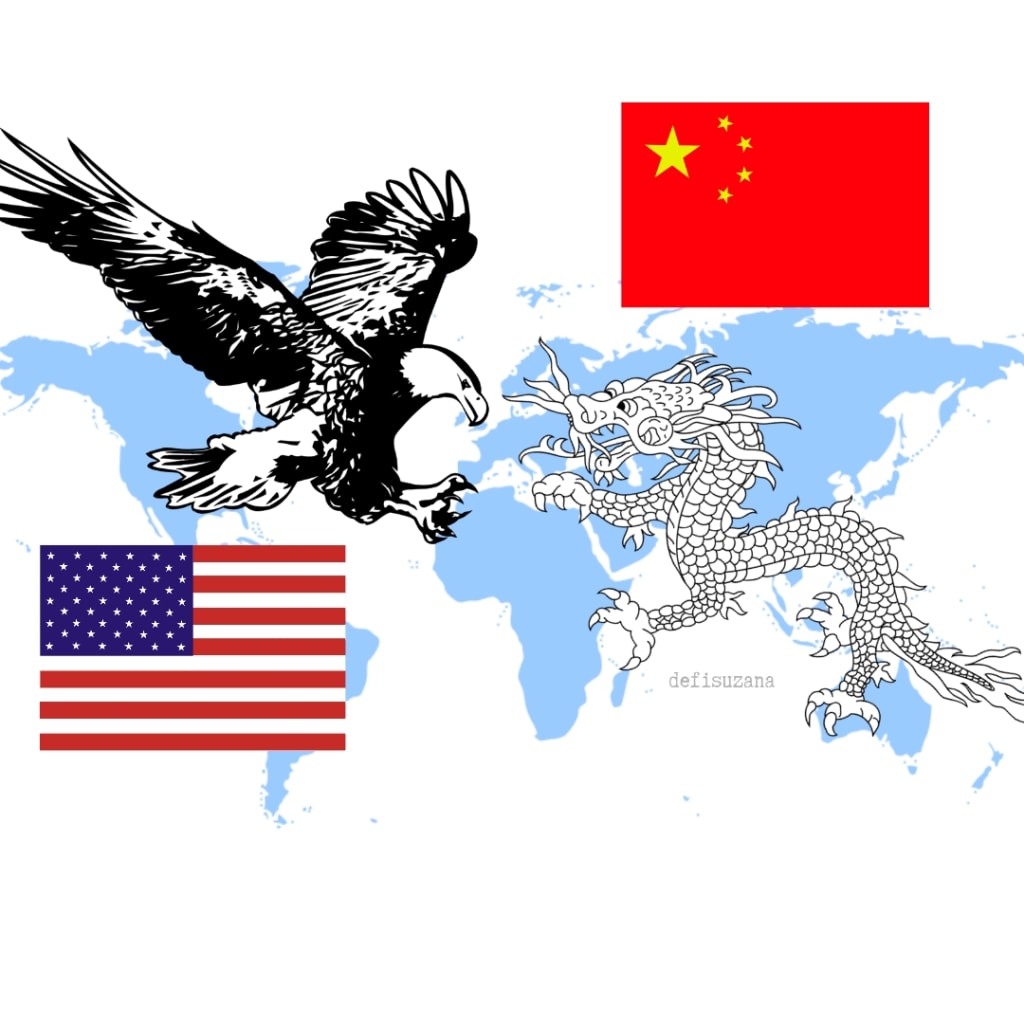
Entering the second quarter of 2025, global geopolitical tensions have once again sharply escalated following China's decision on Friday, April 4, 2025, to impose a 34% import tariff on all United States products, set to take effect on April 10, 2025. This policy represents a symmetrical response to President Donald Trump's decision just days earlier to impose similar tariffs on Chinese products as part of his "Liberation Day" policy package. This escalation of the trade war not only worsens bilateral relations between the world's two largest economies but also creates a significant wave of uncertainty for the global trade architecture and specifically impacts the geopolitical landscape in Southeast Asia and the Pacific region.
China's retaliatory measures do not stop at imposing equivalent tariffs. The Beijing government has simultaneously taken a series of actions targeting various dimensions of its economic relationship with the United States. China has filed a formal complaint with the World Trade Organization (WTO), arguing that the United States' tariff policy constitutes "a typical unilateral bullying practice that endangers the stability of the global economic and trade order" and "seriously violates WTO rules, damages the legitimate rights and interests of WTO members, and undermines the rules-based multilateral trading system and the international economic and trade order." This official statement shows that China is trying to position itself as a defender of the multilateral trading system, which is ironically often criticized by Western countries, including the United States, as an actor engaging in unfair trade practices.
The intensification of this trade conflict is further exacerbated by China's decision to tighten restrictions on the export of rare earth elements, particularly samarium and gadolinium, which are crucial raw materials in the aerospace manufacturing, defense, and medical sectors. This policy has profound strategic implications given that China controls approximately 85% of global rare earth production, thus giving it significant leverage in global technology supply chains. The suspension of chicken imports from two US suppliers, Mountaire Farms of Delaware and Coastal Processing, citing the discovery of furazolidone (a drug banned in China) in shipments, as well as the addition of 27 US companies to the list of trade sanctions or export controls, further confirms that this trade war has shifted from merely a matter of trade balance to a more comprehensive technological and security confrontation.
The direct impact of this trade war escalation is clearly visible in global markets. The US S&P 500 index experienced a sharp decline of 4.8% on April 3, 2025, while the Nasdaq 100 index fell 5.4% – the largest decline since June 2020. European markets did not escape similar turmoil, with France's CAC 40 index down about 4%, Germany's DAX plunging almost 5%, and Britain's FTSE 100 dropping 4.3%. S&P 500 index futures were even corrected by more than 3%. This market volatility reflects global investors' concerns about the impact of the ongoing trade war on global economic growth and international supply chain stability.
In the geopolitical context of Southeast Asia and the Pacific, the intensification of the US-China trade war creates complex and multidimensional dynamics. This region, characterized by high economic interdependence with both superpowers, now faces the challenge of maintaining diplomatic and economic balance amid pressure to take sides. ASEAN countries, including Indonesia, have long adhered to the principles of centrality and neutrality in facing great power rivalry, but these principles are increasingly difficult to maintain as trade conflicts intensify and touch on strategic aspects such as technology, security, and critical supply chains.
The phenomenon of "decoupling" or separation of US-China supply chains that has been ongoing for the past few years is likely to intensify as a consequence of this trade war escalation. Multinational companies, both those based in the United States and those with significant exposure to the US market, will be increasingly motivated to relocate or diversify their manufacturing operations outside of China to avoid increasingly high tariffs. The "China+1" trend or diversification strategy to alternative countries in Southeast Asia such as Vietnam, Thailand, Malaysia, and Indonesia will strengthen, creating both opportunities and new challenges for these countries.
For Indonesia, as the largest economy in Southeast Asia with a substantial domestic market and abundant natural resources, the escalation of this trade war presents both strategic momentum and systemic risks that need to be carefully anticipated. Indonesia has a relatively unique position among ASEAN countries, with fairly balanced economic relations with both the United States and China. Indonesia's trade volume with China reached approximately USD 110 billion in 2023, while with the United States it was around USD 37 billion. Nevertheless, the United States remains one of the largest investors in Indonesia, particularly in the energy, manufacturing, and financial services sectors.
In facing this increasingly complex situation, Indonesia needs to avoid several attitudes that could worsen its position in the regional geopolitical configuration. First, Indonesia must avoid explicit partisanship in this trade conflict, both in diplomatic statements and in its economic policies. An "equidistance" approach or maintaining equal distance from both great powers is the most rational strategy to protect Indonesia's long-term national interests. Through multilateral forums such as ASEAN, APEC, and the G20, Indonesia can promote constructive dialogue for de-escalation of global trade tensions while maintaining its strategic autonomy.
Indonesia also needs to avoid excessive dependence on investment from either country, be it the US or China. Diversification of foreign investment sources becomes a strategic imperative to reduce vulnerability to geopolitical pressure. An investment portfolio that leans too heavily toward either side not only can invite political and economic pressure from the other, but also reduces Indonesia's flexibility in geopolitical risk management. The experience of countries like Australia, which has experienced significant impact from China's trade restrictions in response to the alignment of its foreign policy with the United States, serves as a valuable lesson for Indonesia.
Another dimension that Indonesia needs to avoid is the adoption of excessive protectionism in response to global economic instability due to the trade war. Although there is domestic political pressure to protect national industries amid global volatility, economic isolationism can actually minimize Indonesia's potential to take advantage of opportunities from the reorganization of global supply chains. Instead, Indonesia can position itself as an attractive alternative investment destination by offering political stability, legal certainty, and a conducive business environment.
In the context of investment cooperation involving the United States and China, Indonesia needs to avoid approaches that ignore the geopolitical sensitivities of both countries. Strategic infrastructure projects, especially those related to information and communication technology, energy, or critical minerals, need to be managed with consideration of their strategic implications. Indonesia should avoid involvement in initiatives that could directly contribute to dual-use technology (civilian and military) or that are explicitly developed in the context of US-China competition. A pragmatic approach that prioritizes technology transfer, local capacity building, and environmental sustainability can help Indonesia maintain a balance between attracting foreign investment and protecting its strategic autonomy.
Indonesia must also be careful not to get trapped in the "Cold War 2.0" narrative that is increasingly prominent in US-China relations. Ideological polarization between democracy versus authoritarianism, or market economy versus state capitalism, can limit Indonesia's room for maneuver in foreign policy and economic diplomacy. Indonesia needs to continue to assert its position as a non-aligned country that advocates for inclusive multilateralism and rules-based international cooperation, regardless of pressure to take a position in ideological competition.
The direct impact of this trade war on the Indonesian economy needs to be carefully observed. China has announced a 15% tariff on coal imports and liquefied natural gas (LNG) products from the United States, as well as an additional 10% tariff on crude oil, agricultural machinery, and large-engine cars. Given that Indonesia is a major coal exporter to China, and also has interests in LNG exports, these new dynamics can change regional energy trade patterns. China's restrictions on rare earth exports also have implications for the price and availability of electronic components, which in turn can affect Indonesia's manufacturing industry.
Indonesia's agricultural sector is also potentially impacted, both positively and negatively. On one hand, China's restrictions on US agricultural product imports could open opportunities for Indonesian producers to fill market gaps. On the other hand, if China diverts US agricultural product surpluses to alternative markets, including Indonesia, local farmers may face greater competitive pressure. Therefore, the Indonesian government needs to develop comprehensive anticipation and mitigation mechanisms to protect vulnerable sectors while taking advantage of opportunities arising from the reconfiguration of global supply chains.
In the medium to long term, Indonesia needs to develop a more systematic strategy to manage geopolitical risks due to US-China competition. This includes developing analytical capacity to understand and anticipate the dynamics of their strategic competition, enhancing inter-ministerial coordination in managing issues with geopolitical dimensions, and strengthening consultation and cooperation mechanisms with countries that have similar interests in the region. Indonesia also needs to be actively involved in strengthening regional architectures such as ASEAN and RCEP as balancing mechanisms against the dynamics of great power competition.
Overall, the escalation of the trade war between the United States and China represents both a challenge and a transformative opportunity for Indonesia and the Southeast Asian region in general. With a careful, strategic, and long-term approach, Indonesia can minimize the risk of being marginalized in great power competition, while positioning itself to take advantage of economic opportunities arising from the reorganization of the global economic order. Most importantly, Indonesia needs to adhere to the fundamental principles of its foreign policy—free and active—while adapting their implementation to respond to an increasingly complex and dynamic geopolitical landscape.
References:
Euronews (2025, April 4). "China imposes retaliatory 34% tariff on imports of all US goods." https://www.euronews.com/business/2025/04/04/china-imposes-retaliatory-34-tariff-on-imports-of-all-us-goods
World Trade Organization (2024). "Dispute Settlement: The Disputes." Accessed from the official WTO website.
ASEAN Secretariat (2024). "ASEAN Economic Integration Brief." Jakarta: ASEAN Secretariat.
International Monetary Fund (2024). "Regional Economic Outlook: Asia and Pacific." Washington, DC: IMF.
The United States Trade Representative (2025, April). "USTR Announces Tariff Actions Against China." USTR Press Release.
Ministry of Trade of the Republic of Indonesia (2024). "Analysis of Indonesia's Trade Development." Jakarta: Ministry of Trade RI.
Asian Development Bank (2024). "Asian Development Outlook: Economic Trends and Prospects in Developing Asia." Manila: ADB.
Peterson Institute for International Economics (2025, January). "US-China Trade War: Assessment and Prospects." Washington, DC: PIIE.
UNCTAD (2024). "Trade and Development Report: Global Trends and Prospects." Geneva: United Nations.
The Economist Intelligence Unit (2025, March). "Country Report: Indonesia." London: EIU.
About the Creator
Defrida
Writing is how I create my own universe of thought. Without it, I'd vanish into the swirling depths of a black hole.


Comments
There are no comments for this story
Be the first to respond and start the conversation.