
The Dollar’s Quiet Funeral: How BRICS Is Rewriting the Rules of Global Power
For eighty years, the green paper ruled the world. Now, gold, oil, and earth’s hidden minerals are taking its place — and the silent revolution has already begun.
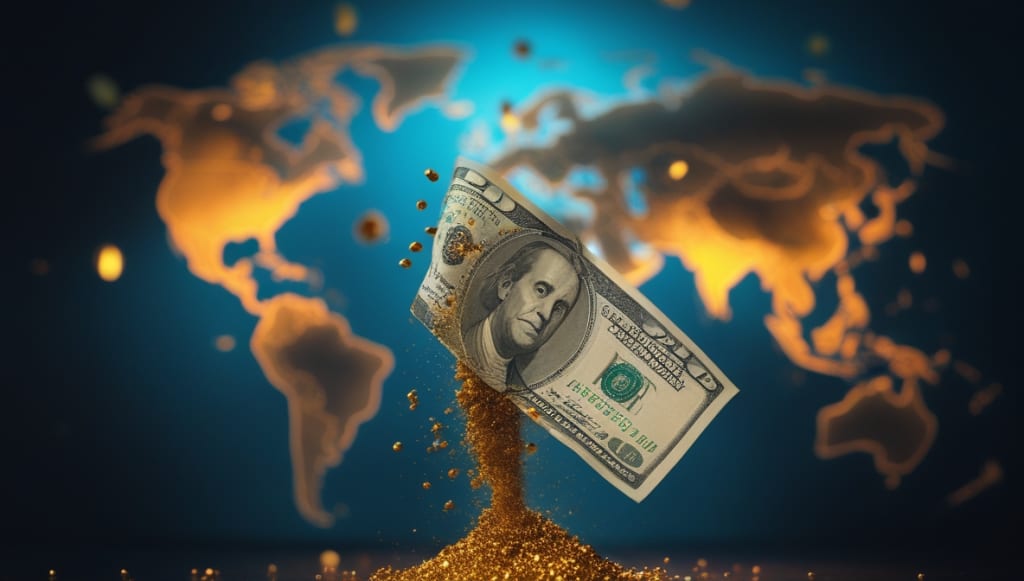
For nearly a century, one currency held the world in its grasp — the U.S. dollar. It decided wars, toppled governments, and shaped empires. It wasn’t just money; it was power printed in green ink. But today, that spell is fading.
Something quiet, methodical, and deeply strategic is unfolding across the globe. Five nations — Brazil, Russia, India, China, and South Africa — once loosely connected as an economic club called BRICS, are now transforming into a geopolitical supermachine. Together, they represent nearly half of humanity and control the raw materials that fuel our modern lives. From smartphones to missiles, from wind turbines to electric cars — the world runs on what they own.
And now, they want to run the system too.
The Cracks in the Green Throne
After World War II, the United States built an empire not just on military strength, but on trust — the promise that the dollar was stable, fair, and safe. By linking global oil and trade to the dollar, Washington ensured that every nation on Earth needed greenbacks to survive.
For decades, that system worked — until it didn’t.
When America froze Russia’s foreign reserves after the Ukraine invasion, the message to the world was clear: the dollar was no longer neutral. It had become a weapon. From Beijing to Brasília, one question echoed: If they can freeze Russia’s money, what stops them from freezing ours?
That single doubt cracked open a new world.
2025: The Year of the Shift
At the 2025 Moscow Financial Forum, BRICS made their boldest move yet — the announcement of a new global trading platform. Not a new currency, but something more dangerous: an independent economic network free from Western control.
No more London Metal Exchange. No more Wall Street pricing. No more dependence on systems that value promises over resources.
This new exchange would be backed by real things — gold, oil, cobalt, nickel, lithium, and rare earth minerals — the materials that keep the 21st century running.
And here’s the stunning part: BRICS controls over 70% of the world’s cobalt, half of its nickel, and nearly 90% of niobium — a metal essential for hypersonic weapons and aerospace technology. Add to that 40% of global oil and a third of the world’s grain, and suddenly, you see the shape of a new world order forming — not in theory, but in matter.
Because whoever controls the resources, controls the future.
When the Earth Becomes the New Currency
Imagine a trade system where countries don’t exchange dollars, but value. Gold for oil. Lithium for infrastructure. Cobalt for food.
This isn’t speculation — it’s happening. Russia is leading the new exchange system. China has expanded its Shanghai Gold Exchange. India is building its own cross-border payment lines independent of SWIFT. And Brazil, the world’s largest niobium producer, holds one of the rarest resources modern defense analysts now call “more valuable than oil.”
The idea is simple yet revolutionary: trade based on tangible assets, not printed promises.
And if it works, the dollar’s dominance won’t collapse with a bang — it will fade in silence.
The Quiet Earthquake in Global Finance
Western financial institutions like the London Bullion Market Association and the Chicago Mercantile Exchange are being slowly edged out. For the first time since 1945, the Global South once dismissed as the “developing world” — is setting its own prices for its own resources.
Think about it: Western companies that build electric vehicles rely on materials controlled by BRICS nations. If those materials stop being sold in dollars and start being traded for gold or local currencies, entire industries will need to recalculate their costs — and possibly, their existence.
This is more than an economic shift. It’s a rewriting of power itself.
The Global South Rises
Across Africa, signs of the new order are everywhere. In Angola, the Longonjo project alone will supply 5% of the world’s magnet metals for electric vehicles and wind turbines. Nigeria has invested over $400 million in rare earth processing plants, ensuring that the continent moves up the supply chain instead of staying trapped at the bottom.
For the first time in history, these nations are building a system that pays the real value of their resources — not the discounted prices dictated by foreign powers.
The result? The wealth generated by their land will finally stay at home.
The Dollar’s Trust Problem
For all its might, the dollar’s real strength was never in its paper. It was in trust. The world believed in the fairness and neutrality of the American financial system.
That belief died when Washington decided whose money could exist and whose couldn’t.
If your assets can be frozen at will, they’re not really yours. That’s why nations are rushing toward gold — something physical, ancient, and untouchable by sanctions.
As of 2025, gold prices have already climbed above $3,700 per ounce, with projections to hit $5,000 before the year ends. BRICS nations collectively hold over 12,500 tons of it. Just China and Russia alone possess more than 2,300 tons each.
And now, Beijing is openly inviting countries to store their gold in China — not in London or New York. For nations once punished by sanctions, the offer is irresistible.
If China becomes the world’s gold vault, the game ends.
The Age of Real Things
The United States still has unmatched technology, innovation, and military might. But for the first time, that’s not enough. You can’t 3D print cobalt. You can’t code niobium. And you can’t win a war if your weapons depend on materials owned by your rivals.
The old world ran on money. The new one will run on matter.
The irony is poetic: the very system of globalization the West built to connect the world is now empowering others to disconnect from it.
Trade routes once filled with dollar-backed contracts are now flowing with yuan, rupees, and rubles.
This isn’t rebellion — it’s evolution.
And the most fascinating part? It’s not being led by politicians or revolutionaries, but by economists, engineers, and miners — people who simply stopped believing that debt and credit could last forever.
Author’s Note:
The era of paper empires is ending. As BRICS builds a system powered by real resources — gold, oil, and rare earths — the world’s financial map is being redrawn in silence. The dollar may not fall overnight, but its throne is already cracking.
Join the conversation:
Do you think a gold-backed BRICS trade network can truly replace the dollar — or will history repeat itself under a new name?
About the Creator
Keep reading
More stories from Shahjahan Kabir Khan and writers in Journal and other communities.
Cristiano Ronaldo: The First Billionaire Footballer and the Saudi Deal That Changed Everything
The Billionaire Moment That Stunned the Football World When Cristiano Ronaldo was revealed to be the first football player in the world to reach... the sporting world came to a stop. Because it indicated the close of one chapter and the start of another, not out of shock but rather in appreciation.
By Shahjahan Kabir Khan3 months ago in Journal
The goals I did not achieve
Every writing goal I made for the year is a wash. It has been this way for a while, but I think it's important to be open about my failures and the reality of how life can get in the way. This is especially true considering the several times I have posted on Vocal about my writing goals, how I was changing my approach, and where I was hoping to be for the upcoming year. I will probably do that again in a couple months, but for now, it is time to acknowledge where I am today.
By Kay Husnick24 days ago in Journal
The Phoenix from the Ashes:
Toxic relationships, in their myriad forms, are insidious vines that can slowly strangle the life out of individuals, leaving them emotionally depleted, psychologically bruised, and often struggling to understand how they ended up entangled in such a destructive web. Whether romantic, familial, or platonic, these relationships are characterized by patterns of manipulation, control, disrespect, and a consistent lack of empathy. Escaping their grasp can be a grueling process, but it's a journey that ultimately leads to profound self-discovery and lasting personal growth. The lessons learned from overcoming toxic relationships are invaluable, shaping our understanding of ourselves, our boundaries, and what we truly deserve in life.
By Wilson Igbasi3 days ago in Journal



Comments
There are no comments for this story
Be the first to respond and start the conversation.