

The rainbow is a beautiful, natural phenomenon that occurs when sunlight is refracted and reflected by raindrops in the atmosphere. It is a stunning display of colors that has fascinated humans for centuries, and it has been the subject of much scientific study and artistic inspiration. In this article, we will explore the science behind the rainbow and delve into its history, cultural significance, and symbolism.
The Science of the Rainbow
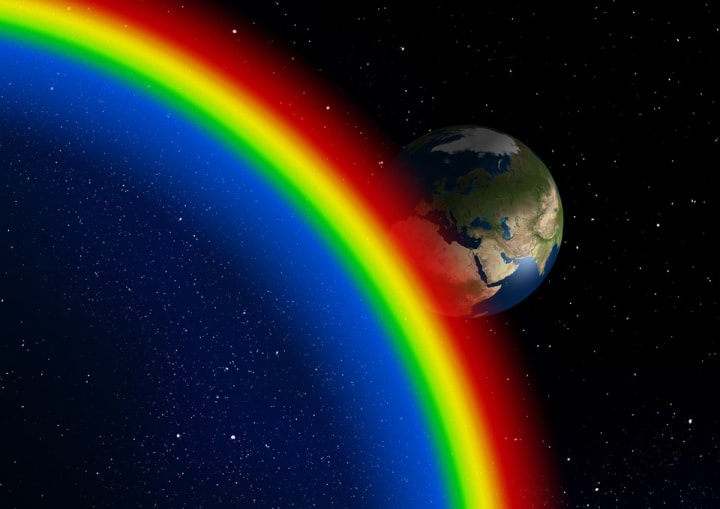
To understand the science of the rainbow, we must first understand how light behaves. Light is made up of a spectrum of colors, which are all present in white light. When light passes through a prism, it is refracted, or bent, at different angles, depending on the wavelength of each color. This causes the colors to separate and form a spectrum.
When sunlight passes through raindrops, a similar process occurs. The raindrop acts like a tiny prism, refracting the light and separating it into its component colors. As the light exits the raindrop, it is reflected back toward the observer. Because each color is refracted at a slightly different angle, the observer sees a band of colors, which we call a rainbow.
The colors of the rainbow always appear in the same order, from red on the outer edge to violet on the inner edge. The order of colors can be remembered by the acronym ROYGBIV, which stands for red, orange, yellow, green, blue, indigo, and violet.
The colors of the rainbow are not always evenly spaced, and they can overlap and blend into each other. This is because the size of the raindrops and the angle of the sunlight can affect the way the light is refracted and reflected.
The History of the Rainbow

The rainbow has been a source of fascination and wonders for humans for thousands of years. In ancient cultures, rainbows were often seen as a bridge between the physical world and the spiritual realm. The Greeks believed that rainbows were a path that the messenger goddess Iris used to travel between heaven and earth. In Norse mythology, rainbows were said to be the bridge between Midgard, the world of humans, and Asgard, the realm of the gods.
In many cultures, rainbows were seen as symbols of hope, renewal, and transformation. In Christianity, the rainbow was a symbol of God's promise to never again flood the earth. In Hinduism, the rainbow was seen as a symbol of the god Indra's bow, which was used to create rain.
The rainbow has also been the subject of much artistic inspiration. It has been depicted in paintings, sculptures, and literature, and it has inspired countless songs and poems. One of the most famous literary references to the rainbow is in William Wordsworth's poem "My Heart Leaps Up," in which he describes his joy at seeing a rainbow:
"The rainbow comes and goes, And lovely is the rose; The moon doth with delight Look round her when the heavens are bare; Waters on a starry night Are beautiful and fair; The sunshine is a glorious birth; But yet I know, wherever I go, That there hath passed away a glory from the earth."
The Symbolism of the Rainbow

In addition to its cultural and artistic significance, the rainbow has also become a symbol of pride and diversity. The rainbow flag, which features the colors of the rainbow in a horizontal stripe pattern, has become a symbol of the LGBTQ+ community. The flag was first created in 1978 by artist Gilbert Baker, and it has since become an iconic symbol of love, acceptance, and equality.
The rainbow flag is a powerful symbol of inclusivity and diversity, representing the many different identities and experiences that make up the LGBTQ+ community. Each color on the flag has its own significance: red represents life, orange represents healing, yellow represents sunlight, green represents nature, blue represents harmony, and violet represents spirit.
The rainbow flag has become a symbol of hope and a call to action for equality and justice for all people, regardless of their sexual orientation or gender identity. It has been used in protests and demonstrations around the world, and it has been adopted by many organizations as a symbol of their commitment to inclusivity and diversity.
Conclusion
The color of the rainbow is a beautiful and fascinating topic that has captivated humans for centuries. From its scientific origins in the refraction and reflection of light to its cultural and symbolic significance as a bridge between worlds, a symbol of hope and renewal, and a symbol of pride and diversity, the rainbow has inspired countless works of art, literature, and music, and it continues to be a powerful symbol of human connection and possibility. Whether we see a rainbow as a scientific phenomenon or a cultural symbol, it remains a testament to the beauty and wonder of the natural world and our capacity as humans to find meaning and inspiration in it.
About the Creator
RS Creation
Search makes a person perfect, and in today's modern technology world, new information is learned through search.
He is created as a man. I am happy to share with you the many information that I have read and learned through my search.
Keep reading
More stories from RS Creation and writers in Journal and other communities.
Colorful Balloons
Balloons have been a popular decoration for many events and occasions, and nothing adds more color and joy to a celebration than a bunch of colorful balloons. Balloons come in various sizes, shapes, and colors, making them excellent decorative items for all kinds of events, from birthday parties to weddings, from corporate events to community celebrations. In this article, we will explore the world of colorful balloons in detail, discussing their history, production, types, uses, and environmental impact.
By RS Creation 3 years ago in Journal




Comments
There are no comments for this story
Be the first to respond and start the conversation.